
Which Are The Most In-Demand Jobs In eLearning & EdTech In 2026?
AI is no longer an "emerging" technology, and it was never a passing fad. This has left many eLearning pros wondering if their roles are still relevant today, especially when venturing (back) into the job market. The truth is that automation in education weighs on many candidates' minds every time they apply for the most in-demand jobs.
The bottom line is that it's not just about securing any vacancy that comes your way, but positions with demand, longevity, and growth. So, how can you pivot to embrace the latest trends and tech tools to pave thriving career paths? Are there any education jobs that will still matter (or might explode) this year and beyond?
Thankfully, Jobs by eLearning Industry helps you explore open eLearning & EdTech roles. We make sure you know all about the latest trends while job hunting in L&D.
If you're thinking about your next career move, these roles are shaping the future of education.
At A Glance
- Demand for eLearning and EdTech roles continues to grow toward 2026.
- Instructional Design, AI-enabled learning, and data-focused roles are expanding fastest.
- Employers prioritize digital, analytical, and platform-related skills.
- Many roles offer remote and cross-industry opportunities.
Why The Most In-Demand eLearning & EdTech Jobs Are Growing Toward 2026
While some may view AI as a threat, automation in L&D is actually an opportunity for resilient eLearning job candidates. There's mounting pressure to upskill and reskill employees, and digital learning is gaining momentum because it bridges the gaps.
Enter AI tools to help tackle mundane processes and give eLearning professionals even more time to showcase their human abilities, such as creativity and lateral thinking. It's all about making the most of the AI-people partnership to deliver higher value through L&D. That's why jobs in online education aren't a thing of the past, but an example that other industries are sure to follow when it comes to setting up AI-powered roles.
What Makes A Job One Of The Most In-Demand In 2026?
One of the key indicators of in-demand jobs in 2026 is high market demand and hiring volume. Companies need talent to fill roles that drive growth faster than ever, thanks to skill shortages, especially in areas like AI, cybersecurity, data science, and cloud engineering. Tech adoption, which includes generative AI, automation, and advanced analytics, is helping to forge new roles and reshape existing ones. Therefore, increasing demand for adaptable, tech-savvy employees who don't shy away from innovation, even if that means expanding their core competencies.
eLearning jobs that enable scalability across industries, such as corporate, higher ed, SaaS, and healthcare, are particularly sought after, as they support digital transformation and cross-sector growth. First and foremost, employers who offer the most in-demand jobs in education 2026 value continuous learning and hybrid skillsets that combine technical know-how with soft skills.
Top In-Demand eLearning & EdTech Jobs For 2026
By all accounts, 2026 is shaping up to be a breakthrough year for eLearning and EdTech careers. From AI-powered learning design to data-driven education strategy, let's dive deeper into the most in-demand jobs in education that you may want to think about:
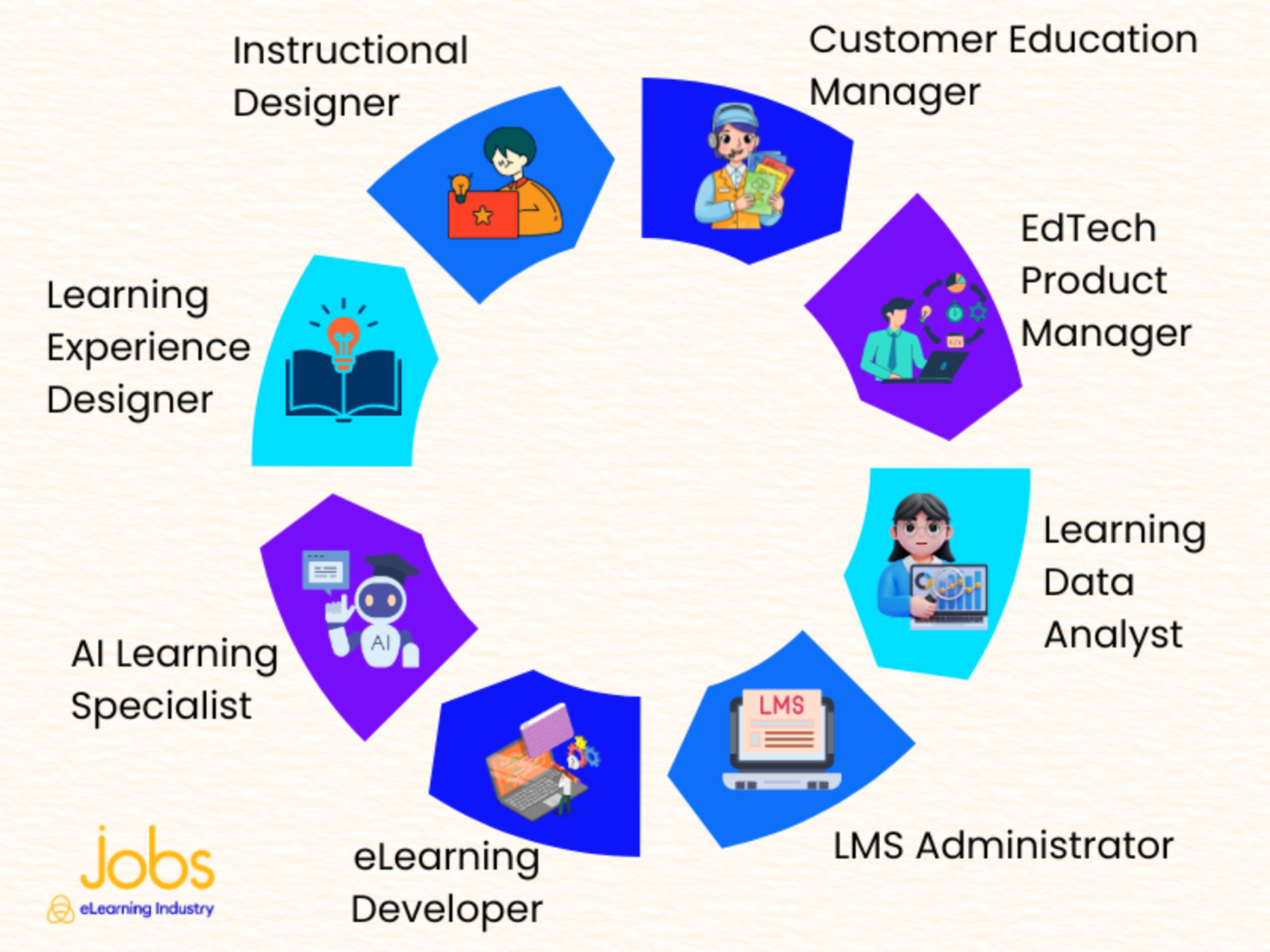
1. Instructional Designer (Digital & AI-Enhanced Learning) Roles
Instructional Designer careers are still gaining ground as organizations prioritize more scalable and personalized learning experiences for their workforce. Remote and hybrid work models and upskilling pain points call for professionals who can design learning that is both engaging and measurable. At the same time, AI is reshaping how learning content is created, delivered, and optimized, which is creating new roles and expectations. For example, AI and data analytics allow designers to tailor content to learner needs, predict learning outcomes, and continuously improve content.
Key skills include Learning Experience (LX) design to develop user-centered approaches and cross-channel learning, as well as understanding the ins and outs of AI tools. This ranges from generative content systems to adaptive learning engines. Microlearning design skills are another must, as attention spans get shorter and learners prefer bite-sized modules accessible on mobile devices. Last but not least, there's a focus on data-driven design capabilities, such as interpreting learning analytics and using A/B testing to refine courses. This is critical for designers to demonstrate the impact of their work and achieve the desired outcomes.
Industries that are hiring Instructional Designers in 2026 include corporate enterprises, technology companies, healthcare, higher education, government agencies, and nonprofits that want to boost their workforce's capabilities. Some of the common job titles include Instructional Designer, eLearning Developer, Learning Experience Designer, AI Learning Specialist, Digital Curriculum Learning Specialists, Curriculum Designer, and Learning Innovation Lead. These eLearning job titles have expanded so greatly in recent years because of the blend of creativity, technology, and strategic design that is now part of the job description.
2. Learning Experience Designer (LXD) Jobs In-Demand In 2026
While Instructional Design eLearning in-demand jobs often emphasize content structure, learning objectives, and assessments, LXD expands the role to include the holistic learning journey. LXDs factors in how learners feel, interact, and stay motivated before, during, and after the learning process.
LXD work incorporates user experience (UX) design, psychology, and learning technology. These pros apply UX principles such as user research, journey mapping, and prototyping to learning environments. They also draw on cognitive psychology and behavioral science to improve motivation, memory, and transfer of learning. Likewise, learning technologies, such as LMSs, AI-driven personalization tools, and mobile learning solutions, are used to support human-centered L&D experiences.
The LXD role is considered future-proof because it's all about how people learn in digital environments that often change rapidly. As automation and AI handle more content creation tasks, being able to design meaningful, ethical, and engaging learning experiences becomes even more desirable for organizations. They'll continue to need professionals who can leverage technology to meet human needs, adapt learning to diverse audiences, and demonstrate real-world impact from a people-first perspective. Another tie-in job to have on your radar in this field is Learning Strategist, especially in corporate L&D.
3. AI Learning Specialist/AI In Education Consultant Career Paths
An AI Learning Specialist and an AI in Education Consultant are still relatively new AI jobs in education that focus specifically on how AI can enhance learning experiences. It's based on ensuring that technology complements human instruction rather than becoming a substitute. A key aspect of the role is developing AI-powered educational content that adapts to the individual needs and preferences of learners. This includes using generative tools to create customized lessons, interactive simulations, and multimedia learning materials.
They also design intelligent assessment systems that automatically gauge learner progress, provide instant feedback to identify gaps, and adjust difficulty or pacing based on performance. By applying data analytics and predictive models, AI Learning and AI-Powered Education Specialists enable organizations to create personalized learning pathways that cater to individual strengths, areas for improvement, and goals.
Companies are hiring these specialists now, and demand is expected to continue growing through 2026, as mindsets shift. Many organizations view AI not just as a tool, but as a strategic asset in education and workforce development. As schools and businesses invest in scalable, data-driven learning solutions, they're looking for experts who understand the synergy between pedagogy and AI capabilities. These professionals are often responsible for selecting the right technologies, implementing them effectively, and evaluating their impact on learning outcomes.
4. eLearning Developer Careers Most In-Demand 2026
An eLearning Developer builds digital learning experiences that blend instructional strategy with technology and multimedia. This role requires creative and technical expertise to work with a wide range of tools and platforms, including authoring software and Learning Management Systems. Technical skills typically include HTML, CSS, JavaScript, xAPI, SCORM standards, multimedia editing, accessibility compliance, and basic data analysis to evaluate learner performance. However, successful developers typically possess strong visual design skills, UX principle know-how, and storytelling abilities as part of their arsenal.
Creative–technical roles like this are difficult to fill because they require a unique combination of talents. Employers are on the lookout for candidates who understand learning theory, can design compelling experiences, and can also troubleshoot technical issues. Many professionals excel in one area but may fall short in another, which creates an ongoing talent gap. That said, those who do have the qualities companies are after enjoy the benefits of the remote-friendly nature of the role. eLearning Developers often get to collaborate with their teams and deliver scalable learning solutions from anywhere in the world. If you're looking forward, VR/AR Education Developers are one of the standout careers to keep an eye on this year.
5. LMS Administrator/Learning Systems Manager Jobs In-Demand
An LMS Administrator or Learning Systems Manager is responsible for ensuring that organizations get the most from their LMS and that everything runs smoothly from an EdTech standpoint. As companies increasingly rely on digital platforms to train employees, maintain compliance, and develop internal skills, expertise in managing these systems is crucial. These specialists typically ensure that courses are uploaded correctly, user access is configured, and the system functions reliably for all parties involved.
A major part of the role involves working with data, integrations, and reporting. LMS Administrators extract learner data to track participation, completion rates, and performance metrics. Additionally, they generate reports that assess training effectiveness and compliance status, enabling leaders to make informed, data-driven decisions and mitigate risks. In some cases, this involves integrations with HR systems, credentialing platforms, content libraries, and analytics tools. As such, technical skills are a must to create a cohesive tech stack and maintain data integrity across systems.
Demand for LMS expertise in education technology jobs is high because digital learning has become an essential part of onboarding, upskilling, and continuous development initiatives across sectors. For example, large organizations with distributed workforces depend on Learning Systems Managers to optimize workflows, enforce learning standards, and enhance user experience. As businesses grow their learning ecosystems and rely on data to prove L&D's impact, the role will continue to be a strategic and in-demand piece of the talent development puzzle.
6. Learning Data Analyst Roles Most In-Demand This Year
A Learning Data Analyst role centers on transforming L&D data into actionable insights that steer strategic decisions. There's an abundance of data when it comes to learner performance, engagement, and progression data. Fortunately, these analysts are at-the-ready to use statistical methods, visualization tools, and predictive models to help L&D teams understand what's working, where gaps are, and how learning outcomes tie to business goals.
One of the most significant job responsibilities is making data-driven learning decisions. Learning Data Analysts design dashboards and reports that highlight patterns in training effectiveness, skill acquisition, and learner behavior. By interpreting these trends, organizations are able to make curriculum adjustments, recommend targeted interventions, and measure the ROI of learning initiatives.
There's quite a bit of skill overlap with HR analytics and business intelligence. For instance, professionals often use SQL, Python or R, Tableau, and Machine Learning techniques. They also need to understand data governance and blending multiple data sources, as well as align learning metrics with organizational performance indicators.
EdTech careers in this niche are exploding in demand because businesses increasingly see learning not as a cost center but as a strategic asset that leads to long-term growth. With remote work, quick skill cycles, and a focus on measurable talent development, organizations are looking for specialists who can quantify real learning impact and inform key decisions with actionable data.
7. EdTech Product Manager Careers
An EdTech Product Manager lays the foundation for the vision, development, and success of educational technology products by bridging learning needs, technology capabilities, and business goals. They convert insights from educators, learners, and market research into product features that enhance teaching and learning experiences across the board. However, a major part of the job is ensuring solutions are technically feasible and commercially viable. Therefore, it requires a combination of instructional understanding, technical fluency, and strategic thinking.
EdTech Product Managers work closely with designers, developers, customer success teams, and stakeholders to define product roadmaps, prioritize features, and take charge of development cycles. They need to balance user feedback with data analytics and industry trends to improve usability, engagement, and learning outcomes. Clear communication and decision-making skills are essential for bringing diverse teams together around a shared product vision.
There is high demand for these careers in learning technology in SaaS companies and platform providers, especially those offering LMSs, adaptive learning tools, collaboration platforms, and AI-enabled EdTech platforms. As schools, universities, and enterprises adopt cloud-based learning technologies, they're hiring product leaders who understand education and software development inside and out.
EdTech Product Management also offers strong career progression. Professionals can advance into senior product leadership roles, general management, or executive positions. That said, the secret to success is leveraging expertise in market strategy, customer insights, and cross-functional leadership.
8. Customer Education Manager Jobs That Are In High Demand
A Customer Education Manager helps users get the most value from a product by designing and delivering learning experiences that drive adoption and engagement. For example, courses on how to maximize the product's main selling points. This role combines product-led growth with learning, utilizing educational content such as tutorials, webinars, courses, and just-in-time support tools to enhance product proficiency and improve customer satisfaction. By teaching users how to solve real problems with the product instead of just relying on theoretical application, Customer Education Managers help convert new adopters into loyal brand advocates.
SaaS companies invest heavily in this role because scalable, user-centered education streamlines product adoption and reduces customer churn. When customers learn how to use key features effectively, they're more likely to renew, expand usage, and recommend the product to others. In subscription-based business models, improving outcomes through education supports revenue growth and lifetime value. Additionally, education teams collect user feedback that guides product improvements and helps cross-functional teams understand where users encounter the most challenges.
The role's importance is also expanding in EdTech and HR tech fields. In EdTech, educators and administrators require training to effectively implement complex platforms. Likewise, in HR tech, learning modules assist organizations in onboarding employees and tracking compliance. As enterprise tech stacks become more intricate, being able to educate users and drive meaningful engagement makes Customer Education Managers even more in demand in 2026.
Skills That Will Matter Most For Future In-Demand Jobs In Education
Now that we've covered the most in-demand eLearning jobs, let's take a closer look at the skills that are part of the package.
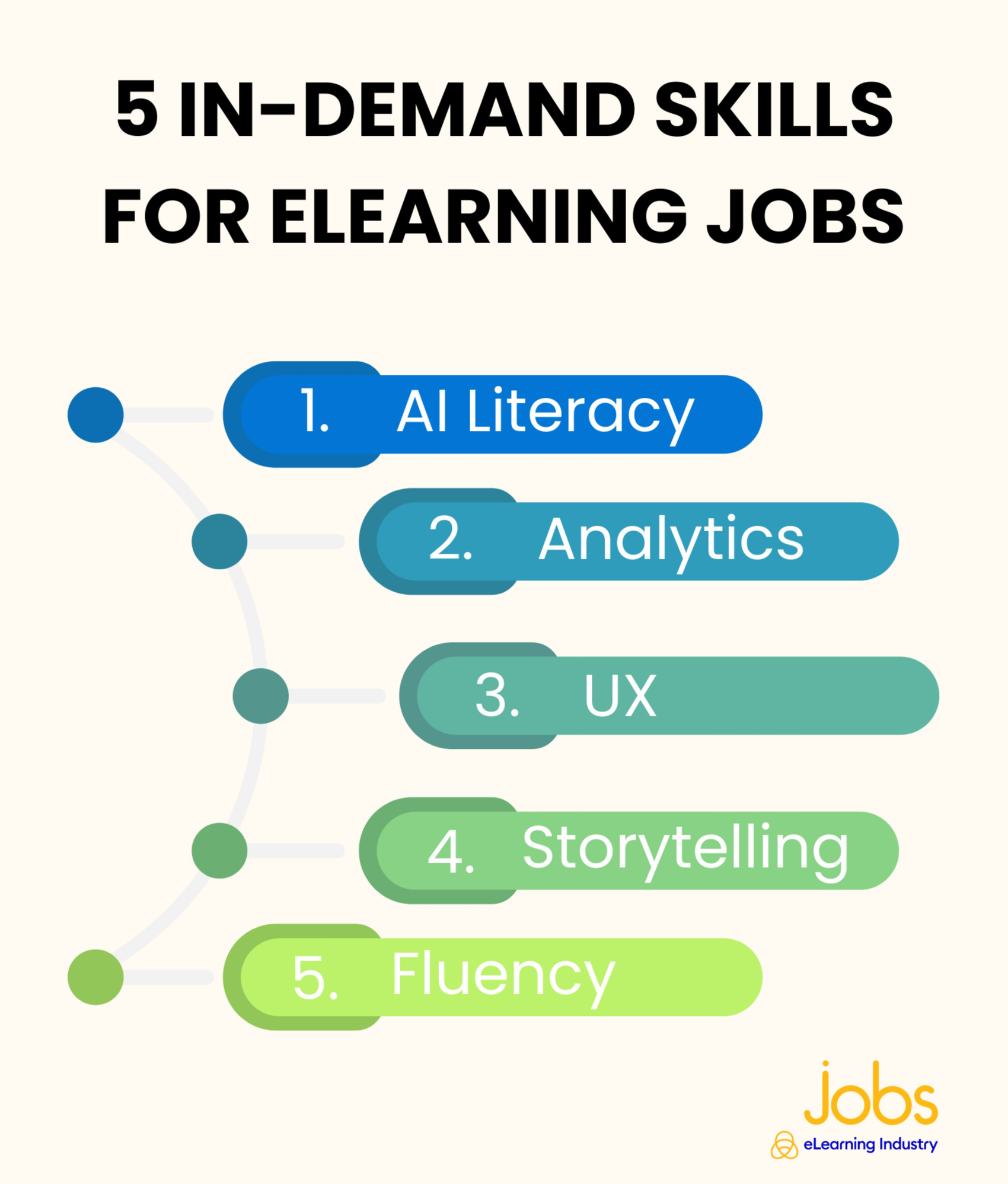
1. AI Literacy
It's not just about inputting prompts and hoping for the best. eLearning and EdTech job roles call for AI literacy and understanding how AI tools work, what their limitations are, and how to leverage them ethically. Once you know the fundamentals, it's on to mastering how to use this technology to enhance personalization, streamline content creation, and improve admin efficiency.
2. Learning Analytics
You must be able to interpret learner data to measure engagement, progress, and outcomes. This greatly depends on making sense of the metrics rather than simply generating reports, which allows you to improve Instructional Design processes and make well-informed decisions.
3. UX & Learner Psychology
Designing learner-centered experiences grounded in cognitive science that fuel motivation and engagement is no small feat. For this reason, eLearning and EdTech pros need to have a firm grasp of psychological principles to reduce cognitive load, increase knowledge retention, and facilitate real-world application.
4. Content Strategy & Storytelling
Information dumps are not part of the L&D equation. One of the critical skills for future jobs in education is structuring learning content for clarity, relevance, and scalability. You should also be able to use narrative techniques to make learning more memorable and meaningful for every member of your audience.
5. Platform Fluency (LMS, LXP, And Authoring Tools)
Knowing your way around learning platforms and authoring software is nonnegotiable. These tools will help you build, manage, and iterate on learning experiences. It's also important to be able to quickly adapt to different platforms and keep up with tech advancements.
How To Prepare For An In-Demand eLearning Or EdTech Career In 2026
The top jobs in online education are rewarding, but how do you prepare for your new (or rerouted) career path?
1. Upskill Vs. Reskill
Building skills for the most in-demand jobs in education usually involves a two-pronged approach. However, you need to know when it's time to upskill vs. reskill. As an example, you may need to upskill to fine-tune your Instructional Design or analytical skills. On the other hand, reskilling to move into adjacent fields or roles may require you to venture into new skill-building areas, such as graphic design or data administration.
2. Portfolio-First Mindset
Build a strong, practical portfolio showcasing real projects, prototypes, and measurable outcomes to showcase your expertise. You can also delve into how your skills helped organizations solve problems and make a lasting impact on learners. A CV isn't enough to showcase all your accomplishments and what you bring to the table for high-demand education technology jobs.
3. Certifications Vs. Real-World Experience
Another distinction to bear in mind is certifications vs. hands-on experience. You should use certifications to validate foundational knowledge and prove that you've met educational prerequisites. On the other hand, real-world experience through freelance work, internships, pilots, or internal projects shows that you know how to apply all the knowledge you've gained.
4. Remote & Global Opportunities
If you're someone who's used to working on-site, going global may be an adjustment if you opt for remote jobs in eLearning. Just remember that you must be prepared to work with distributed teams across different time zones who have different backgrounds and cultures. So, traditional (and digital) communication skills, eLearning localization, and asynchronous project management skills.
Where To Find eLearning & EdTech Jobs
The most in-demand jobs in education 2026 are usually hard to land because applications flood in as soon as the posting goes live. Fortunately, there are ways to get your CVs in front of hiring managers as soon as possible. Check out job listings to see which positions match your skillsets and experience. You can also apply role-based filtering to narrow your search and create a job alert for eLearning roles to get notified first. Remember that landing your dream job isn't a matter of luck, but finding the right fit for your talents at the right time.