Why Most eLearning CVs Don't Get Interview Calls
Most eLearning CVs don't lead to interview calls because they're competing in a crowded job market where small mistakes can cost you big. Recruiters often receive hundreds of applications and typically scan CVs in seconds, looking for clear signals of fit rather than reading every single word.
Another major issue is relying on generic CV advice. Tips like "keep it to two pages" or "list your responsibilities" don't work well for eLearning roles, which are more about skills and outcomes. Recruiters want to see evidence of Instructional Design thinking, learning impact, and familiarity with tools, not vague job descriptions. CVs that don't clearly show how a candidate creates learning solutions, solves performance problems, or measures effectiveness simply don't stand out from the pile.
Writing an eLearning CV isn't about listing everything you've ever done. What sets you apart is demonstrating impact in this highly specialized field. Our Instructional Design resume tips can help you craft an eLearning CV that speaks the language of recruiters and lands you an interview.
Create an account to start building your eLearning CV!
Key Takeaways
- eLearning CVs must highlight skills, impact, and learning outcomes.
- Employers prioritize practical experience and portfolios over titles.
- Tailoring your CV to eLearning roles significantly improves interview chances.
- Clear structure and role-specific language matter more than design.
What Makes An eLearning CV Different From A General Resume?
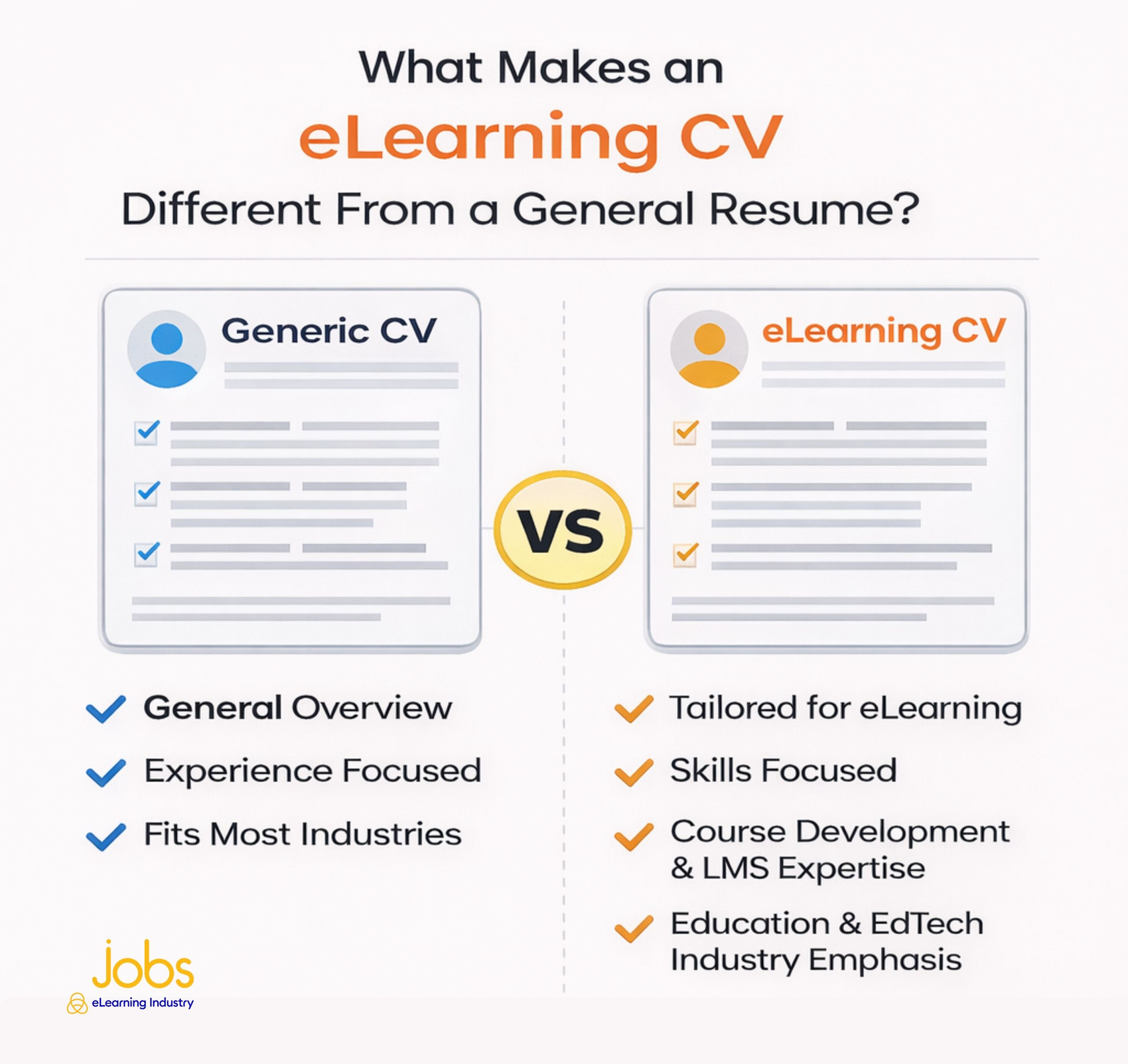
An eLearning CV is fundamentally different from a general resume because the "one CV fits all" approach doesn't work in this field. Generic resumes are usually built around job titles and years of experience, but eLearning roles are far more specialized and outcomes-driven. When candidates use the same resume for corporate training, Instructional Design, LMS administration, and Learning Experience Design roles, recruiters might just move on because the value they can deliver is unclear.
eLearning roles are evaluated based on how well a candidate can design, build, and measure learning solutions. Hiring managers look for evidence in a variety of areas, ranging from Instructional Design methodology and digital learning tools to performance-based outcomes and alignment with business or learner needs. They want to know how you think, not just where you worked. A general resume rarely provides that level of insight.
This is why a skills-first CV for eLearning jobs is the best option. While experience still matters, recruiters prioritize demonstrable skills, such as learning strategy, authoring tools, assessment design, and data-driven improvement, over a long list of your job history. A strong eLearning CV highlights capabilities, results, and problem-solving impact, which makes it easier for recruiters to quickly assess whether you're a good match.
Core Sections Every eLearning CV Should Include
Including these key sections in your Instructional Designer CV makes it easier to scan, easier to understand, and far more compelling to recruiters looking for learning professionals who bring real results.
Professional Summary
The professional summary sets the tone and determines whether a recruiter keeps reading. This section should fully align with the role you're targeting. Include your specific eLearning role, years or level of experience, key specializations, and the type of learning problems you solve.
Try to avoid vague traits like "hardworking," broad corporate language, or summaries that could apply to virtually any profession. Start with the role and specialization, then the core skills or methods, and finally the outcomes or the audience.
Skills
The skills section is critical because many recruiters and applicant tracking systems scan it first. Here are a few things to cover in your eLearning CV:
- Technical skills: Demonstrate your knowledge of multimedia basics, accessibility standards, and data analysis and reporting.
- Learning design skills: Understanding of Instructional Design models, needs analysis, assessment design, learning evaluation, microlearning, and learner engagement strategies.
- Tools and platforms: Experience with authoring tools, Learning Management Systems, collaboration tools, project management software, content libraries, and emerging learning technologies.
Experience
This is where many eLearning CVs fall short. Listing responsibilities doesn't demonstrate value, but showing results does. This is why you should focus on outcomes and what you accomplished, not just what you did. Instead of saying you "developed eLearning modules," explain what problem the learning solved and how it performed. Whenever possible, you should also quantify learning impact. For example, did the training reduce training time, improve assessment scores, increase completion rates, lead to faster onboarding, or get positive stakeholder feedback? Even qualitative results, like a boost in learner confidence or better alignment with business goals, are stronger than task-based descriptions on your eLearning CV.
Education, Certifications, And Continuous Learning
This section supports your credibility, but it doesn't need to take center stage on your CV. eLearning is a field that's constantly evolving, so showing continuous learning, such as tool training, design frameworks, or emerging learning trends, can be more valuable than formal education alone. What matters most are degrees in learning, education, psychology, Instructional Design, or technology. The best eLearning resume examples also include certifications that align with the role and programs candidates are currently enrolled in. This shows that you're invested in ongoing professional development. On the other hand, unrelated degrees, outdated certifications, or long lists of courses without context are optional.
How To Tailor Your eLearning CV By Role
Tailoring your eLearning CV by role is so important because "eLearning" covers multiple job types with very different expectations and responsibilities. An L&D CV that works for one role may miss the mark for another, even within the same organization. The key is to align your language, examples, and priorities with how each role is evaluated.
Instructional Designer CV Tips
Instructional Designer CVs should focus on how you design learning, not just what you build. Recruiters want to see evidence of instructional thinking and structured problem-solving. Some of the key Instructional Design skills to highlight are needs analysis, learning objectives, curriculum mapping, assessment design, learner analysis, accessibility, and evaluation models. You should also show your familiarity with design frameworks and how you apply them in real projects. Steer clear of just listing tools alone without explaining the design decisions behind them.
One of the top CV tips for Instructional Designers is including portfolio references. Your CV should lead them to a portfolio that demonstrates scenario design, assessment strategies, storyboards, and completed learning experiences. Briefly reference what each sample shows, such as performance-based design or learner engagement, so recruiters understand the relevance before clicking.
L&D And Learning Specialist Resume Tips
L&D and Learning Specialist roles are evaluated less on content creation and more on organizational impact. Your CV should reflect how learning supports business goals rather than focusing solely on course development.
Emphasize business impact by linking learning initiatives to measurable outcomes. This might include how you improved performance metrics, faster onboarding, mitigated compliance risks, or bridged certain skill gaps. You need to show that you understand learning as a strategic function within organizations, not just a delivery vehicle.
Strong stakeholder collaboration is another area to zero in on. Highlight your experience working with Subject Matter Experts, managers, leadership teams, and even external vendors. Demonstrate your eLearning skills and how you use them to translate business needs into learning solutions, manage competing priorities, and influence decision-makers. While Instructional Designer CVs dive deep into design and methodologies, L&D resumes are often more about the entire process. For example, you can include experiences that cover program planning, change support, and performance analysis.
Common eLearning CV Mistakes (And How To Fix Them)
Many eLearning CVs fail not because a candidate doesn't have the right skills, but because the CV doesn't allow recruiters to quickly see how those skills connect to real-world value. Here are a few common eLearning CV slip-ups and tips to help you fix them.
Listing Tools Without Context
Simply naming authoring tools, LMS platforms, or software doesn't explain how well you can use them or why they matter. Recruiters want to see how tools support learning design and problem-solving. So, pair tools with outcomes: what you built, why you chose that tool, and what impact the learning had.
Overloading With Jargon
Terms like "learner-centric," "engagement-driven," or "end-to-end solutions" sound impressive but don't mean much to recruiters. Too much jargon makes a CV harder to scan and understand. Instead, use clear, specific language that explains what you did and how it benefited learners or the organization. Simplicity often makes your L&D resume more credible.
Ignoring Learning Outcomes
Listing tasks such as "developed eLearning modules" doesn't really tell hiring managers anything about your skills and experience. Recruiters want evidence that learning made a difference. You can remedy this by highlighting outcomes. For example, you improved performance, reduced errors, sped up onboarding, achieved higher completion rates, or received positive feedback.
Poor Structure And Formatting
Dense paragraphs, inconsistent headings, and cluttered layouts make a CV for eLearning jobs difficult to scan, especially when recruiters review dozens in one sitting. Use clear section headers, bullet points, consistent spacing, and readable fonts. Prioritize the most relevant information near the top and keep formatting clean and professional.
How Recruiters And Hiring Managers Review eLearning CVs
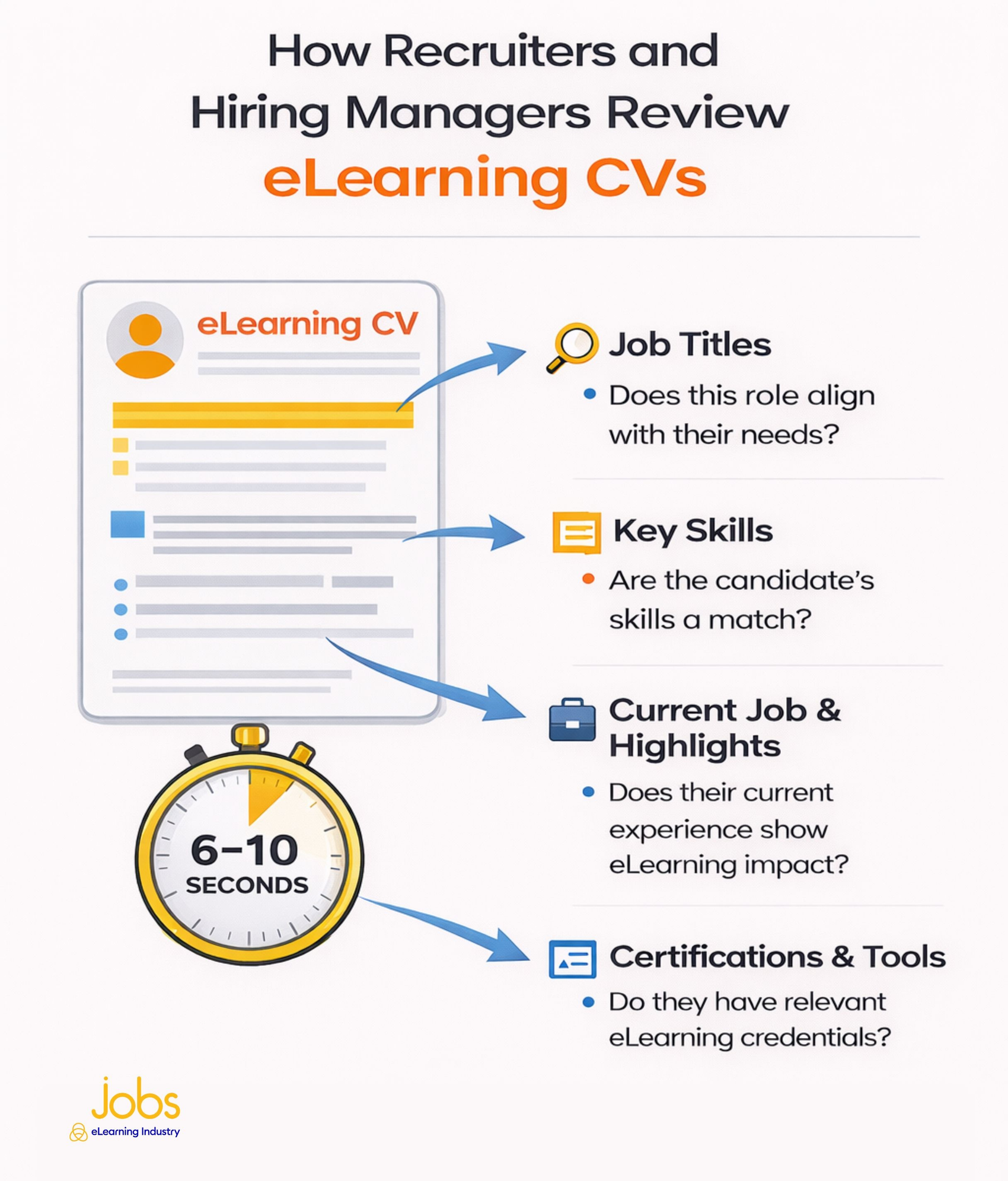
Most recruiters quickly scan your professional summary, job title alignment, and eLearning CV skills section. They look for immediate signs that you are a good fit for the role. This includes relevant experience, Instructional Design expertise, proficiency with tools, and evidence of learning impact. If those elements aren't clear within seconds, your CV may not make it to the second round.
Applicant Tracking Systems also affect visibility before a human even sees your application. These systems scan for keywords that match the job description, such as specific tools, methodologies, or role titles. If your CV doesn't have relevant terms, you may be filtered out early, even if you are the best fit for the job.
While creativity is valuable in learning design, clarity matters when you're writing your L&D resume. Overly designed layouts, graphics-heavy formats, or clever wording can distract recruiters and confuse scanning systems. A clean, structured, and easy-to-read CV performs better than one that prioritizes visual appeal over clarity.
Formatting And Layout Tips For An eLearning CV
One of the most important tips for how to write an eLearning CV that gets you an interview is to keep it concise. For most eLearning pros, one to two pages is ideal, depending on experience level. Early-career candidates should aim for one page, while experienced professionals can probably stretch it to two if the content is relevant. Organize sections clearly: Professional Summary, Skills, Experience, Education, and then Certifications. Make sure to use consistent headings so recruiters can quickly go through everything.
Readability is also critical because recruiters scan before they dive deeper into your qualifications. Use clean fonts, consistent spacing, and bullet points instead of long paragraphs. Avoid clutter, excessive design elements, or dense text blocks. Lastly, opt for file formats that maintain formatting across all devices. Recruiters usually prefer PDFs, unless they specify otherwise. To keep your Instructional Design CV ATS-friendly, avoid complex tables, graphics, or text embedded in images.
How To Strengthen Your eLearning CV With A Portfolio
Including a portfolio can strengthen your application because learning roles are skill-based and design-focused. Hiring managers want evidence of how you think, how you structure content, and how you create engaging learning experiences.
So, what counts as a portfolio? It doesn't have to be elaborate. A simple website, a well-organized PDF collection, or even a shared folder with selected samples can work. Strong portfolio pieces might include interactive modules, storyboards, needs analyses, assessment samples, facilitator guides, microlearning examples, or before-and-after redesigns. The goal is to demonstrate your instructional thinking, not just your technical know-how.
Linking work samples is another way to show recruiters that you have what it takes. Include a clear, clickable link near the top of your Instructional Designer CV, ideally in your contact section or professional summary. You can also reference specific pieces within your experience section. Explain what each sample demonstrates, like branching scenarios, performance-based assessments, or accessibility considerations. Just be sure that permissions are set correctly so they can view your samples, as having to request access might be a deal breaker.
Even if you're early-career, you can build a solid portfolio. Academic projects, volunteer work, freelance assignments, mock modules, or redesigned existing training materials all count. If you don't have any corporate experience, create sample projects that showcase your design process and proficiency with tools.
Create An eLearning CV That Matches Real Job Requirements
Many candidates rely on a generic document that lists everything they've done, rather than focusing on what a specific role actually calls for. Matching skills to roles matters so much because hiring managers evaluate fit, not potential. If a job description emphasizes needs analysis, LMS management, and stakeholder collaboration, your CV should clearly highlight these capabilities.
Aligning your CV with job listings improves your chances of passing Applicant Tracking Systems, which scan for keywords tied to the role. It also makes your application easier to review, since recruiters don't have to guess how your background lines up with job responsibilities. Plus, they know that you understand the specific expectations of the role.
Another tip for writing your learning and development CV is to keep it updated as you change roles. New tools, methodologies, and strategic responsibilities continue to reshape the eLearning field. In fact, you should regularly review job postings in your target area to identify emerging skills and adjust your CV accordingly.
Now that you know which mistakes to avoid and how to craft an L&D resume that gets results, upload your eLearning CV and apply with confidence!