

Why Recruiting Process Optimization Matters More Than Ever
Recruiting delays are becoming one of the biggest barriers to hiring top talent. This is why recruiting process optimization has become a strategic priority for HR leaders and talent acquisition teams.
In competitive industries, qualified candidates often receive multiple offers within days, not weeks. When hiring teams move too slowly, companies risk losing strong applicants before the interview process is even complete. Faster hiring does not mean rushing decisions. It means removing unnecessary friction, improving coordination, and creating a more efficient recruitment workflow from sourcing to the offer stage.
Hiring speed also directly affects candidate experience. Long response times, unclear communication, and repetitive interview stages can damage an employer's reputation and reduce offer acceptance rates. Candidates increasingly expect transparent timelines and streamlined interactions throughout the recruitment process.
At the same time, organizations are under pressure to improve hiring efficiency while maintaining quality. The challenge is not simply how to hire faster, but how to build a recruitment process that is structured, scalable, and consistent. Companies that optimize their hiring funnel are better positioned to attract talent, reduce time-to-hire, and compete more effectively in 2026.
Key Takeaways
- Recruiting process optimization focuses on improving speed, efficiency, and candidate experience.
- Bottlenecks in sourcing, screening, and decision-making slow down hiring.
- Structured workflows and better alignment between teams improve results.
- Technology and automation play a key role in modern hiring processes.
What Is Recruiting Process Optimization?
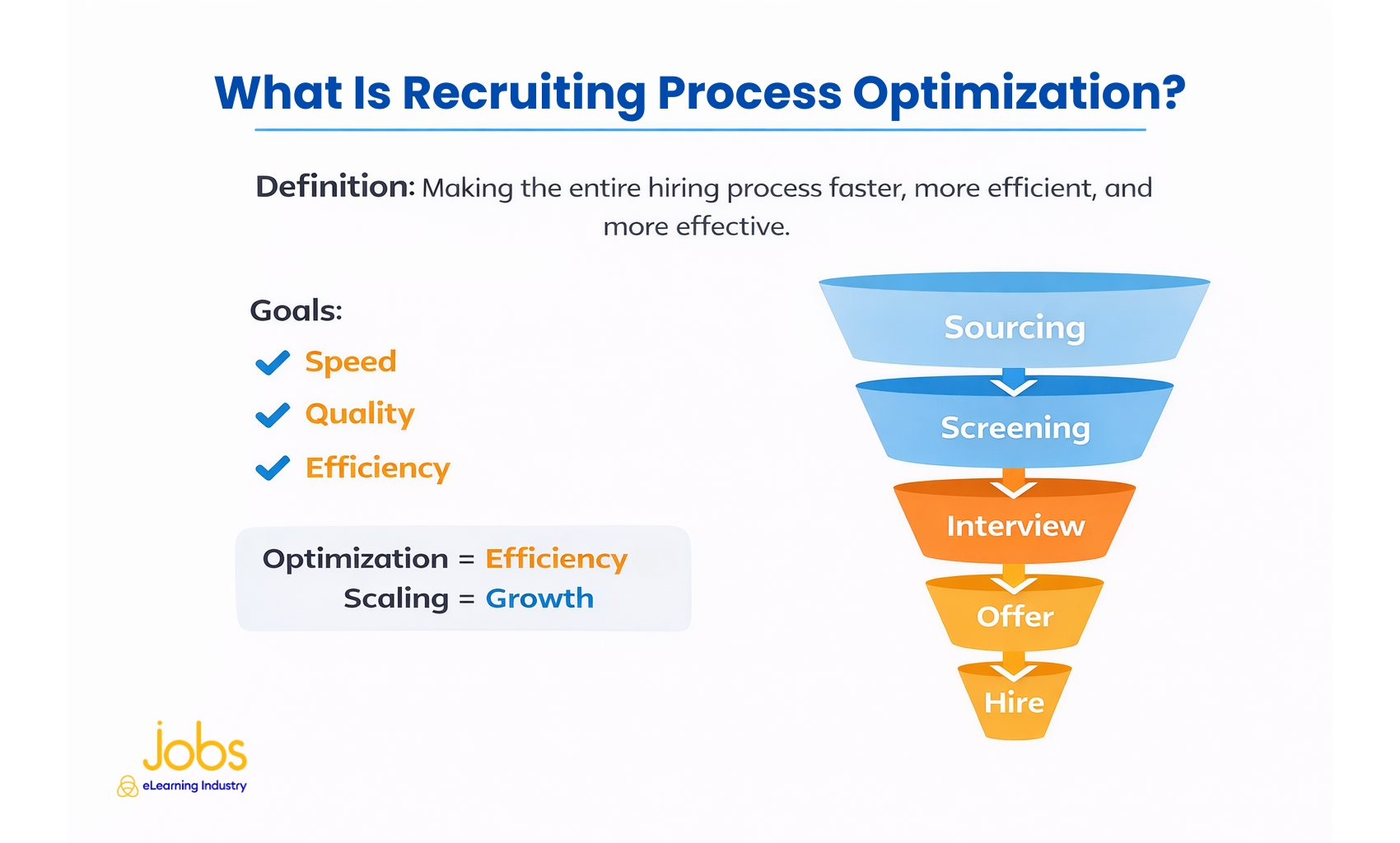
Recruiting process optimization is the practice of improving how organizations attract, evaluate, and hire candidates. The goal is to create a hiring process that is faster, more consistent, and more effective without reducing hiring quality. Instead of adding more interviews or tools, companies focus on removing bottlenecks, simplifying workflows, and improving decision-making across the recruitment cycle.
A strong recruitment process optimization strategy typically focuses on three core outcomes: speed, quality, and efficiency. Speed helps organizations reduce time-to-hire and compete for in-demand talent. Quality ensures teams hire candidates who are aligned with role requirements and long-term business needs. Efficiency helps recruiters and hiring managers spend less time on repetitive tasks and more time on high-value interactions.
It is also important to understand the difference between optimization and scaling. Recruitment process optimization improves the structure and performance of an existing hiring system. Scaling increases hiring volume. If companies attempt to scale before improving workflows, inefficiencies often grow larger and become harder to manage. Effective hiring process improvement starts by fixing delays, communication gaps, and unclear steps in the recruitment process before expanding recruitment efforts.
Where Most Hiring Processes Break Down
Many organizations struggle with hiring delays because inefficiencies are built into the recruitment process itself. Even companies with strong employer branding and competitive compensation can lose qualified candidates when workflows become slow, fragmented, or difficult to navigate. Recruitment process optimization starts with identifying the points where hiring teams lose momentum, communication, and decision-making speed.
Slow Candidate Screening
Recruiters often manage high application volumes while balancing sourcing, coordination, and stakeholder communication. Without clear screening criteria or automated workflows, applications can remain unreviewed for days.
This creates bottlenecks early in the hiring funnel. Strong candidates may accept other offers before the first interview is scheduled. Slow screening also affects recruiter productivity and makes it harder to improve hiring efficiency across multiple open roles. In many cases, companies focus heavily on sourcing talent but invest less in optimizing their recruitment workflows. As a result, the pipeline grows, but the hiring process itself remains slow.
Too Many Interview Stages
Excessive interview rounds and additional stages are often introduced to reduce hiring risk, but they can create the opposite effect. Long interview cycles increase scheduling delays, extend decision timelines, and frustrate candidates.
Many organizations unintentionally add duplicate interviews where stakeholders assess the same skills or competencies multiple times. This slows down hiring without improving evaluation quality. For companies trying to reduce time-to-hire, simplifying interview structures is often one of the fastest improvements they can make. A streamlined process with clearly defined evaluation goals usually yields faster, more consistent hiring decisions.
Lack Of Team Alignment
Hiring delays frequently happen when recruiters, hiring managers, and leadership teams are not aligned on role expectations. Teams may disagree on required skills, ideal experience levels, salary ranges, or interview priorities after the recruitment process has already started.
This lack of alignment creates repeated revisions, inconsistent candidate feedback, and delayed approvals. It also weakens talent acquisition process improvement efforts because teams spend more time correcting decisions than moving candidates forward. Organizations that want effective hiring process improvement need shared hiring criteria and faster communication between stakeholders.
Poor Candidate Experience
Long response times, unclear next steps, and inconsistent communication can cause candidates to disengage from the process entirely. Poor experiences also damage an employer's reputation, especially in competitive industries where candidates share feedback publicly. Companies focused on hiring faster must also prioritize transparency and responsiveness. Faster communication, structured timelines, and simpler processes help organizations strengthen both candidate satisfaction and recruiting performance.
If your hiring process is slowing down your ability to secure top talent, the right next step is to streamline execution and reduce time-to-hire. You can post a job on our platform and hire the right employee sooner by connecting with candidates who are actively looking and ready to move through a faster hiring funnel.
Recruiting Process Optimization Strategies That Work In 2026
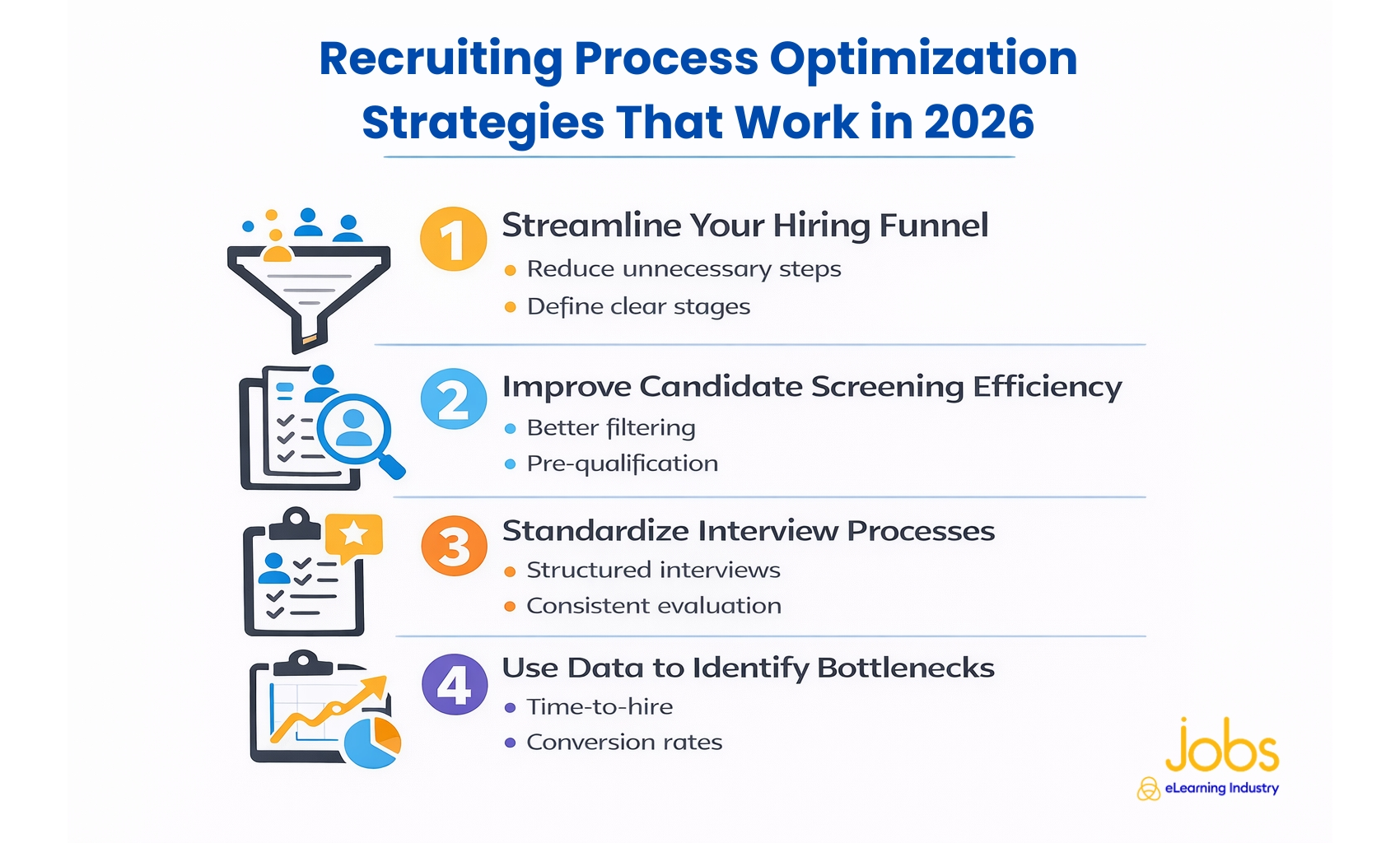
1. Streamline Your Hiring Funnel
Many hiring delays come from overly complex recruitment process steps. Multiple approval layers, repeated interviews, and unclear ownership can slow hiring without improving decision quality. One of the most effective strategies for optimizing the recruiting process is simplifying the hiring funnel.
Start by defining clear stages for sourcing, screening, interviews, assessments, and final approvals. Each stage should have a specific purpose and timeline. If a step does not help evaluate candidates more effectively, it may not be necessary.
Companies focused on optimizing their hiring funnel often reduce interview rounds and improve internal coordination. This helps reduce time-to-hire while creating a more predictable candidate experience.
2. Improve Candidate Screening Efficiency
Screening is one of the biggest bottlenecks in recruitment workflow optimization. Hiring teams often spend too much time reviewing unqualified applications or manually repeating the same evaluation process.
Improving screening efficiency starts with better filtering criteria. Define the non-negotiable skills, experience levels, and role requirements before reviewing applications. Pre-qualification questions can also help identify stronger candidates earlier in the process.
Many organizations are also using AI-assisted tools to optimize the recruitment process. Automated resume screening and skills matching can reduce administrative workload while helping recruiters focus on higher-quality applicants. The goal is not to remove human judgment, but to improve hiring efficiency by reducing repetitive manual work.
3. Standardize Interview Processes
Unstructured interviews create inconsistent evaluations and slower hiring decisions. Different interviewers may assess candidates using different criteria, making it harder to compare applicants fairly. On the contrary, standardized interviews improve both speed and consistency. Structured questions, predefined scorecards, and shared evaluation criteria help hiring teams make decisions more efficiently.
This approach also supports better talent acquisition by reducing bias and improving collaboration across departments. Interviewers spend less time debating subjective impressions and more time evaluating measurable qualifications. Organizations looking at how to hire faster should focus on making interviews more consistent rather than simply shortening them.
4. Use Data To Identify Bottlenecks
Recruitment teams cannot improve processes they do not measure. Data plays a central role in modern recruitment process optimization by helping identify where delays occur.
Key hiring metrics include:
- Time-to-hire
- Time-to-fill
- Interview-to-offer conversion rates
- Candidate drop-off rates
- Offer acceptance rates
For example, a high drop-off rate after the first interview may indicate poor candidate communication or slow follow-up times. Long approval cycles may signal internal decision-making problems rather than sourcing challenges. Tracking recruitment metrics allows companies to make targeted hiring process improvement decisions instead of relying on assumptions.
5. Automate Repetitive Tasks
Administrative work continues to consume significant recruiter time. Scheduling interviews, sending follow-up emails, and coordinating feedback can slow the recruitment process unnecessarily.
Thankfully, automation helps reduce operational friction without removing the human side of hiring. Many organizations now automate:
- Interview scheduling
- Candidate status updates
- Initial screening questionnaires
- Reminder emails
- Feedback collection
This type of recruitment workflow optimization allows recruiters to focus on relationship-building and candidate evaluation instead of repetitive coordination tasks. Automation is especially valuable for companies managing high-volume hiring or distributed hiring teams.
6. Align Hiring Teams And Stakeholders
Slow hiring decisions often result from poor alignment between recruiters, hiring managers, and leadership teams. Unclear responsibilities can lead to approval delays and duplicate work.
Strong recruiting process optimization requires clearly defined roles at every stage of hiring. Recruiters, hiring managers, and interview panels should understand who owns sourcing, evaluation, feedback, and final approvals.
Alignment also improves communication speed. When expectations are established early, hiring teams can make decisions faster and avoid unnecessary delays between interview stages. This becomes increasingly important as organizations scale hiring across multiple departments or locations.
7. Optimize Job Descriptions For Better Candidates
Job descriptions directly affect candidate quality and application relevance. Vague requirements, unrealistic expectations, or overly broad role descriptions often attract mismatched applicants.
Effective job descriptions focus on clarity, priorities, and realistic expectations. Candidates should quickly understand the role, required skills, responsibilities, and growth opportunities. Clearer postings support recruitment process optimization by improving applicant quality earlier in the funnel. This reduces screening time and increases the likelihood of attracting qualified candidates who align with the role requirements.
How To Reduce Time-To-Hire Without Sacrificing Quality
Reducing time-to-hire starts with improving decision speed across the entire recruitment process. Many hiring delays are not caused by a lack of candidates but by slow approvals, unclear ownership, and inconsistent evaluation criteria. Effective recruiting process optimization focuses on removing these bottlenecks without lowering hiring standards.
Stakeholder Alignment
One of the most effective hiring process improvement strategies is aligning stakeholders before the role opens. Recruiters, hiring managers, and interviewers should agree on required skills, evaluation methods, and decision timelines early in the process. This reduces back-and-forth discussions later and helps teams move candidates through the hiring funnel more efficiently.
Improving Candidate Quality
Faster hiring becomes difficult when recruiters must review large volumes of unqualified applications. Stronger job descriptions, targeted sourcing, and structured screening questions help improve hiring efficiency by identifying better-fit candidates earlier. Skills assessments and portfolio reviews can also reduce unnecessary interview rounds while maintaining quality standards.
Interview Structure
Too many interview stages often increase drop-off rates and delay hiring decisions. Instead of adding more interviews, organizations should make each stage more purposeful. Structured scorecards, standardized evaluation criteria, and clear feedback deadlines can significantly reduce time-to-hire.
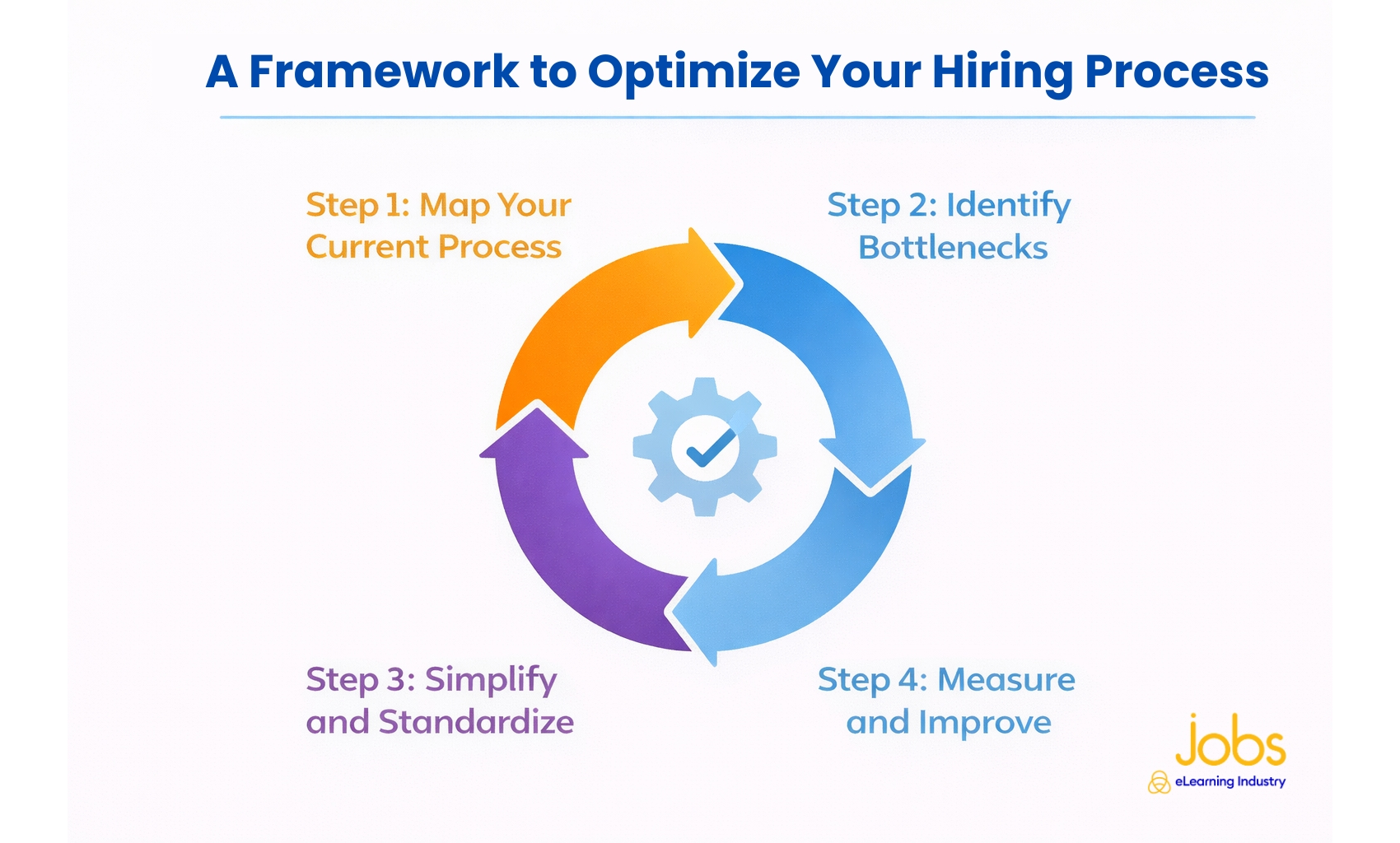
A Simple Framework To Optimize Your Hiring Process
Effective recruiting process optimization starts with understanding how your current hiring system actually works. Many organizations try to improve hiring speed by adding more tools or interview stages, but this often creates additional complexity instead of better results.
Step 1: Map Your Current Process
Begin by documenting every step of your recruitment process, from job approval to onboarding. Identify who is involved, how long each stage takes, and where decisions happen. This creates visibility into the full hiring funnel and helps teams understand how candidates move through the process.
Step 2: Identify Bottlenecks
Once the workflow is mapped, analyze where delays occur most often. Common bottlenecks include slow resume reviews, inconsistent interview scheduling, unclear hiring criteria, and delayed manager feedback. This stage of the recruitment process optimization helps teams focus on the changes that will have the greatest impact on reducing time to hire.
Step 3: Simplify And Standardize
Recruiting process optimization often comes from removing unnecessary steps and creating consistent workflows. Standardized interview scorecards, structured communication templates, and clearly defined approval processes can improve hiring efficiency without lowering hiring quality. This also supports better recruitment workflow optimization across departments and hiring teams.
Step 4: Measure And Improve
Optimization is an ongoing process, not a one-time fix. Track key metrics such as time to hire, interview-to-offer ratio, and candidate drop-off rates. These insights help organizations evaluate talent acquisition process improvement efforts and make better decisions over time. Companies that continuously measure performance are better positioned to adapt, scale, and learn how to hire faster in competitive markets.
Tools That Help Optimize Recruiting Processes
Technology plays a central role in modern recruiting process optimization. As hiring volumes increase and candidate expectations change, companies need systems that reduce manual work, improve visibility, and support faster decision-making across the hiring funnel.
Applicant Tracking Systems (ATS)
These are often the foundation of recruiting process optimization. An ATS centralizes candidate data, automates communication, and helps recruiters manage recruitment process steps more efficiently. It also improves collaboration between hiring managers, recruiters, and HR teams by keeping feedback and evaluation workflows in one place.
Job Boards
Job boards also influence hiring speed and candidate quality. While large general platforms can generate high application volume, niche job boards often deliver more targeted results. Specialized platforms such as Jobs by eLearning Industry help employers connect with professionals who already have relevant industry knowledge, portfolios, and technical skills. This improves hiring funnel optimization by reducing irrelevant applications and increasing the likelihood of qualified matches.
Automation Tools
These handle repetitive tasks such as interview scheduling, candidate screening, and follow-up communication. This allows recruiting teams to focus more on evaluation and relationship-building rather than on administrative work. In many organizations, automation is becoming essential for reducing time-to-hire without sacrificing consistency.
Analytics Platforms
They help teams identify bottlenecks in the recruitment workflow. Metrics such as source quality, interview conversion rates, and offer acceptance rates help organizations improve hiring efficiency through data-driven decisions. These insights also support broader talent acquisition process improvement initiatives by showing where delays, drop-offs, or communication gaps are affecting hiring outcomes.
The Business Impact Of Faster Hiring
Faster hiring creates measurable business advantages across the entire organization.
Competitive Advantage
Companies that invest in recruiting process optimization often secure stronger candidates before competitors reach the final stages of recruitment. This directly improves candidate experience, especially when communication is consistent and interview timelines are clearly defined.
Better Acceptance Rates
Candidates are more likely to accept opportunities when the recruitment experience feels organized, responsive, and respectful of their time. In contrast, delayed feedback and lengthy approval chains can create uncertainty and reduce engagement.
Reduced Hiring Costs
Recruiting process optimization helps reduce hiring costs by shortening vacancy periods and minimizing repetitive manual tasks. Open roles place additional pressure on existing teams, often leading to reduced productivity and delayed project delivery. The longer positions remain unfilled, the greater the impact on business performance.
Long-Term Workforce Planning
When recruiters and hiring managers can improve hiring efficiency, teams spend less time managing bottlenecks and more time focusing on strategic talent decisions. In competitive markets, organizations that reduce time-to-hire are better equipped to maintain productivity, strengthen retention, and respond quickly to changing business needs.
How Optimized Recruiting Connects To Better Hiring Outcomes
Better recruiting outcomes result from structured recruiting process optimization. When organizations focus on optimizing the recruitment process, they move beyond reactive hiring and build systems that consistently match the right candidates to the right roles. Better job matching happens when job requirements, screening criteria, and evaluation frameworks are clearly defined from the start. This reduces misalignment and ensures candidates progress only when they meet core role expectations.
Ultimately, improving hiring efficiency is not just about speed. It strengthens the entire talent acquisition process improvement strategy by increasing consistency, reducing drop-offs, and ensuring that strong candidates are not lost due to internal delays. This alignment helps organizations hire faster while maintaining consistent quality standards today across.
Optimizing your recruiting process is ultimately about building consistent, scalable access to quality talent. Connect with top talent faster in our platform by leveraging smarter hiring workflows that reduce delays and improve candidate matching.