

Yearly Salary Calculator: How Much Do You Really Earn Per Year?
A yearly salary calculator lets you see your earnings as one clear number. This is helpful when employers show pay in different formats.
Some jobs list pay by the hour, others by the month, and some only give an annual salary. It can be hard to compare these unless you convert them to the same time period.
Your pay might be shown as:
- Hourly pay
- Weekly pay
- Monthly pay
- Annual salary
Changing these numbers into the same format helps you answer a key question: How much do I make in a year?
Use our Salary Calculator to change your hourly pay into weekly, monthly, or yearly earnings.
Try the Jobs by eLearning Industry Yearly Salary Calculator to turn an hourly rate into weekly, monthly, or yearly pay. You can also use it to find the hourly rate from an annual salary.
If you are looking at new jobs in eLearning, Learning and Development, Instructional Design, EdTech, HR, or learning technology, knowing these numbers helps you compare your options more easily.
Key Takeaways
- Yearly salary represents your estimated gross earnings over one year.
- Hourly workers can calculate their annual salary by multiplying their hourly rate by the number of hours worked per week and the number of working weeks per year.
- Gross yearly salary is different from net or take-home income.
- Benefits, bonuses, overtime, paid leave, and expected working hours can change the overall value of a job.
- When comparing job offers, first convert compensation to the same annual and hourly measures.
What Is a Yearly Salary Calculator?
A yearly salary calculator helps you figure out your annual earnings by turning your hourly rate or other pay figures into a yearly amount, based on how much you work. This tool is useful when job postings or work agreements show pay in different ways.
The Jobs by eLearning Industry calculator can help you with calculations like:
- Hourly to weekly pay
- Hourly to monthly pay
- Hourly to yearly salary
- Annual salary to hourly rate
For example, if you make $30 an hour, you can enter your usual weekly hours and number of working weeks to see what that adds up to each week, month, and year. Similarly, if a job lists a $70,000 yearly salary, you can figure out the hourly rate by entering how many hours and weeks you plan to work.
This makes a yearly income calculator especially helpful when you want to compare hourly jobs with salaried ones. Keep in mind, though, that salary conversion is not the same as figuring out your take-home pay. Gross salary estimates do not show exactly how much you will get after taxes, insurance, retirement savings, or other deductions.
Use Our Yearly Salary Calculator
Our calculator helps you quickly turn your pay into numbers that are easier to understand and compare.
Here’s how to use it:
- First, pick if you want to start with your hourly pay or your yearly salary.
- Next, enter your hourly rate or your yearly salary.
- Type in how many hours you work each week.
- Then, enter how many weeks you work in a year.
- You’ll see your estimated pay per hour, week, month, and year.
If you’re paid by the hour, this shows how your hourly wage adds up over a year. If you’re on a salary, it helps you see how much you make per hour based on your schedule. This is especially helpful when you want to compare jobs with different work hours.
Give it a try and see your yearly salary now.
How to Calculate Yearly Salary From Hourly Pay
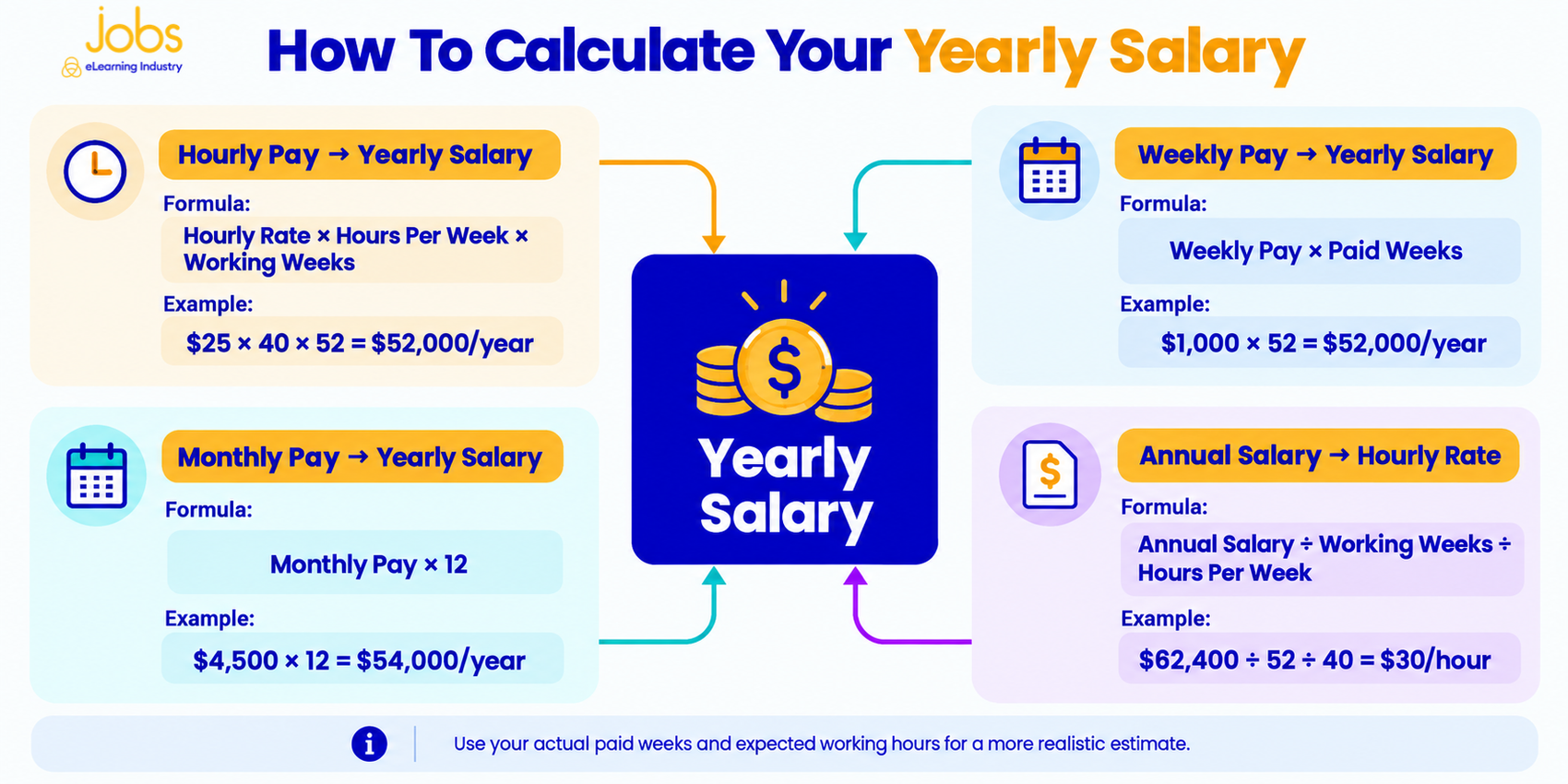
To calculate yearly salary from an hourly wage, multiply your hourly rate by the number of hours you work each week and then multiply that figure by the number of weeks you work during the year.
The basic formula is:
Hourly rate x hours per week x weeks worked in a year = yearly salary
For example:
- Hourly rate: $25
- Hours per week: 40
- Working weeks: 52
The calculation is:
$25 × 40 × 52 = $52,000
So, your estimated gross yearly salary would be $52,000.
This is the usual way to convert an hourly wage to a yearly salary, but your actual yearly earnings might differ.
Factors that can affect the final amount include:
- Unpaid time off
- Overtime
- Reduced working hours
- Seasonal employment
- Variable schedules
- Periods without paid work
For example, someone earning $25 per hour who works only 48 paid weeks would earn:
$25 × 40 × 48 = $48,000
That’s why the number of weeks you work is important when figuring out your yearly salary from an hourly rate.
If your schedule changes often, estimate your yearly salary based on the number of hours and paid weeks you actually expect to work, rather than assuming 40 hours a week and 52 weeks a year.
How to Calculate Your Hourly Rate From Annual Salary
You can also use a yearly salary calculator to figure out the hourly rate from your annual salary.
Here’s a simple formula you can use:
Annual salary ÷ working weeks ÷ hours per week = hourly rate
Let’s say you earn $62,400 a year and work 40 hours each week for all 52 weeks.
The calculation would be:
$62,400 ÷ 52 ÷ 40 = $30 per hour
So, your hourly rate would be about $30.
Knowing how to convert an annual salary to an hourly rate is helpful, since the yearly amount doesn’t always reflect how much time the job actually takes.
This can be useful when you want to compare things like:
- Salaried and hourly positions
- Jobs with different weekly schedules
- Roles with substantial overtime expectations
- Full-time and part-time opportunities
For instance, two jobs might pay about the same each year but expect very different weekly hours.
A $65,000 job with a 40-hour week and a $68,000 job that often needs 50 hours a week won’t have the same hourly rate.
If you convert both salaries, the difference becomes much clearer.
How to Estimate Yearly Salary From Other Pay Frequencies
You don’t have to use a yearly salary calculator to figure out your annual income. It’s also possible to convert common pay periods by hand. These calculations come in handy when you’re looking at a job posting, a work contract, a freelance deal, or your current paycheck.
Weekly Pay to Yearly Salary
To turn your weekly pay into a yearly salary, just multiply what you make each week by the number of weeks you get paid in a year.
The formula is:
Weekly pay × paid weeks per year = yearly salary
For example, if you earn $1,200 per week for 52 paid weeks:
$1,200 × 52 = $62,400
So, your estimated gross yearly earnings would be $62,400.
If you don’t get paid every week, use the actual number of paid weeks instead.
Biweekly Pay to Yearly Salary
Biweekly pay means you get paid every two weeks.
This usually adds up to 26 paychecks each year.
The formula is:
Biweekly pay × 26 = estimated yearly salary
For example, if your gross biweekly pay is $2,400:
$2,400 × 26 = $62,400
Don’t mix up biweekly pay with twice-monthly pay. A twice-monthly schedule gives you 24 payments a year, while a biweekly schedule gives you 26.
Monthly Pay to Yearly Salary
To figure out your yearly salary from your monthly pay, multiply your monthly amount by 12.
The formula is:
Monthly salary × 12 = yearly salary
For example:
$5,000 × 12 = $60,000
So, if you make $5,000 a month, your estimated gross yearly salary is $60,000.
Want to understand what you should be earning?
Read our salary guide to explore salary ranges, compare roles, and make more informed decisions about your next career move.
Gross Yearly Salary vs. Net Yearly Income
Your yearly salary before taxes is not necessarily the amount you actually receive during the year. Knowing the difference between gross and net income helps you avoid a common mistake when figuring out your salary.
Gross Yearly Salary
Your gross yearly salary is what you earn before any deductions are made. For instance, if your contract says your annual salary is $70,000, this usually means your gross salary unless it says something different.
Gross income is usually the number you see in:
- Job advertisements
- Employment contracts
- Salary negotiations
- Compensation benchmarking
- Annual salary comparisons
Net Yearly Income
Net yearly income is what you have left after all deductions are taken out. Depending on where you live, who you work for, and your personal situation, deductions can include:
- Income taxes
- Social or payroll taxes
- Health insurance
- Retirement contributions
- Other payroll deductions
Because of this, a calculator that estimates your gross pay should not be used to figure out your exact take-home pay.
What Does Yearly Salary Include?
The term 'yearly salary' can mean different things depending on the employer and situation. So, it’s important to know exactly what’s included before you compare job offers.
Common compensation components include:
- Base salary
- Guaranteed allowances
- Overtime
- Performance bonuses
- Commission
- Equity or stock awards
- Employer-provided benefits
However, you shouldn’t assume all these items are always counted as salary.
Base Yearly Salary
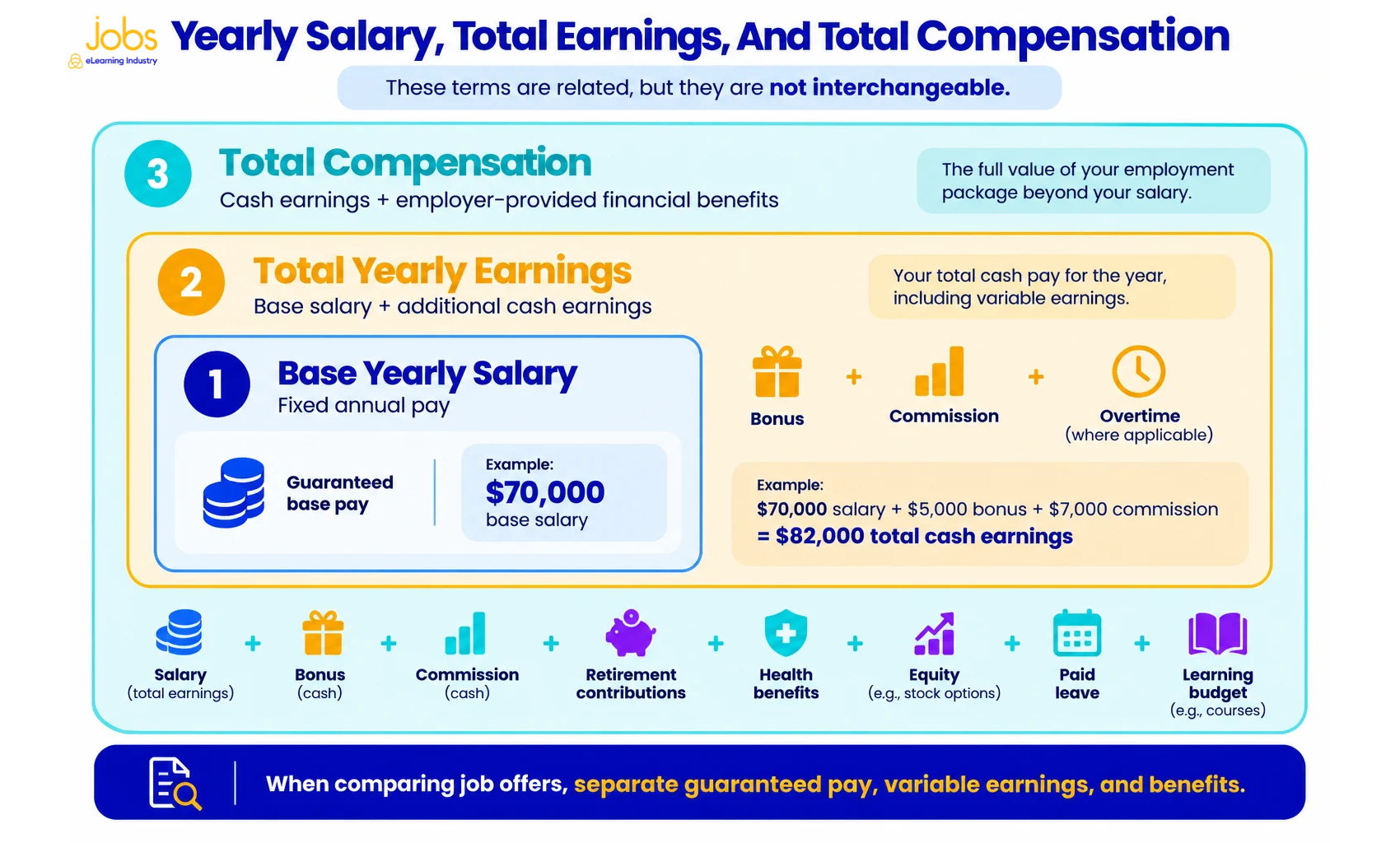
Your base yearly salary is the set amount you earn for your job, not including extras like bonuses or commission.
For example, a job might offer:
Base salary: $70,000
This number is usually the easiest way to compare what you’re guaranteed to earn each year.
Total Yearly Earnings
Total yearly earnings can include your base pay plus any extra cash you get during the year.
For example:
- Base salary: $70,000
- Bonus received: $5,000
- Commission earned: $7,000
So, your total cash earnings would be:
$82,000
Keep in mind, though, that bonuses and commissions might not be guaranteed every year.
Total Compensation
Total compensation covers more than just your yearly salary.
It may include:
- Salary
- Bonuses
- Commission
- Employer retirement contributions
- Health benefits
- Equity
- Paid leave
- Learning or professional development budgets
- Other financial benefits
Therefore, a $75,000 salary and a $75,000 total compensation package aren’t always the same.
When you compare jobs, check which parts of the offer are fixed, which are variable, and which are non-cash benefits.
How to Compare Yearly Salaries Between Roles
A yearly salary calculator is especially helpful when two jobs list pay in different ways. Rather than just looking at the main numbers, make sure to put both salaries on the same scale first.
Convert Both Roles Into Annual Figures
Begin by making sure both pay offers are measured over the same period.
For example, suppose one employer offers:
$31 per hour
Another offer:
$64,000 per year
If the hourly role involves 40 hours per week for 52 weeks:
$31 × 40 × 52 = $64,480
Now you can compare the offers using yearly amounts.
Compare the Hourly Equivalent
A yearly salary alone doesn’t show how many hours you’ll actually work. This matters if one job regularly expects longer work weeks.
For example:
Job A: $70,000 at 40 hours per week
Job B: $75,000 at 50 hours per week
Approximate hourly equivalents:
Job A: $70,000 ÷ 52 ÷ 40 = $33.65 per hour
Job B: $75,000 ÷ 52 ÷ 50 = $28.85 per hour
Job B pays more each year, but Job A pays more per hour based on the schedule.
Neither calculation gives the full picture, but looking at both is more helpful than just the yearly salary. If you’re comparing job offers, figure out both the yearly and hourly pay for each before you decide.
Separate Guaranteed and Variable Pay
Don’t count possible bonuses or extras as guaranteed pay.
For example:
Base salary: $65,000
Potential annual bonus: $10,000
Your guaranteed pay is still $65,000 unless the bonus is written into your contract.
When evaluating an offer, ask:
- Is the bonus guaranteed?
- What percentage of employees receive it?
- What determines eligibility?
- Is commission capped?
- Does the amount depend on individual or company performance?
This keeps you from overestimating one offer compared to another.
Compare Benefits and Paid Leave
Salary matters, but benefits can also be worth real money.
Consider factors such as:
- Retirement contributions
- Health insurance
- Paid holidays
- Paid vacation
- Sick leave
- Learning and development budgets
- Remote-work support
- Equipment allowances
- Flexible working arrangements
A job with a lower salary might offer benefits that help lower your expenses or give you more paid time off.
Consider Career Growth
When thinking about pay, remember it’s not just about your next paycheck. When you compare jobs, you might also look at:
- Level of responsibility
- Promotion opportunities
- Skills development
- Access to new technologies
- Professional visibility
- Employment stability
- Long-term earning potential
If you are moving into Instructional Design, a job that lets you work with authoring tools, LMS administration, analytics, and stakeholder management can help you build skills for future roles. For experienced L&D professionals, a job that includes strategy, team leadership, or enterprise learning technology can help you move into more senior roles. Therefore, salary is just one part of your bigger career decision.
Example: Comparing Two Job Offers
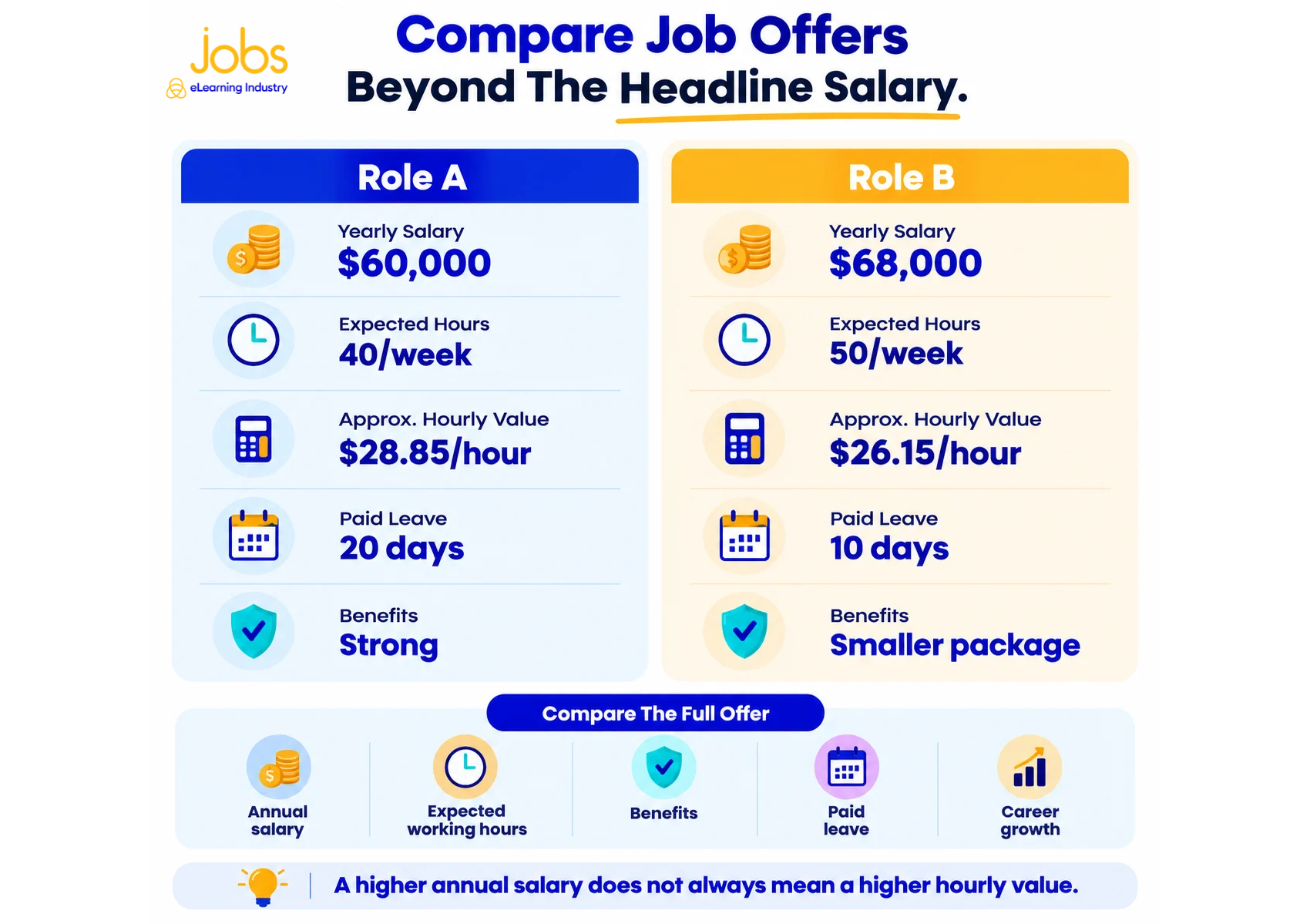
A yearly salary calculator helps you see the differences between two job offers more clearly. Let’s look at two example roles.
Role A
- $60,000 yearly salary
- 40 hours per week
- Strong benefits
- 20 paid leave days
Here’s a simple way to convert the annual salary to an hourly rate:
$60,000 ÷ 52 ÷ 40 = approximately $28.85 per hour
Role B
- $68,000 yearly salary
- 50 expected hours per week
- Smaller benefits package
- 10 paid leave days
For Role B, the hourly rate works out to about:
$68,000 ÷ 52 ÷ 50 = approximately $26.15 per hour
Differences
Role B offers a headline salary that is $8,000 higher. But Role B also requires about 10 more working hours each week. If you look only at the hours and pay, Role A pays about $28.85 per hour, while Role B pays about $26.15 per hour. There are also differences in benefits and paid leave.
These numbers alone do not decide which job is best. One job might have better chances for advancement, more interesting work, greater flexibility, or higher earning potential in the future.
That’s why it helps to look at several factors together when comparing jobs:
- Annual salary
- Approximate hourly rate
- Expected working hours
- Guaranteed versus variable compensation
- Paid leave
- Benefits
- Career development
The headline salary shows what a company plans to pay, but looking at all the details gives you a better idea of what you really get for your time.
Common Yearly Salary Calculation Mistakes
A yearly salary calculator makes it easier to compare pay, but its results depend on the information you put in. Here are some common mistakes to look out for.
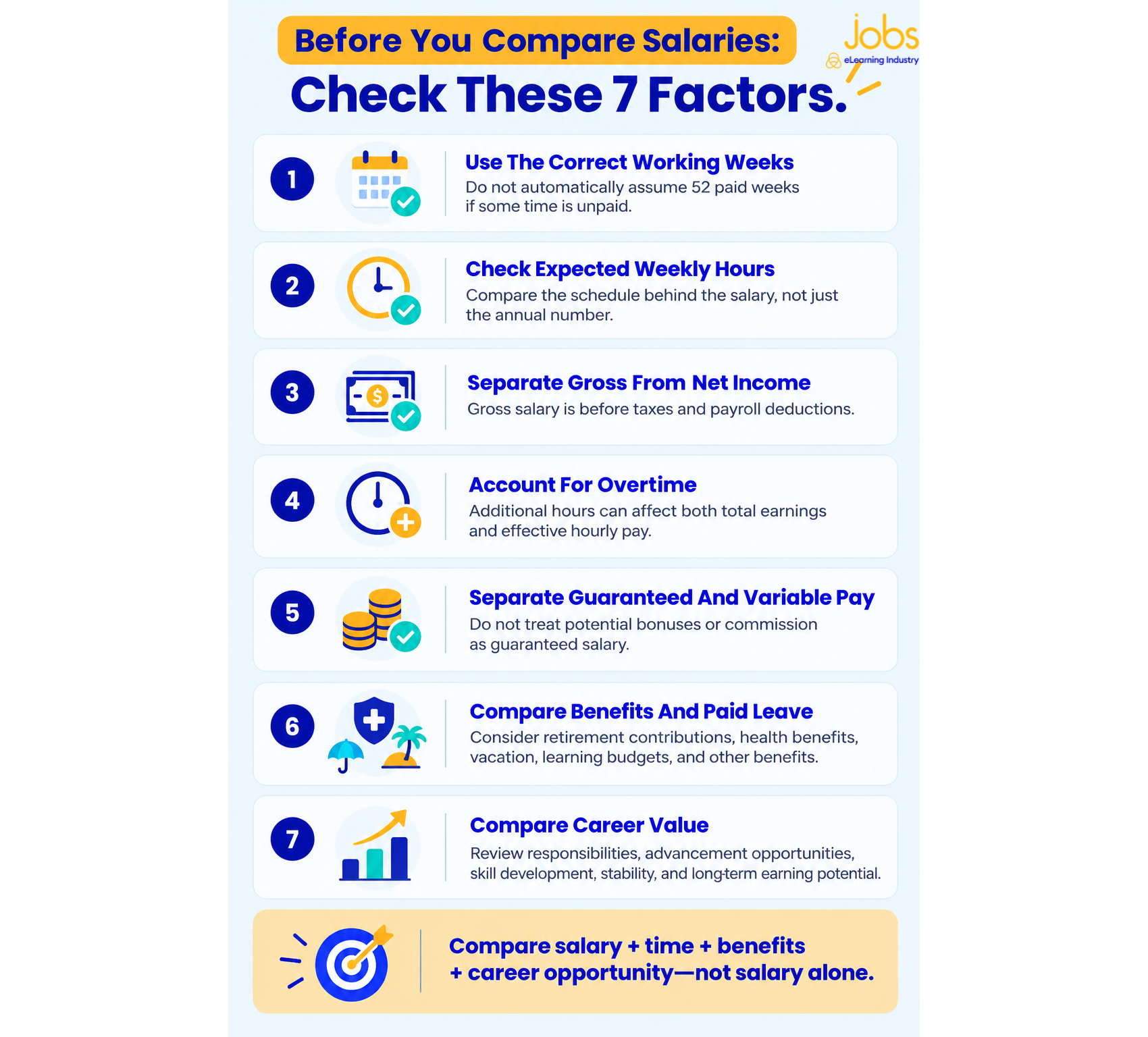
1. Using 52 Weeks When Some Time Is Unpaid
Not everyone receives pay for all 52 weeks. Seasonal workers, contractors, freelancers, and some hourly employees may have unpaid periods. If you get paid for 48 weeks but use 52 in your calculation, your yearly earnings will seem higher than they really are.
2. Confusing Gross and Net Income
If your gross salary is $70,000, you won’t actually take home that full amount. Taxes and other deductions lower the amount you get in your paycheck.
3. Ignoring Overtime
If you often work overtime, you might earn more than your base salary suggests. On the other hand, if you’re salaried and often work extra hours without extra pay, your real hourly rate could be lower than you think.
4. Comparing Salaries Without Comparing Hours
A bigger yearly salary might mean you have to work a lot more hours. When work schedules differ, compare both the annual pay and the hourly rate.
5. Including Uncertain Bonuses as Guaranteed Income
Don’t count bonuses, commissions, or other extra payments as part of your guaranteed salary right away. Keep your base pay and any extra earnings separate.
6. Confusing Biweekly With Twice-Monthly Pay
Biweekly pay normally means 26 payments per year. Twice-monthly pay normally means 24 payments. If you use the wrong number of pay periods, your yearly total won’t be accurate.
7. Ignoring Benefits and Paid Leave
Two jobs with similar pay can have very different benefits. Things like paid vacation, retirement plans, insurance, and employer-paid training all add value to your job offer.
8. Assuming the Highest Headline Salary Is Automatically the Best Offer
Yearly salary is just one thing to consider. Other factors like work hours, flexibility, benefits, job security, chances to move up, where you have to work, and extra pay can all change how good an offer really is.
When Should You Use a Yearly Salary Calculator?
A yearly salary calculator comes in handy whenever you want to see your pay in a clear, consistent way.
Common situations include:
1. Comparing hourly and salaried jobs
2. Figure out the yearly and hourly pay for each job so you can compare them more easily.
3. Reviewing a new job offer
4. Check how the pay offered matches up with the hours you expect to work.
5. Preparing for salary negotiations
6. Know your current hourly and yearly pay before you start talking about a new salary.
7. Evaluating a promotion
8. Look at how much your pay will go up and whether your duties or hours will change.
9. Moving from part-time to full-time work
10. Figure out how a new work schedule might affect your yearly income.
11. Estimating income for budgeting
12. Turn your hourly pay into a rough yearly amount to help with budgeting.
13. Comparing roles with different schedules
14. See if a bigger paycheck also means you’ll be working a lot more hours.
So, a salary calculator isn’t just for figuring out, “How much do I make a year?” It can also help you answer a bigger question: “How does this job stack up against the one I have now?”
Find Roles That Match Your Salary Goals
When you know your yearly income, it’s easier to set realistic pay expectations for your next job. For instance, if you earn $30 an hour, that adds up to about $62,400 a year if you work 40 hours a week for 52 weeks.
If you’re searching for a job in Instructional Design, L&D, LMS, EdTech, HR, or learning technology, you can use that number as a reference when looking at job openings.
You can then compare each job opportunity by looking at things like:
- Salary range
- Expected hours
- Role seniority
- Required experience
- Benefits
- Remote or hybrid options
- Skills required
- Career progression
Making a candidate profile can help you keep track of your job search. Personalized job alerts can also help you spot new opportunities as soon as they come up. Instead of focusing only on salary, look for jobs that align with both your pay expectations and your broader career goals.
FAQs About The Yearly Salary Calculator
1. How Do I Calculate My Yearly Salary?
To calculate your yearly salary from your hourly pay, multiply your hourly wage by the number of hours you work each week and then by the number of working weeks in the year.
The formula is:
Hourly rate × weekly hours × working weeks = yearly salary
For example, $30 per hour × 40 hours × 52 weeks equals an estimated gross yearly salary of $62,400.
2. What Is My Hourly Wage Per Year?
If you are paid hourly and want to know your yearly income, multiply your hourly wage by your weekly working hours and the number of paid working weeks. For example:
$22 × 40 × 52 = $45,760 per year
If your hours or working weeks vary, use realistic averages for a more useful estimate.
3. Is Yearly Salary Before or After Taxes?
A quoted yearly salary normally refers to gross yearly salary, meaning compensation before taxes and other payroll deductions. Your net income, or take-home pay, will usually be lower. The difference depends on factors such as your location, taxes, insurance, retirement contributions, and other deductions.
4. How Many Working Weeks Are Used in a Yearly Salary Calculation?
Many standard calculations use 52 weeks, because there are approximately 52 weeks in a year. However, you should use your actual number of paid working weeks if you have unpaid time off, seasonal breaks, contract gaps, or another nonstandard arrangement. For instance, a person working 48 paid weeks should use 48 rather than 52.
5. Does Yearly Salary Include Bonuses?
Yearly base salary normally refers to fixed annual pay and does not automatically include bonuses. Bonuses may be included when discussing total yearly earnings or total compensation, depending on how the employer presents the package. When comparing job offers, keep guaranteed salary and potential bonuses separate unless the additional payment is guaranteed.