
Why Resume Length Still Matters In 2026
Recruiters often spend only a few seconds scanning each application. This means they don't have time to sift through unnecessary details to learn about your qualifications if you submit a multi-page doc. Applicant Tracking Systems (ATS) also factor into the hiring equation. They're designed to identify relevant skills and keywords, and pages of content that aren't targeted to the role only make things more complicated. Ultimately, clarity beats volume. A focused, well-structured resume helps both humans and software to quickly understand the value you bring and the impact you've had. It doesn't just highlight all your past responsibilities, but focuses on what's most relevant to the role you're applying for. Whether your resume ends up being one page or more, the goal is to make every line count instead of trying to pad it out. This guide maps out how long a resume should be, what recruiters want to see, and common mistakes to avoid.
Key Takeaways
- Most resumes should be one to two pages long.
- A one-page resume works best for early-career candidates.
- Two pages are ideal for experienced professionals.
- Resume length should reflect relevance, not total experience.
How Long Should A Resume Be?
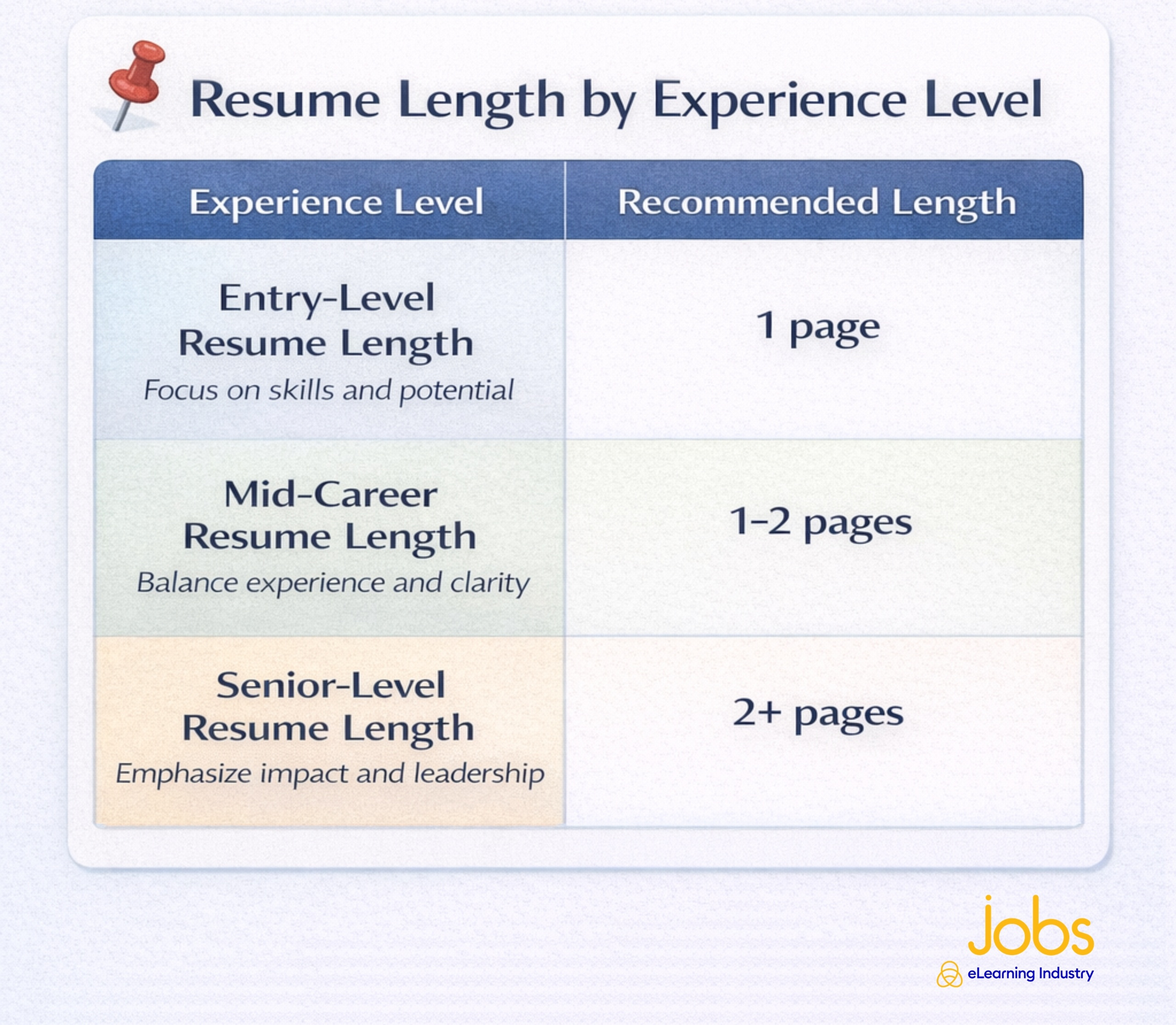
Is a one-page resume enough? How do you know when to use a two-page resume? As a general rule, entry-level candidates should keep their applications to one page. With limited experience, a concise format helps highlight only the most relevant skills, education, and achievements. Mid-level professionals should opt for one or two pages, depending on the depth of experience and how relevant past roles are to the job opening. Senior-level candidates, including executives, should typically use two pages and only go over in rare cases. For example, if they need to include more extensive accomplishments that, once again, are highly relevant to the role.
When A One-Page Resume Is The Best Choice
A one-page resume is ideal for entry-level candidates, career switchers, or professionals applying for highly focused roles. If your experience is limited or doesn't directly align with the job, keeping everything on a single page ensures that your most important qualifications stand out. This also makes it easier for recruiters to scan, and it forces you to prioritize what truly matters so that you make the best first impression. Plus, the last thing you want is to overwhelm hiring managers instead of highlighting your real potential with a concise resume.
When A Two-Page Resume Makes More Sense
A two-page resume is best for professionals with at least five years of experience, especially if you have multiple relevant roles or are looking for jobs in technical or specialized fields. When you've built a track record of accomplishments, promotions, or complex projects, you need more space to present the value you offer potential employers. However, the second page should add meaningful details, such as measurable achievements, leadership experience, or specialized expertise, rather than filler or repetitive info. In short, if the second page doesn't strengthen your application, it's better to leave it out.
 Should A Resume Ever Be Longer Than Two Pages?
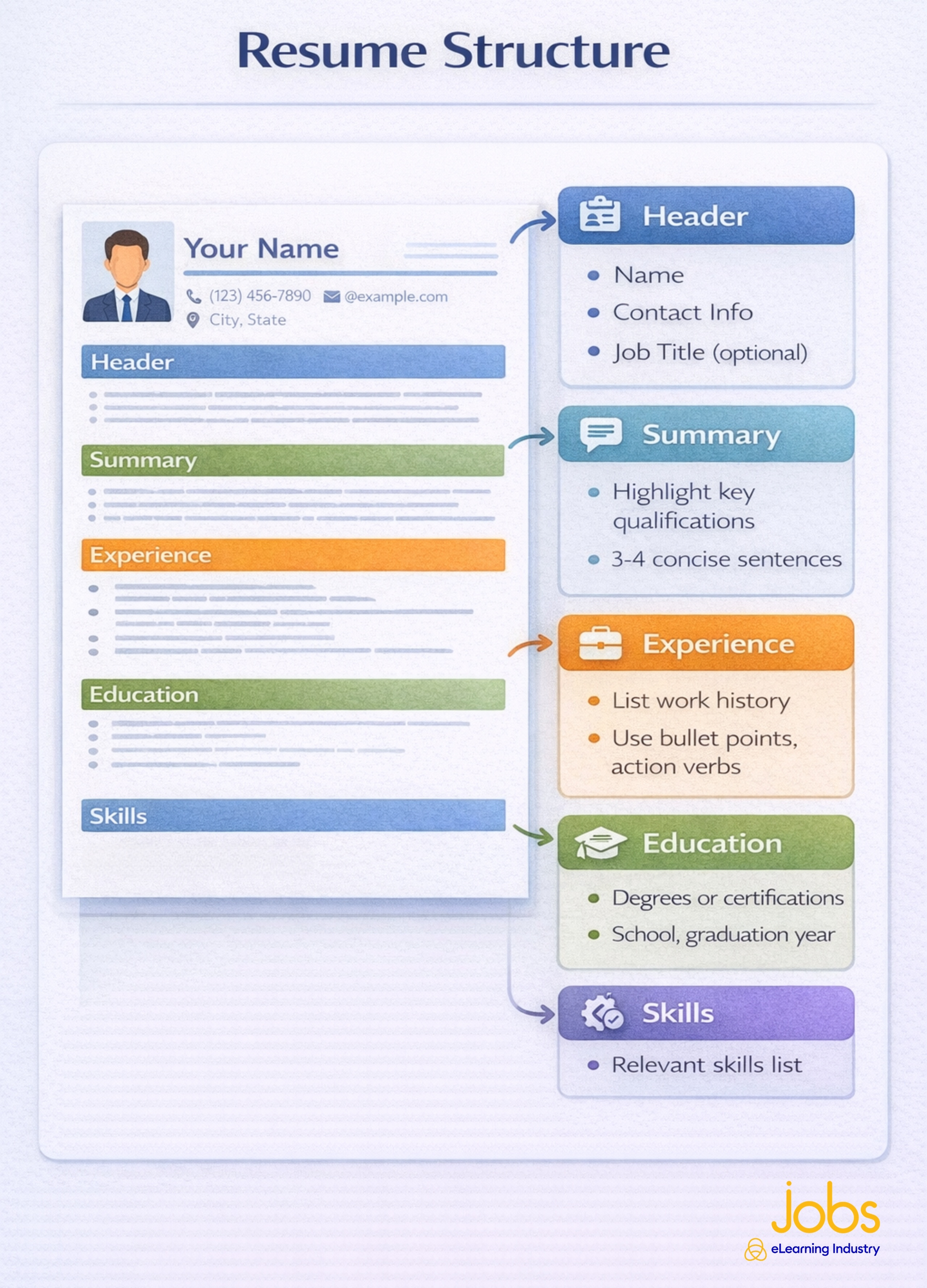
In most cases, no. Resumes longer than two pages aren't usually necessary for typical job seekers. The exceptions are for fields like academia, research, or highly technical careers, where you need a CV with detailed publications, projects, or credentials. Even then, the content must be relevant and well-organized.
Resume Length By Experience Level
Resume length in 2026 should reflect your experience while remaining clear and tailored to the role. The goal isn't to fill space, but to present your skills and talents at every stage of your career.
Entry-Level Resume Length
How many pages should a resume be if you're new to a career path? For entry-level candidates, a one-page resume is the standard. With limited professional experience, the main focus should be on skills, education, internships, and any relevant projects. Employers hiring at this level are looking for potential, not a long list of past positions that don't really pertain to the opening. A concise format helps highlight your transferable skills and achievements without excessive detail. Above all else, keeping it to one page helps hiring managers quickly identify your strongest points.
Mid-Career Resume Length
Mid-career applicants can typically go with a one- to two-page resume. At this stage, you likely have several years of relevant experience, multiple roles, and measurable accomplishments to include. The challenge is conveying the depth of your experience without listing every responsibility from every past job. Include enough detail to demonstrate your growth, level of expertise, and results you've achieved, but prioritize recent and relevant experience.
Senior-Level Resume Length
Senior-level candidates should generally use a two-page resume. With extensive experience, leadership roles, and strategic contributions, you need more space to show your impact. The emphasis should be on results, decision-making, and leadership rather than day-to-day tasks. Highlight major achievements and business outcomes. Even at this level, you need to narrow your focus so that recruiters can immediately see your qualifications.
Create your resume and tailor it to your target roles!
 What Recruiters Actually Look For (It's Not Length)
Recruiters aren't focused on the length of your resume. They're focused on how quickly they can convey the value you'll bring to their organization. Their first priority is relevance. Hiring managers want to see experience, skills, and achievements that directly match the role. If your resume isn't tailored, even a resume that's just the right size won't get you an interview.
Also, keep in mind that results matter more than responsibilities. Recruiters look for evidence of impact, such as metrics, outcomes, and specific contributions that show what you've achieved, not just what you were assigned to do in your past roles. And clarity is just as important. A resume should be easy to read, with straightforward language and no unnecessary jargon. If a recruiter has to struggle to understand your background, they'll move on to the next candidate. Last but not least, structure ties everything together. Consistent formatting and logical sections help guide the recruiter's eye and make key information easy to find.
How To Keep Your Resume The Right Length
If you realize that your resume is getting a bit long and you still have to cover some essentials, there are a few things you can do to scale it back. Firstly, remove irrelevant experience and focus only on roles, skills, and details that directly relate to the position you're applying for. You can even omit or shorten older, unrelated jobs to focus on jobs that really matter.
Another top tip is to concentrate on achievements rather than just listing tasks. Employers are more interested in the impact you made than in the job responsibilities you had. For example, instead of stating that you "managed a team," highlight measurable results, such as improved performance, increased sales, or completed projects ahead of schedule.
You can also scan your resume for repetition. Repeating similar responsibilities across multiple roles takes up valuable space and might even confuse the hiring manager. Instead, consolidate similar experiences and emphasize what was unique in each position that you held.
Lastly, use bullet points to keep your resume organized and easier to read. Each bullet should be direct, specific, and no longer than one or two lines. Start with strong action verbs and omit unnecessary words to keep descriptions clear and concise.
Common Resume Length Mistakes
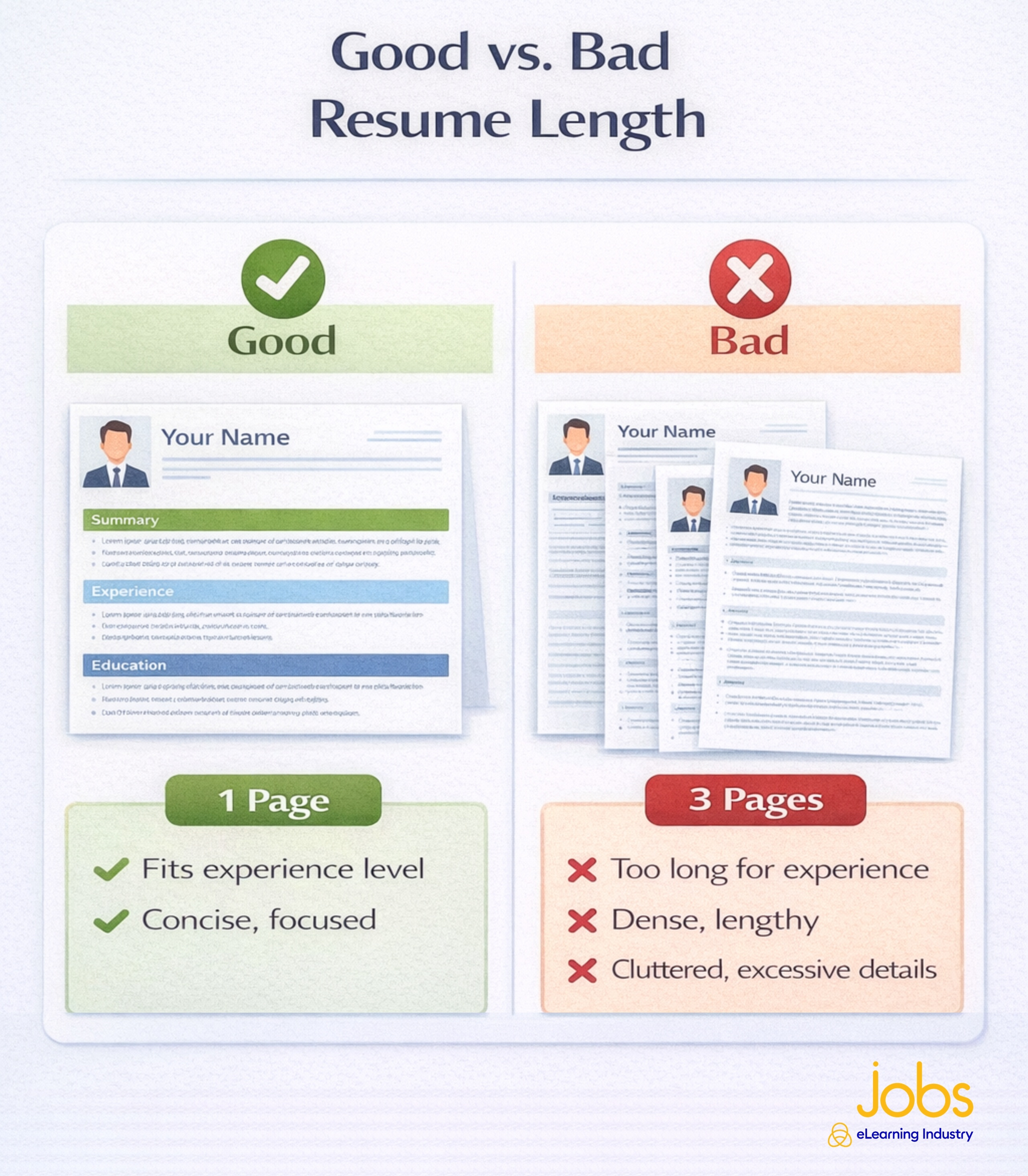
One of the most common missteps is trying to fit everything onto a single page. While a one-page resume is ideal for candidates early in their careers, cramming extensive experience into limited space often means tiny fonts and crowded sections. A resume should be easy to scan, even if that means extending to a second page when necessary.
On the other hand, some candidates make the opposite mistake by padding their resumes to reach two pages. Adding unnecessary details, such as overly detailed job descriptions or irrelevant skills, can make important information seem less valuable.
Including outdated experience is another mistake to avoid. Positions from many years ago that no longer relate to your current career goals can clutter your resume and distract from your most recent (and relevant) achievements. Instead, focus on roles that demonstrate skills connected to the job you want now.
Finally, poor formatting, such as inconsistent spacing, long paragraphs, and a general lack of structure, makes a resume seem longer and harder to read than it actually is. So, use clear headings, well-organized sections, and some white space to improve the readability.
 Resume Length Vs. CV Length: What's The Difference?
Understanding the key differences between CV vs. resume length allows you to choose the right format when applying so that you're more likely to land an interview. A resume is designed to be concise and targeted. It typically highlights your most relevant skills, experience, and achievements for a specific job, usually within one or two pages. The goal is to provide a quick, clear snapshot that employers can scan and understand your value right away.
Then there's a curriculum vitae, or CV, which is much more detailed and comprehensive. It includes a full overview of your academic background, work history, publications, certifications, and other accomplishments. CVs are typically used in academic, research, or medical fields. Basically, whenever employers need a complete record of your experience.
Create A Resume That Matches Job Requirements
Creating a resume that aligns with job requirements gives you the opportunity to stand out in a competitive job market. One of the most effective strategies is to tailor your resume to each role you apply to. Instead of sending the same version to every employer, adjust your content to reflect the specific responsibilities and qualifications mentioned in the job posting. This shows employers that you've taken the time to understand what they're looking for in a candidate and that you're genuinely interested.
You should also include the skills highlighted in the job description. Review the posting and identify the employer's key competencies, tools, and qualifications. Then, outline how your own experience directly ties into those requirements. Using similar language can also make your resume more relevant and easier for hiring managers to review at a glance. Finally, keep your content focused to ensure that your resume is clear and highlights the most important information. Avoid adding unrelated experience or unnecessary details that distract from your core strengths.
By tailoring your resume to each role, aligning your skills with the job description, and using a focused structure, you can position yourself as the right person for the job rather than letting your resume get lost in the pile.
Through our platform, you can upload your resume and explore matching jobs. However, don't forget to set alerts for the roles that interest you, so you can always get the news first and begin applying.