

Why Icebreaker Questions Matter At Work
Icebreaker questions for work help teams communicate more comfortably, especially in meetings, interviews, training sessions, and collaborative projects. A well-chosen question can reduce awkwardness, encourage participation, and make conversations feel more natural from the start.
They also play an important role in team building. Simple prompts can help coworkers learn more about each other, build trust, and create stronger working relationships over time. In remote and hybrid workplaces, icebreaker questions can also improve engagement and make virtual meetings feel more interactive. The best icebreaker questions are short, relevant, and easy to answer. They should help people connect without putting anyone on the spot. Whether you're leading a team meeting, onboarding new employees, hosting a workshop, or preparing for interviews, having a list of good icebreaker questions can make group conversations more productive and less stressful.
Below, you'll find 50+ practical icebreaker questions for different workplace situations, including meetings, team building activities, interviews, and virtual sessions.
Key Takeaways
- Icebreaker questions help teams connect and communicate more effectively.
- The best questions are simple, relevant, and easy to answer.
- Different situations require different types of questions.
- Well-chosen icebreakers can improve meetings, interviews, and team dynamics.
Icebreaker Questions For Work (Quick List)
If you need quick icebreaker questions for work, start with simple prompts that encourage conversation without making people uncomfortable. These questions work well for team meetings, onboarding sessions, workshops, and virtual calls. They are also useful as meeting icebreakers when teams need a more relaxed and collaborative atmosphere.
- What's one skill you would like to improve this year?
- What's the best career advice you've received?
- Which app or tool do you use most during the workday?
- What's your ideal way to start the morning?
- What's one small thing that helps you stay productive?
- If you could instantly learn a new skill, what would it be?
- What's your favorite way to take a break during work?
- What's one project or achievement you're proud of?
Good icebreaker questions should feel natural, easy to answer, and relevant to the workplace. Whether you are planning team-building questions for a workshop or looking for fun icebreaker questions for work, short, practical prompts usually lead to the best discussions. They also help teams communicate more openly and reduce awkwardness in group settings.
Icebreaker Questions For Meetings
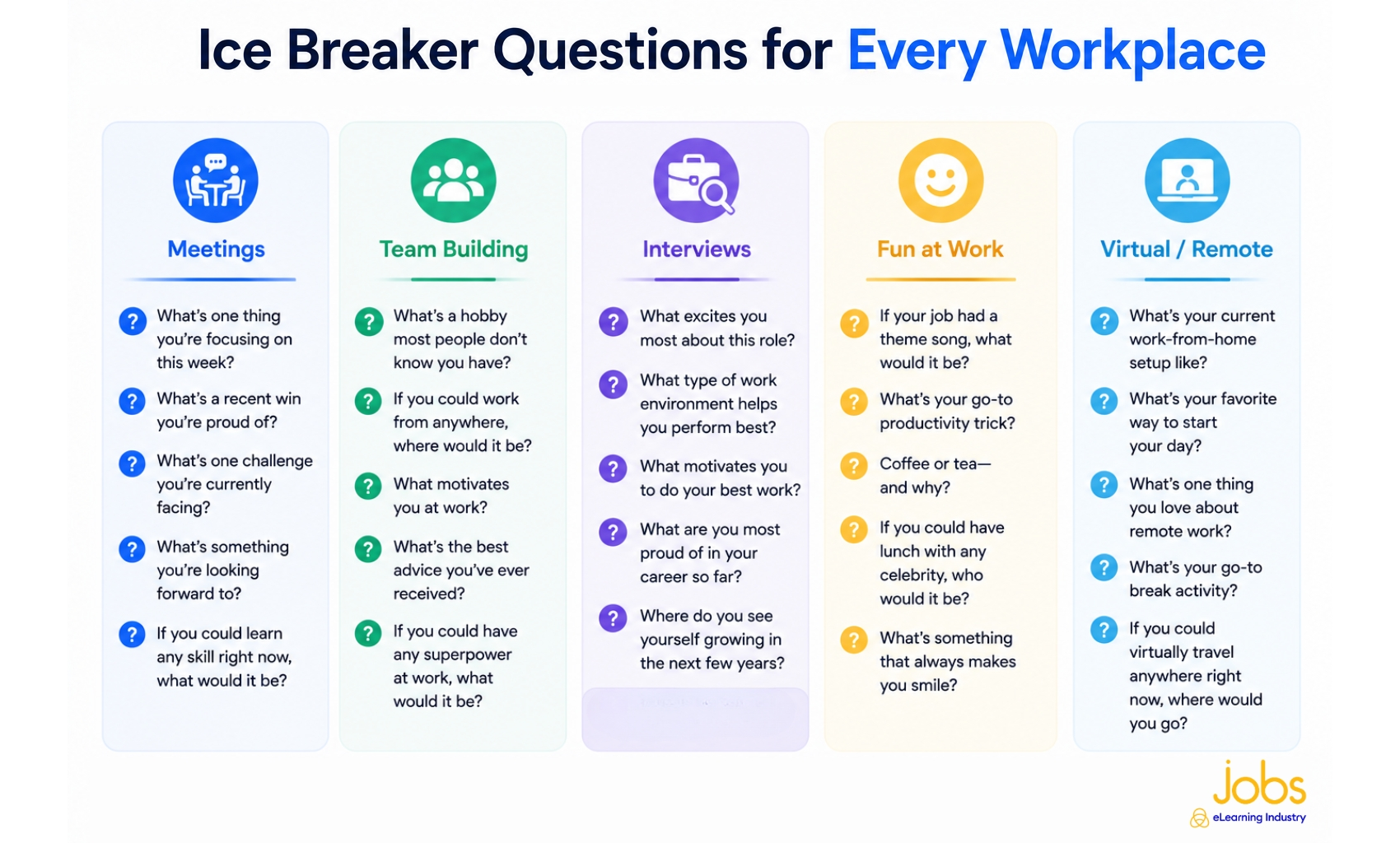
Good icebreaker questions for meetings help teams start conversations naturally and encourage participation early in the discussion. They are especially useful for team check-ins, workshops, brainstorming sessions, and onboarding meetings.
Examples
- What's one thing you're focusing on this week?
- What's a recent win you're proud of?
- What's one challenge you're currently facing?
- What's one skill you want to improve this year?
- What helps you stay productive during busy days?
- What's one thing your team can help you with right now?
- What's the most useful tool you use at work?
- What's one project you're excited about?
- What's your preferred way to organize tasks?
- What's one thing you learned recently?
- What part of your workday is usually the most productive?
- What's one goal you want to achieve this month?
Icebreaker Questions For Team Building
Team-building icebreaker questions can help employees feel more comfortable around coworkers and encourage stronger collaboration. The best team-building questions are simple, inclusive, and easy to answer in group settings.
Examples
13. What's a hobby most people don't know you have?
14. If you could work from anywhere, where would it be?
15. What motivates you at work?
16. What's your favorite way to relax after work?
17. What's a skill you would love to learn?
18. What's your ideal work environment?
19. What's the best team project you've worked on?
20. What's one thing that helps you stay motivated?
21. What's a small achievement you're proud of?
22. What type of tasks do you enjoy most?
23. What's your favorite way to collaborate with others?
24. What's one thing you appreciate in a teammate?
Icebreaker Questions For Interviews
Icebreaker questions for interviews help candidates feel more relaxed while providing hiring teams with useful insights into communication style, motivation, and workplace preferences. They can also make interviews feel more conversational and less stressful for both sides. For more preparation tips, interview formats, and common employer questions, you can check out our article here.
Examples
25. What excites you most about this role?
26. What type of work environment helps you perform best?
27. What motivates you to do your best work?
28. What skills are you currently developing?
29. What type of projects do you enjoy most?
30. What's one achievement you're especially proud of?
31. What's your preferred way to receive feedback?
32. What inspired you to apply for this position?
33. What's one professional goal you're working toward?
34. What do you enjoy most about teamwork?
Fun Icebreaker Questions For Work
Fun icebreaker questions for work can make meetings feel more relaxed without becoming distracting or overly personal. These questions work well for informal team sessions, social events, and creative workshops.
Examples
35. If your job had a theme song, what would it be?
36. What's your go-to productivity trick?
37. Coffee or tea—and why?
38. What's the most unusual job you've ever had?
39. What's your favorite work snack?
40. If you could instantly master one skill, what would it be?
41. What's one app you could not work without?
42. What's your ideal four-day workweek schedule?
43. What's the funniest thing that has happened during a meeting?
44. What's one small thing that improves your workday?
Virtual Icebreaker Questions
Virtual icebreaker questions are especially useful for remote and hybrid teams. They help employees connect more naturally during video calls and improve engagement in online meetings.
Examples
45. What's your current work-from-home setup like?
46. What's your favorite way to start your day?
47. What's one thing that helps you stay focused remotely?
48. What's your preferred virtual meeting routine?
49. What's one remote work habit you've developed?
50. What's your favorite background noise while working?
51. What's one benefit of remote work you value most?
52. What's your favorite way to take breaks during the day?
53. What helps virtual meetings feel more engaging for you?
54. What's one productivity tip that works well for remote work?
How To Choose The Right Icebreaker Question
Choosing the right icebreaker questions for work depends on the context, the group, and the goal of the interaction. Not every question works in every situation, so relevance is key when using icebreaker questions for work in meetings, interviews, or team settings. For example, ice-breaker meetings should focus on current work topics, while interview settings require more professional, insight-driven prompts.
A simple way to choose effective icebreaker questions is to first match the context. In structured meetings, use meeting icebreakers that connect to goals or progress updates. In contrast, team building questions can be more personal but still work-appropriate. Always keep relevance in mind so the conversation feels natural and not forced.
Strong communication skills are essential across many L&D and eLearning roles, from Instructional Design to Learning Experience design. If you're exploring how these skills apply in real job contexts, you can discover roles where communication and collaboration are key requirements.
Tips For Using Icebreakers Effectively At Work
Using icebreaker questions effectively at work is not about quantity but about consistency and tone. The goal is to make communication easier without disrupting workflow or making participants uncomfortable.
- Keep them short. For best results, keep icebreaker questions short and easy to answer. Long or complex prompts reduce participation and can slow down meetings.
- Avoid personal questions. Also, avoid overly personal topics, especially in professional environments, as they may make participants uncomfortable.
- Use them consistently. When using icebreaker questions for work, consistency matters. Use them regularly in meetings, but avoid pressuring anyone who prefers to pass. This helps maintain a positive and inclusive environment across teams.
- Leverage them for boosting engagement. Good icebreaker questions also improve engagement in virtual and hybrid settings. In remote teams, simple prompts help reduce silence and encourage participation, especially when team members are less familiar with each other. Over time, this practice supports stronger communication habits and better collaboration across teams.
- Align icebreaker questions with goals. Ultimately, the best approach is to align icebreaker questions with your audience and desired outcome. Whether you are running meetings, interviews, or workshops, the right question can set the tone for better communication and engagement.
- Keep them simple. In the context of icebreaker questions for work, choosing simplicity over complexity usually leads to better participation and more meaningful conversations across teams. This is especially important when using icebreaker questions in meetings or when introducing new team members. The goal is always to create a sense of comfort and encourage open dialogue without pressure.
Icebreaker Questions To Avoid
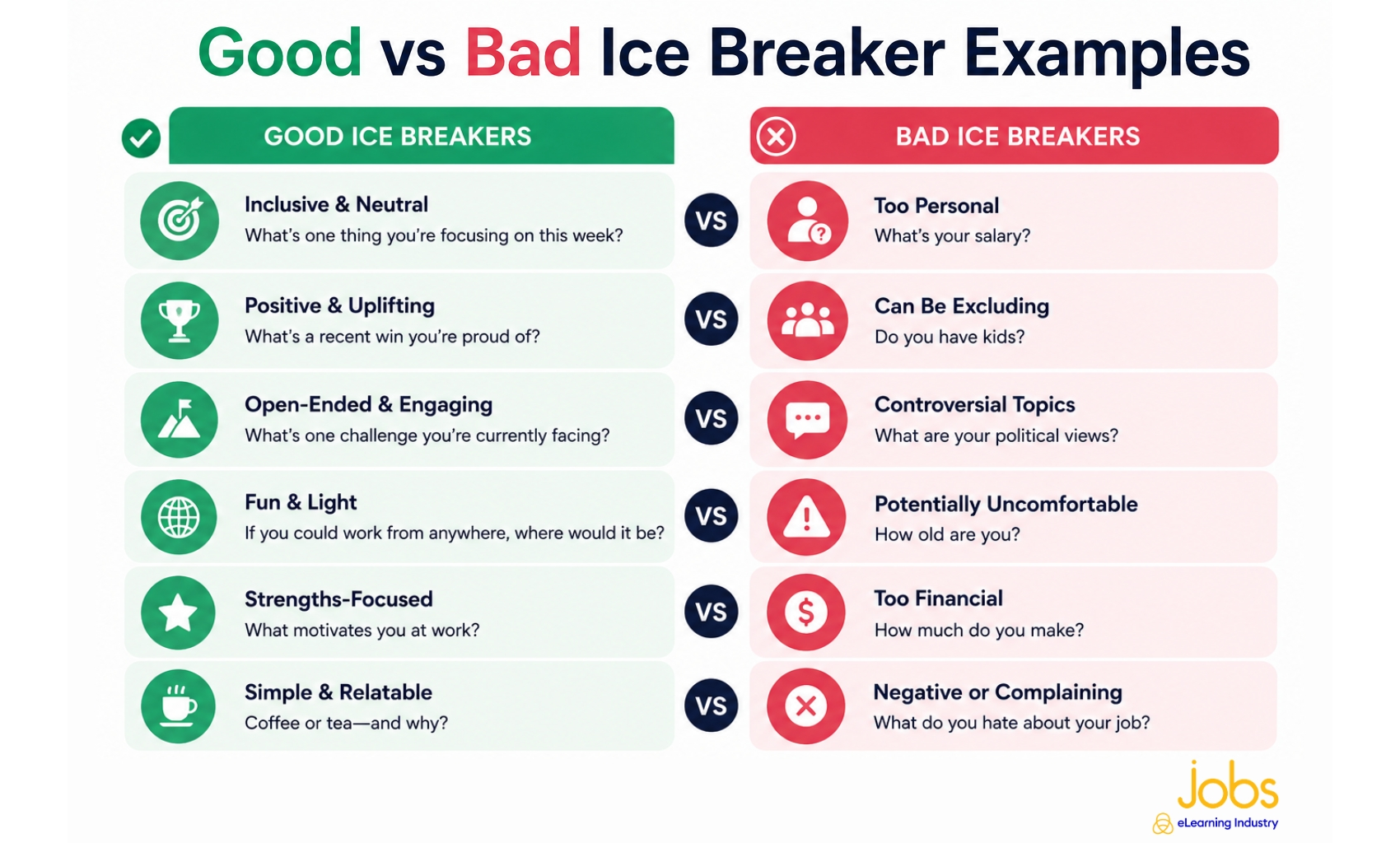
Not all icebreaker questions for work create a positive experience. Some can feel uncomfortable, confusing, or even slow down the flow of a meeting. Knowing what to avoid is just as important as knowing what to ask when using icebreaker questions for work in professional settings.
- Personal questions. One common mistake is asking questions that are too personal. While icebreaker questions should encourage connection, they should never cross boundaries or make participants feel exposed.
- Complex questions. Another issue is complexity. If icebreaker questions are too difficult to understand or require long explanations, they lose their purpose and reduce engagement. This is especially important when using icebreaker questions for meetings, where time is limited.
- Time-consuming questions. Meeting icebreakers should be quick and easy to answer so as not to disrupt the agenda. Overly long discussions can frustrate participants and reduce productivity.
- Awkward questions. If a question feels unnatural or unrelated to the work environment, it can create discomfort rather than improve communication.
Ultimately, the goal of icebreaker questions for work is to support communication, not complicate it. Choosing the right tone and level of depth ensures that conversations remain natural and productive across teams. Avoiding these mistakes helps ensure that icebreaker questions for work remain effective, respectful, and engaging in all professional environments.
Use Icebreakers To Build Stronger Workplace Communication
Icebreaker questions for work can play a meaningful role in strengthening workplace communication and supporting long-term career growth. When used intentionally, they help employees practice clear expression, active listening, and confidence in group settings. Simple icebreaker questions encourage people to share ideas without pressure, which improves communication skills over time. In team environments, they also support smoother collaboration by fostering more open and inclusive conversations. Whether used as meeting icebreakers or informal team-building questions, they help reduce hesitation and create a more connected workplace culture.
Beyond improving communication skills, icebreaker questions for work also contribute to stronger collaboration and career development. Regular use of icebreaker questions helps teams build trust, which is essential for effective teamwork and problem-solving. In meetings, icebreakers can set a positive tone and encourage participation from all members, including quieter voices. Over time, this creates a more supportive environment where ideas flow more freely, and team performance improves. For individuals, these interactions can also support career growth by improving confidence, adaptability, and interpersonal skills. In both remote and in-person settings, well-chosen team-building questions ensure communication remains consistent and productive throughout the workplace.
Stay updated with the latest opportunities in eLearning, L&D, and Instructional Design by getting relevant roles delivered directly to you. Setting up alerts helps you act faster when new positions match your skills and interests.