What Employers Look For In Instructional Designer Interviews
Instructional Design interviews go far beyond a checklist of tools or software know-how. While familiarity with authoring platforms and learning technologies matters, employers are mainly evaluating how you think. What's your approach to solving learning problems? What's your design process? How has your work achieved the desired impact? In short, they want to understand how you analyze needs, structure content, apply learning theory, and measure success, not just what tools you use to build courses. This is what makes Instructional Design interviews very different from many other roles. Instead of focusing solely on past tasks or technical skills, these interviews often explore your decision-making, your ability to collaborate with stakeholders, and how you adapt solutions to different audiences and resource limitations. So, if you're wondering what employers will ask and if you're ready for your next interview, this guide covers Instructional Designer interview questions and sample answers that will help you frame your experience the right way and demonstrate the real value you bring as an ID pro.
Key Takeaways
- Instructional Designer interviews focus on process, problem-solving, and learning outcomes.
- Employers expect candidates to explain their design decisions clearly.
- Behavioral and portfolio-based questions are common.
- Structured answers using real examples improve interview performance.
How Instructional Designer Interviews Are Different
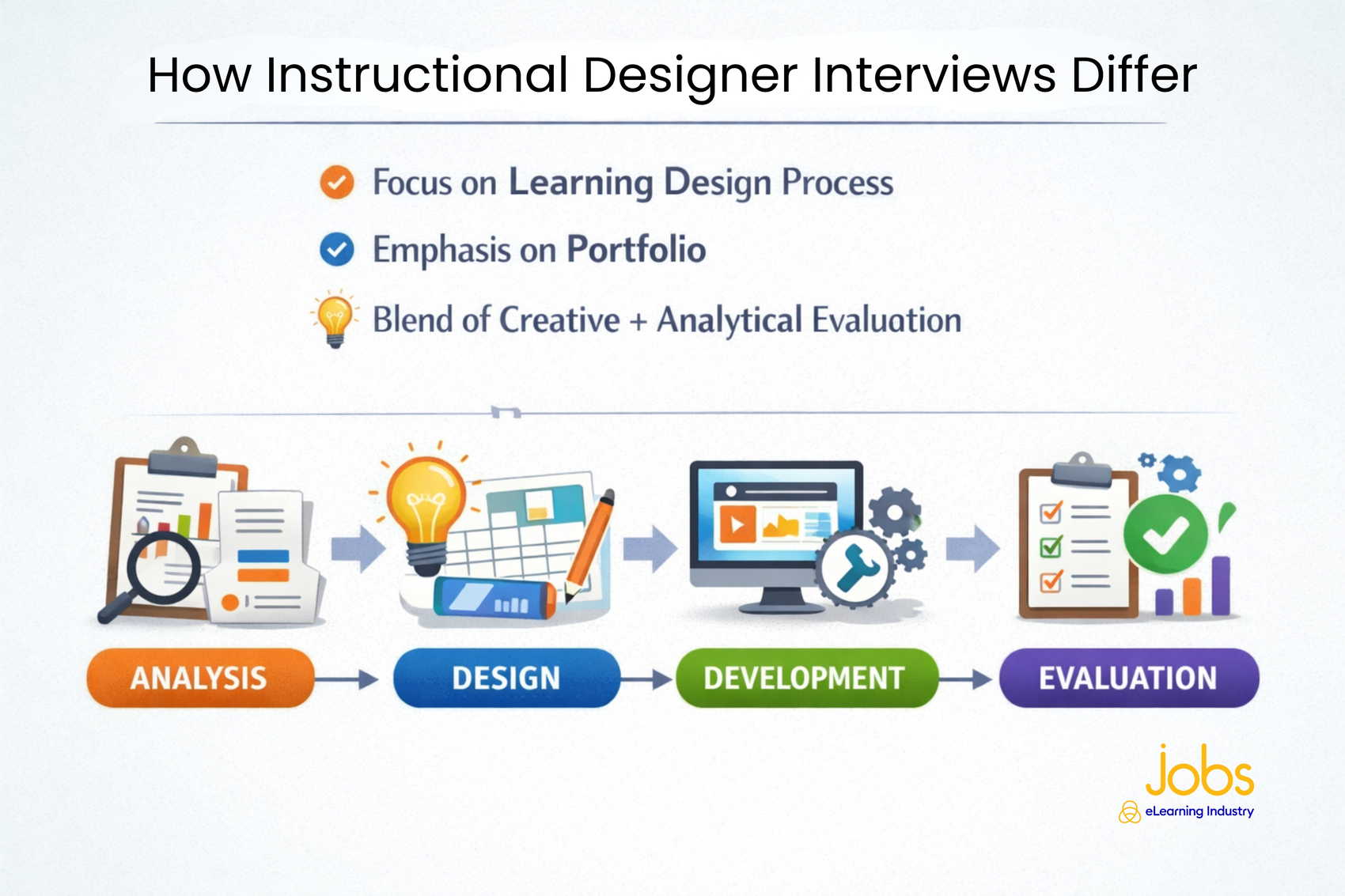
Instructional Designer interviews stand apart from many traditional job interviews because they focus less on what you know and more on how you design learning experiences. Employers are usually interested in your process. It's not just about delivering information, but about creating meaningful, measurable learning outcomes.
One of the main reasons why they are so different is the emphasis on your portfolio. Rather than relying solely on resumes or verbal responses, hiring managers expect you to showcase real examples of your work, which involves Instructional Design portfolio interview questions. They'll often ask you to talk them through specific projects, explain your decisions, and reflect on challenges or trade-offs you had to make. Your ability to clearly explain your design thinking in Instructional Design interview answers is just as important as the final product itself.
These interviews also blend creative and analytical evaluation. They might assess your ability to craft engaging learning experiences while also showing logical reasoning, data-backed decisions, and tying it all into business goals. In some cases, you might even be given a scenario or task to solve in real time.
 Top Instructional Designer Interview Questions And Sample Answers
Preparing for eLearning interview questions requires more than memorizing answers. When you walk (or log in) to an interview, you must be able to clearly communicate how you think, design, and deliver results. Here are ten of the most common Instructional Designer interview questions, what responses employers are really looking for, and framework examples you can use to create your answers.
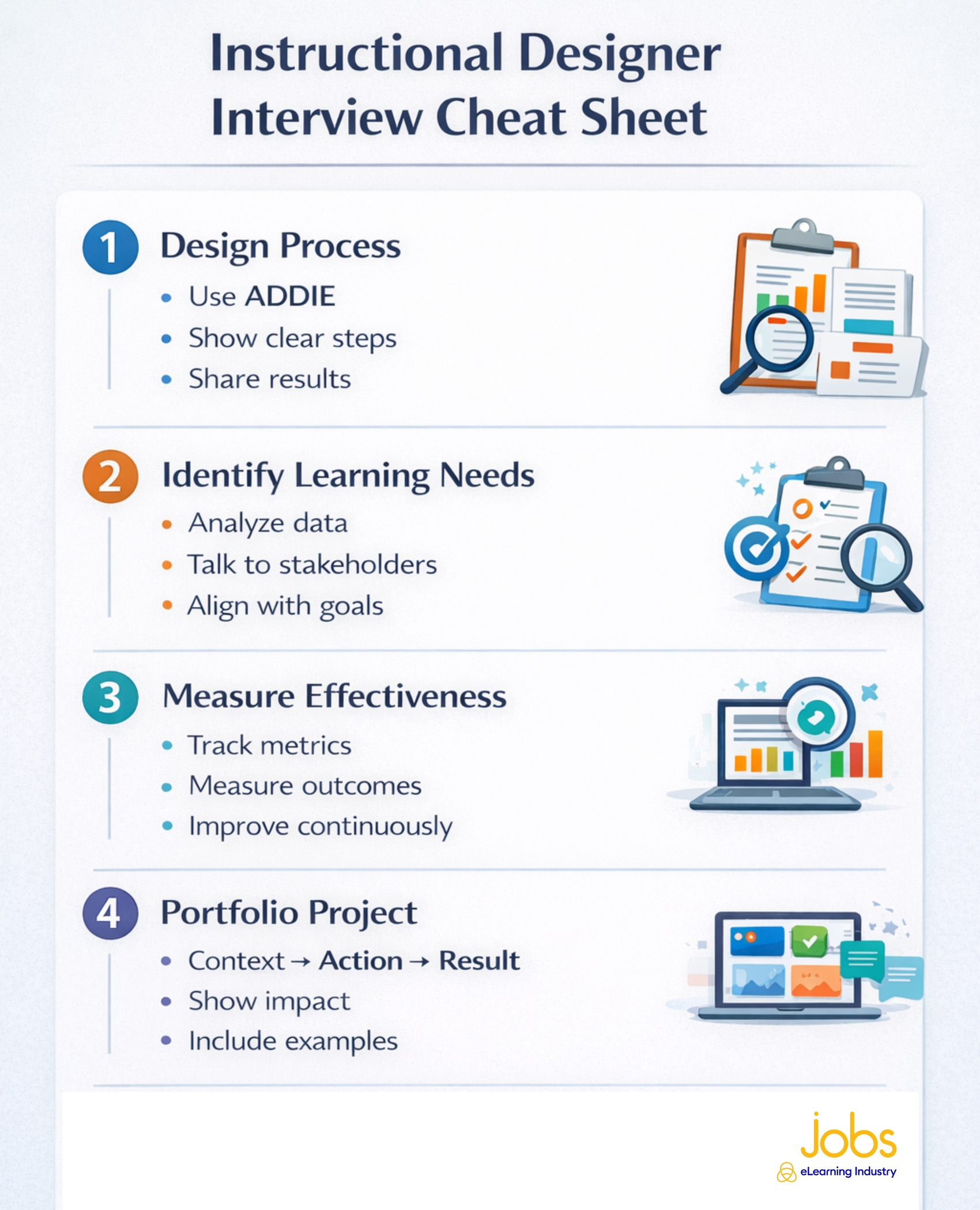
1. Can You Walk Me Through Your Instructional Design Process?
This is one of the most common learning design interview questions, as employers are looking for signs that you have a clear, repeatable approach to solving learning problems. They want evidence that you can move from analysis to evaluation with an adaptable strategy in place. A strong answer demonstrates how you connect each stage of your L&D process to business goals and learner needs. So, it's best to outline your process step by step while still showing that you're flexible.
Sample Answer:
"I follow an adaptable approach that starts with analyzing the audience, their needs, and the business goals. Then I design clear learning objectives and outline the course structure and strategy. In the development stage, I create content using tools like X or Y. After that, I implement the training through the LMS platform. Finally, I measure effectiveness using learner feedback and performance data to continuously improve the experience and adjust the strategy based on evolving organizational needs."
2. How Do You Identify Learning Needs?
This Instructional Design interview question focuses on your ability to conduct a thorough needs analysis. Employers expect you to gather and interpret data, collaborate with stakeholders, and distinguish between training and non-training problems they're facing. Your response should show how you translate findings into actionable learning objectives.
Sample Answer:
"I start a needs analysis by gathering data through interviews, surveys, and performance metrics. Next, I determine whether the issue is a training gap or something else, such as a process issue. I collaborate with stakeholders, including managers and SMEs, to align on goals. Then, I define measurable learning objectives that address the gaps we've already identified."
3. How Do You Measure The Effectiveness Of A Learning Program?
Here's when employers are evaluating your ability to connect learning to actual results. They want to see that you define success using clear metrics and track both quantitative and qualitative data. Strong answers highlight how you use insights to improve future learning experiences and reach the best outcomes.
Sample Answer:
"I define success metrics upfront, such as completion rates, assessment scores, and behavior change. I track both quantitative data through LMS analytics and qualitative feedback from learners and stakeholders. Then, I analyze this data to spot trends and make improvements in order to ensure that the program hits the KPIs and addresses emerging gaps."
4. Tell Me About A Project In Your Portfolio
This Instructional Designer interview question tests your ability to communicate your work through storytelling. Employers are looking for clear and concise responses that describe the problem, your role, and the impact of your solution. Demonstrating measurable results and reflection is the main goal.
Sample Answer:
"In one project, the goal was to improve onboarding for new employees who were struggling to meet performance expectations. I designed a blended learning program that included eLearning modules and hands-on activities. As a result, we reduced onboarding time by 25% and improved learner engagement. This experience taught me the importance of connecting learning solutions with practical on-the-job tasks."
5. How Do You Handle Feedback From Stakeholders?
Collaboration is essential in Instructional Design. Employers want to know that you can accept feedback professionally, manage differing opinions, and keep team projects aligned with organizational goals. Your answer to this behavioral interview question for Instructional Designers should reflect strong communication, conflict resolution, and decision-making skills.
Sample Answer:
"I view feedback as a valuable part of the design process. I prioritize input based on how much it aligns with learning objectives and business goals. When there's conflicting feedback, I open discussions to identify the top priorities and find common ground. I also ensure clear communication so that stakeholders stay informed and we're able to be proactive about any issues that may arise."
6. What Instructional Design Models Do You Use?
Employers are interested in your familiarity with ID models and your ability to apply them in real development projects. Rather than rigidly following a single design framework for every eLearning initiative, you need to demonstrate that you are adaptable and know when to use structured approaches versus more agile methods.
Sample Answer:
"I typically use ADDIE for more structured projects where clear phases are helpful, and SAM for projects that require a more flexible, iterative approach. I choose the model based on the project timeline, complexity, and stakeholder expectations."
7. What Tools Do You Use For eLearning Development?
While eLearning tools are not the primary focus of the Instructional Designer interview, employers still expect you to be comfortable with industry-standard platforms. More importantly, they want to understand how you select tools based on project needs and use them to achieve the learning outcomes.
Sample Answer:
"I use authoring tools like A and B to create interactive content, and the X LMS platform to deliver and track learning. I also use multimedia tools for visuals and, when needed, AI tools to streamline content creation and automate certain workflows."
8. How Do You Design Engaging Learning Experiences?
This Instructional Designer interview question gauges your ability to create learner-centered designs. Employers look for evidence that you consider audience needs, know how to incorporate interactive and immersive elements, and can design experiences that are both engaging and effective.
Sample Answer:
"I focus on learner-centered design by making content relevant, practical, and easy to apply. I incorporate interactive elements like scenarios, quizzes, and real-world examples to increase engagement. I also use multimedia and chunk content to improve knowledge retention and prevent cognitive overload."
9. Describe A Challenge You Faced In A Learning Project
Employers want insight into your problem-solving abilities and how you navigate obstacles, make decisions under pressure, and achieve results. Clear, structured storytelling using the STAR method is usually the best approach.
Sample Answer:
"In one project, I had to deliver training within a very tight timeline. I prioritized key learning objectives and worked closely with SMEs to streamline content development. As a result, we were able to launch on time and received positive feedback from learners."
 10. Why Do You Want To Work As An Instructional Designer?
Employers want to assess your motivation and long-term fit for the role. This Instructional Designer interview question helps them determine if you have a genuine interest in learning design, if your skills align with the role, and whether you're driven without being overly ambitious.
Sample Answer:
"I'm passionate about creating meaningful learning experiences that help people grow and achieve their full potential. Instructional Design gives me the opportunity to combine creativity, problem-solving, and technology. My experience and skill set align with your company's goals, and I'm looking for a career wherein I can continue to broaden my knowledge."
Common Instructional Designer Interview Mistakes
One mistake that many candidates make with Instructional Designer interview questions is focusing too heavily on tools. While it's important to be familiar with authoring software and platforms, employers are more interested in how you think and design. Simply listing tools without explaining how or why you used them can make your experience feel surface-level.
Another common misstep is failing to explain your decisions. Instructional Design is a strategic role, and interviewers want to understand the reasoning behind your choices. For example, if you describe what you created but not why you chose a particular approach, you miss the opportunity to demonstrate your problem-solving ability. Not to mention, your knowledge of learning principles that are required for the job.
Weak portfolio storytelling is another thing to avoid in interviews. Many candidates walk through their work without clearly outlining the problem, their role, and the outcome. This makes it difficult for employers to see the value you bring and how you can actually apply all of your experience and skills in design projects.
Lastly, not including measurable results might hurt your chances of getting hired. Employers want to understand the impact of your work. Did it increase learner engagement or solve a specific performance problem? Without clear outcomes, hiring managers might not be able to see how your design methodologies made a real-world impact.
How To Prepare For An Instructional Designer Interview
Preparing for an Instructional Designer interview requires more than just brushing up on models or updating your CV. You need to focus on how you present their work, explain your thinking, and connect your experience and skills with the organization's needs.
Review Your Portfolio Strategically
Rather than assuming your work will speak for itself, be prepared to walk interviewers through selected projects in your Instructional Designer interview answers. Choose examples that demonstrate a broad range of skills, such as needs analysis, content design, and evaluation, and be ready to explain each one in more detail. Structure your walkthroughs around the problem, your solution, and the outcome. What challenge were you solving? Why did you choose a particular approach? What results did the learning experience achieve? Even if you don't have formal metrics on hand, you can still cover learner feedback, behavior changes, or improvements in performance. This outcome-focused approach shows them that you design with purpose, not just visual appeal.
Practice Explaining Your Design Process
Many candidates make the mistake of relying too heavily on jargon when responding to Instructional Design interview questions, which can make answers feel vague or unnecessarily technical. Instead, describe your process in straightforward terms and go through real examples from your own experience. For instance, instead of simply naming a model, explain how you identified learner needs, collaborated with stakeholders, and fine-tuned your design accordingly. This helps interviewers understand how you actually think and work.
Research The Role And Company
Generic answers can make even experienced candidates seem unprepared and uninterested in the role. Research the organization's goals, audience, and learning challenges, and review the job description carefully to identify the key skills and responsibilities. Then, customize your examples to show how your experience aligns with those specific needs and job expectations. For instance, if the company emphasizes onboarding in their job listing, highlight projects where you supported new hires and helped streamline the initial training process.
 How To Structure Strong Interview Answers
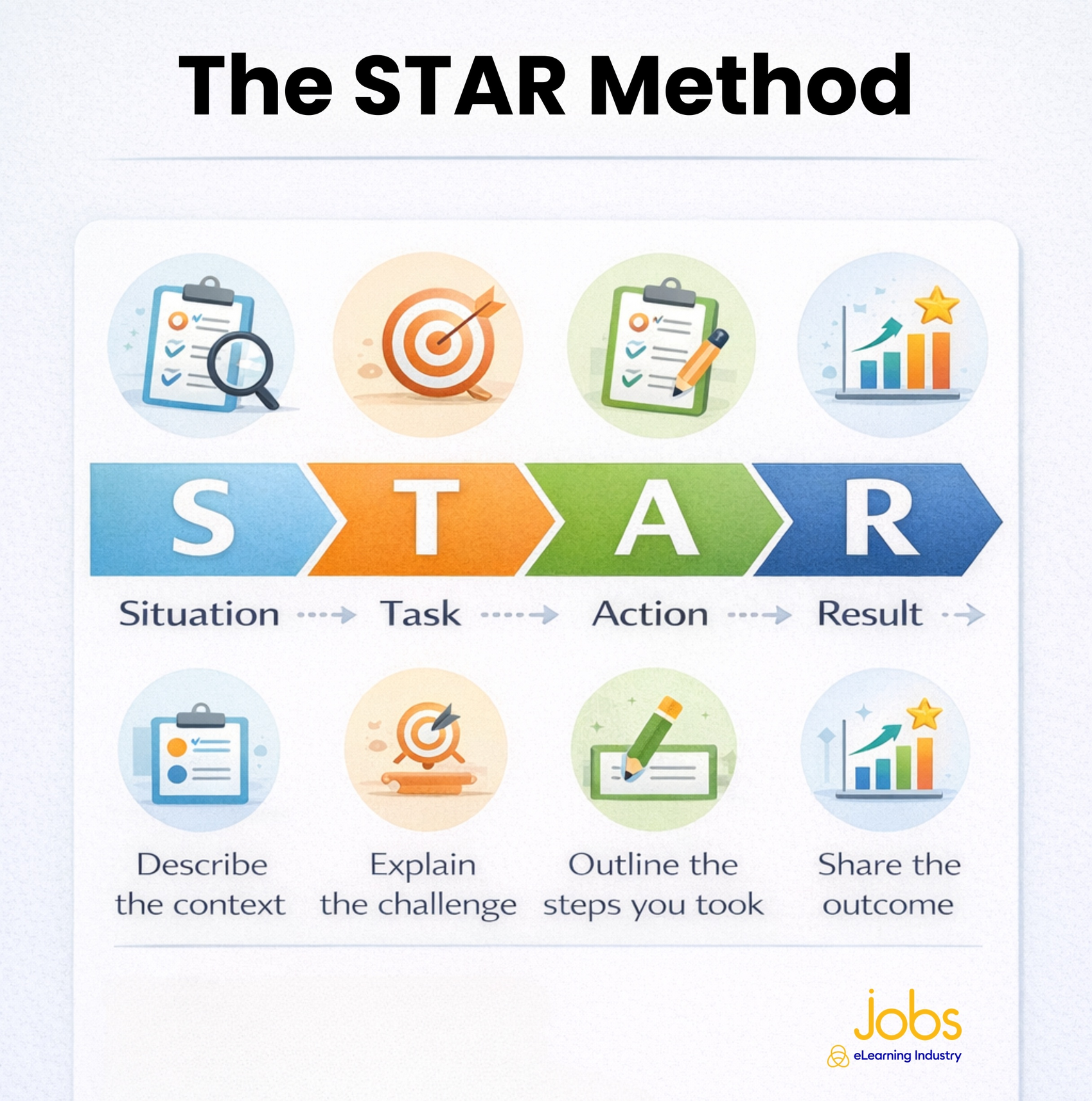
One of the best ways to structure your answers to ID interview questions is using the STAR method (Situation, Task, Action, and Result). This helps you organize your thoughts and ensure that your response covers the essentials without going off on tangents. Start by briefly describing the situation to provide context, then explain the task or challenge you were responsible for addressing. Then move on to the actions you took, focusing on your specific contributions, before sharing the result of all your hard work.
It's also important to emphasize outcomes in your responses. Instructional Design is ultimately about solving problems and improving performance, so interviewers want to understand the impact you've made. When possible, include measurable results such as increased course completion rates, improved assessment scores, and reduced training time. If exact numbers aren't available, describe improvements you observed or stakeholder feedback. For example, instead of saying you "developed an eLearning module," explain how that module bridged a performance gap and how the organization benefited from it. Outcome-based responses show that you think strategically and understand the real purpose behind your designs.
Keeping your answers concise is another top tip. Long, unfocused responses can make it difficult for interviewers to follow your main points. Try to deliver answers that are clear and to the point (aim for no more than 2 minutes). Focus on the most relevant details and leave out unnecessary background info. Practicing your responses in advance can help you fine-tune your delivery and spot areas where you tend to over-explain. It's also a good idea to pause briefly after each answer so that the interviewer has time to ask follow-up questions.
How To Find Instructional Designer Jobs And Start Applying
Finding and applying for Instructional Designer jobs starts by matching roles to your specific skills rather than submitting your CV to every opening. While some job listings emphasize eLearning development, others might focus on curriculum design or learning strategy. So, carefully review job descriptions and look for positions that tie into your strengths, such as tools you've used, industries you've worked in, or types of learning experiences you've created.
Preparation is just as important when you're applying. Tailor your resume to highlight relevant achievements, and make sure your portfolio clearly demonstrates your design process and results. You need to be able to show how your work solves real learning problems, not just what you created.
Last but not least, stay updated with new opportunities by setting up job alerts, regularly checking job boards, and staying in the loop by joining online L&D communities. Many roles are filled quickly, so being one of the first applicants can make a big difference. By combining targeted applications, customized CVs, and keeping up with new openings, you can get a head start on your job search and use all of the Instructional Designer interview question tips above to land your next role. So, why wait? Create an account and set job alerts so that you don't miss out on the right ID role for you!