

Why Employers Ask About Your Reasons For Leaving The Company In Your Previous Role
Hiring managers ask about your reasons for leaving the company to understand your career decisions and how you handle change. It is not a trick question. Most employers expect people to move on for various reasons, especially in fast-evolving fields like eLearning and EdTech.
What they are looking for is context, not personal conflict or detailed backstories. A clear, professional explanation helps them see whether your goals align with the role and whether your transition makes sense. In a typical interview, your answer about your reasons for leaving a job helps employers evaluate three things:
- Your professionalism and communication style
- Your motivation for applying
- Any potential risks (such as frequent job changes or unresolved issues)
They are not expecting a perfect answer. They are looking for a reasonable one. When you understand this, it becomes easier to explain why you left your last job in a way that feels honest, relevant, and safe.
Key Takeaways
- Employers want honest but professional explanations.
- Positive, forward-looking answers work best.
- Avoid negativity or blaming previous employers.
- Preparing your answer in advance improves confidence.
Best Reasons For Leaving A Job (With Examples)
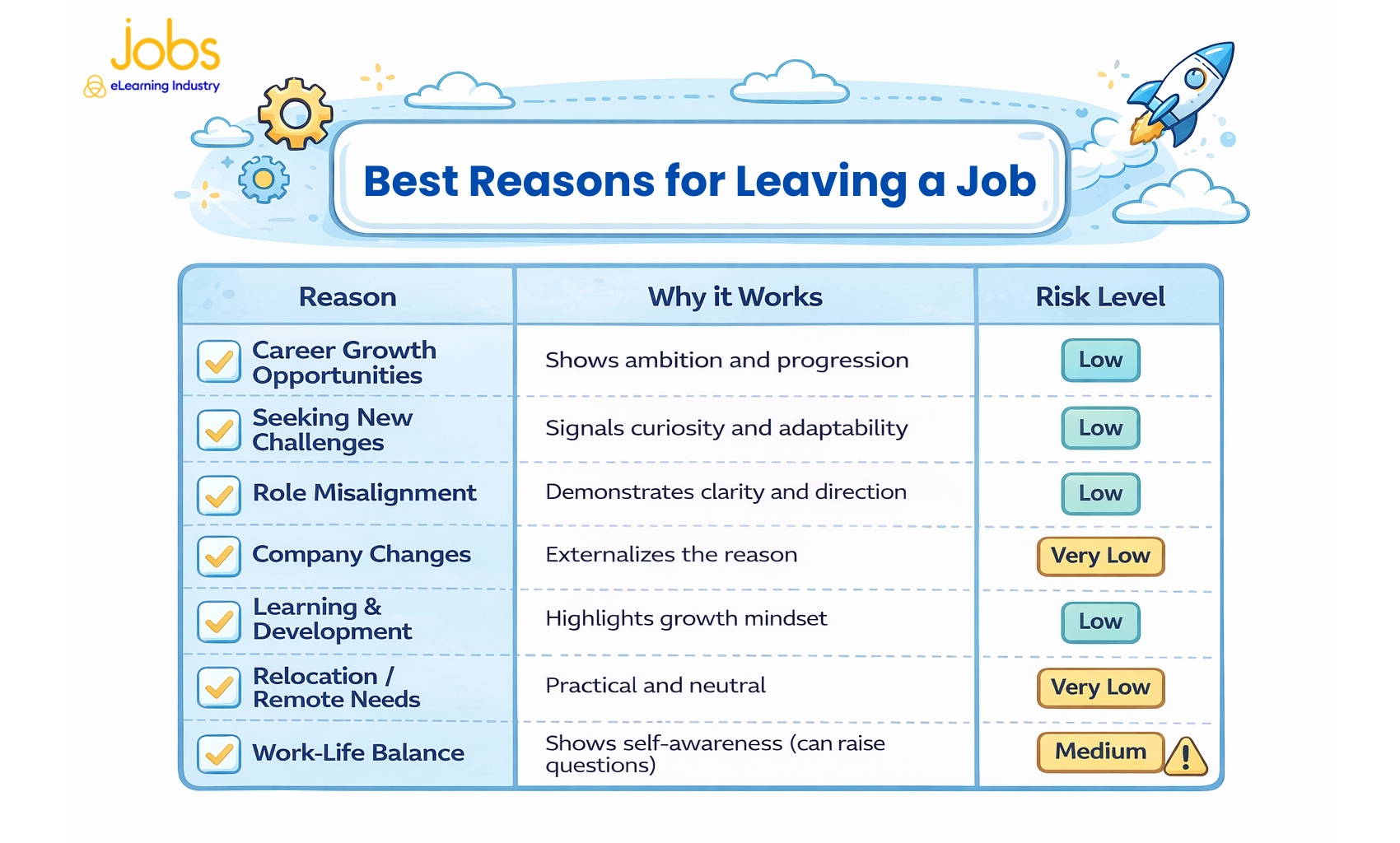
When preparing your answer to the question of your reasons for leaving a job, the key is to stay structured, neutral, and forward-focused. Employers don't expect a long explanation. They expect a clear, professional reason that shows stability and intent. Below are the best reasons for leaving a job you can use in interviews, along with safe, copy-ready examples.
1. Career Growth Opportunities
This is one of the most widely accepted professional reasons for leaving a job. It signals ambition without negativity.
Why it works: Employers see growth-minded candidates as motivated and long-term assets.
Sample answer: "I'm looking for opportunities to grow and take on more responsibility in my career."
This is especially strong in eLearning and L&D roles, where progression often involves expanding skills or taking on more strategic responsibilities.
2. Seeking New Challenges
This reason is useful when your previous role became repetitive or limited in scope.
Why it works: It shows you are engaged and want to stay challenged, not disengaged.
Sample answer: "I'm looking for new challenges where I can continue developing my skills and contribute in a more impactful way."
This is a common interview response to the question of why you left your job, especially for mid-level professionals who have mastered their previous responsibilities.
3. Role No Longer Aligned With Career Goals
Sometimes your career direction changes over time. This is a valid and respected explanation.
Why it works: It shows intentional career planning rather than reactive job changes.
Sample answer: "My long-term career goals have evolved, and I'm now focusing on roles more aligned with learning design and development."
This is one of the good reasons for leaving a job when transitioning into eLearning or Instructional Design.
4. Company Restructuring Or Changes
Organizational changes are common and widely understood by employers.
Why it works: It removes personal blame and focuses on external change.
Sample answer: "My previous company went through restructuring, and my role was affected as a result."
This is one of the safest reasons for leaving the company because it is factual and non-emotional.
5. Learning And Development Opportunities
This reason is especially relevant in the L&D and EdTech space.
Why it works: It directly connects your motivation to skill-building and growth.
Sample answer: "I'm looking for a role that offers stronger L&D opportunities to help me grow in my field."
This is a highly effective example when discussing reasons for leaving a job in career progression contexts, particularly for Instructional Designers and learning specialists.
6. Relocation Or Remote Work Needs
Logistical reasons are straightforward and easy for employers to accept.
Why it works: It is practical and avoids any performance-related interpretation.
Sample answer: "I relocated to a new area and needed to find a role that fits my current location and working arrangements."
This is one of the most neutral professional reasons for leaving a job, especially in global or remote-first companies.
7. Work-Life Balance
This reason should be carefully framed, but it remains valid when kept professional.
Why it works: It shows awareness of sustainability and productivity.
Sample answer: "I'm looking for a role that offers a healthier work-life balance while still allowing me to contribute effectively."
This works best when combined with performance or workload context, not as a complaint.
 Reasons For Leaving A Job You Should Avoid Mentioning
When preparing your answer for reasons for leaving the company, what you choose not to say is just as important as your actual response. Many candidates lose credibility in interviews, not because of their reasons, but because they explain them in a negative or emotional way.
Hiring managers do not expect perfect career paths, but they do look for professional communication and emotional control. Some explanations can make them worry about your attitude, how you handle conflict, or whether you are a good long-term fit.
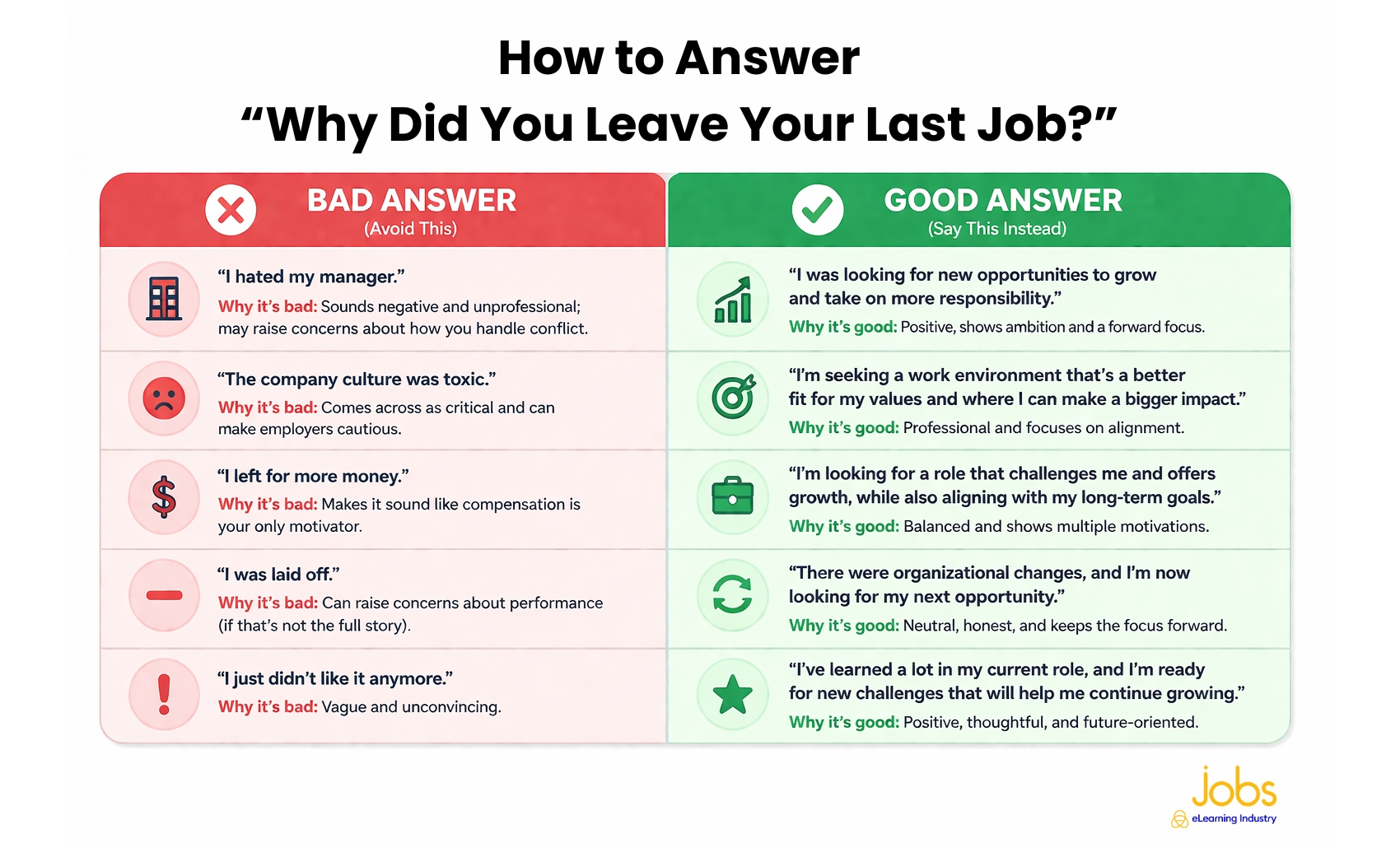
Below are reasons for leaving a job you should avoid mentioning directly, along with safer ways to reframe them.
Conflict With A Manager Or Team
Talking about conflict with a manager or team is a sensitive subject in interviews. Even if your reasons were valid, bringing it up directly might make employers question your teamwork or adaptability.
Why avoid it: It can suggest difficulty working with others or managing disagreements professionally.
Better approach (reframe): Instead, talk about differences in working style or direction, rather than making it personal.
Example: "I realized I work best in environments where communication and decision-making processes are more structured."
This way, your answer stays neutral and avoids placing blame, but still explains your professional reasons for leaving a job.
Disliking The Company Or Culture
Speaking negatively about a previous employer is one of the fastest ways to weaken your interview performance.
Why avoid it: It shows negativity and may raise concerns about how you will speak about future employers.
Better approach (reframe): Try to focus on finding a better fit rather than saying you disliked the company.
Example: "I'm looking for a workplace culture that aligns more closely with collaborative L&D environments."
This approach lets you explain your reasons for leaving a job in a more positive and constructive way.
Burnout Or Exhaustion
Burnout is a real experience, but it must be handled carefully in interviews.
Why avoid it: It may suggest poor workload management or an inability to handle pressure.
Better approach (reframe): Instead, talk about wanting a better balance or a job where you can perform well over the long term.
Example: "I'm looking for a role where I can maintain consistent performance and long-term productivity in a balanced way."
This reframing is especially useful when answering the question "Why did you leave your last job?" without sounding reactive.
Salary Complaints
Talking about money as the main reason for leaving can hurt your chances, even if pay was a factor.
Why avoid it: It can make you appear financially motivated rather than career-focused.
Better approach (reframe): Instead, connect your pay expectations to your growth, responsibilities, or what's standard in the market.
Example: "I'm looking for a role that reflects my current level of experience and responsibilities."
This is a much stronger way to present reasons for leaving a job without sounding transactional.
How To Answer "Why Did You Leave Your Last Job?"
When preparing for a job interview, your answer to "Why did you leave your last job?" is one of the most important moments in the conversation. Employers are not trying to challenge you. They want to see if you are clear, professional, and if your story matches the job you are applying for.
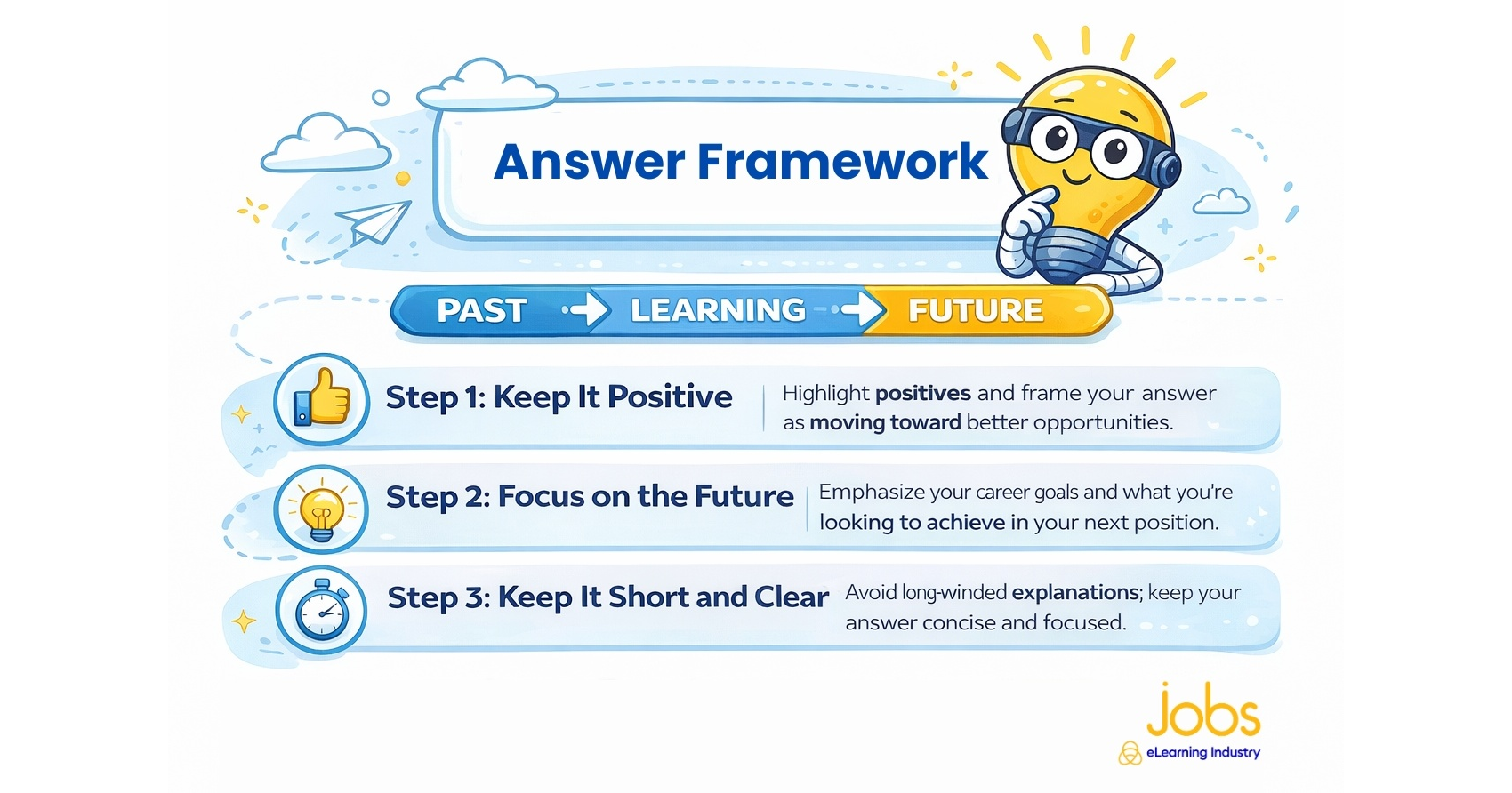
A strong answer should be simple and clear, calm, well-organized, and focused on the future. Use this basic framework to explain your reasons for leaving a job in a way that builds trust and confidence.
Step 1: Keep It Positive
The first rule in any answer about reasons for leaving the company is to avoid negative framing. Even if your experience was difficult, your response should focus on what you learned or what you are moving toward.
Why this matters: Positive framing shows that you are emotionally mature and professional. Employers look for candidates who can manage changes without being negative.
What to do:
- Avoid criticism of managers or companies.
- Avoid emotional language.
- Focus on neutral or constructive explanations.
Example approach: "I enjoyed my time in the role and learned a lot, but I'm now looking for a position that better aligns with my long-term goals."
This is one of the most effective reasons for leaving a job because it is calm and balanced.
Step 2: Focus On The Future
Strong answers about reasons for leaving a job in an interview are forward-looking. Employers care less about where you were and more about where you are going.
Why this matters: It connects your past experience to the opportunity you are applying for and shows career direction.
What to do:
- Link your answer to skills or goals.
- Mention what you are looking for next.
- Avoid talking too much about the past role.
Example approach: "I'm looking to move into a role where I can focus more on Instructional Design and contribute to larger learning projects."
This is especially relevant in eLearning and L&D roles, where growth and specialization are key themes in professional reasons for leaving a job.
Step 3: Keep It Short And Clear
One of the most common mistakes in an interview is over-explaining. The more detail you give, the higher the risk of sounding uncertain or defensive.
Why this matters: Clarity builds confidence. A short answer feels more intentional and controlled.
What to do:
- Keep your response under 2–3 sentences.
- Avoid unnecessary background details.
- End your answer cleanly without over-justifying.
Example approach: "I left my previous role because I was looking for new challenges that align more closely with my career direction in learning and development."
This is a strong example of how to answer the question "Why did you leave your last job?" without oversharing.
If you are currently preparing for interviews, it can help to explore active job opportunities in your field. Reviewing real job descriptions will make it easier to refine your answers and align your experience with what employers are looking for.
 Best Answers By Situation
When preparing your response for reasons for leaving the company, context matters. However, there is no single correct answer. Instead, the best response depends on your situation. Employers are not judging the event itself as much as how you explain it.
Below are structured, safe answers for the most common scenarios job seekers face when explaining reasons for leaving a job.
If You Were Laid Off
Being laid off is one of the most straightforward situations, but it still needs a clear and calm explanation.
Best answer example: "My previous role was impacted by company-wide restructuring, and my position was affected as part of that change."
This is one of the strongest professional reasons for leaving a job because it removes personal responsibility and keeps the explanation neutral.
Tip: Avoid adding emotional detail or trying to justify performance unless specifically asked.
If You Quit Without Another Job
This situation requires careful framing, as employers may want reassurance about stability.
Best answer example: "I decided to leave my previous role to take time to reassess my career direction and focus on opportunities that align better with my long-term goals."
This is a safe way to explain why you left your last job without sounding uncertain or reactive.
Tip: Always connect your break or transition to intentional career planning, not frustration.
If You Were Fired
This is the most sensitive scenario, but it can still be handled professionally if kept brief and neutral.
Best answer example: "My previous role wasn't the right fit, and after that experience, I took time to reflect and focus on roles that better match my strengths in learning and development."
This reframes the real reason into a growth-oriented explanation rather than a negative event.
Tip: Never blame the employer or go into a detailed conflict.
If You're Changing Careers
Career transitions are very common in eLearning, especially for Instructional Design, L&D, and EdTech roles.
Best answer example: "I'm transitioning into L&D because I want to focus on creating structured learning experiences and applying my skills in a more educational context."
This is one of the most positive reasons for leaving a job, especially when shifting into a new field.
Tip: Always connect past experience to future relevance.
 What Recruiters Really Want To Hear
Many candidates think they need a flawless explanation for their reasons for leaving the company they worked for. But recruiters are not expecting perfection. In interviews, they want to see how you think, communicate, and manage career changes. In eLearning, L&D, and EdTech, hiring managers usually care more about these qualities than the exact reason you left your last job.
Professionalism
Recruiters want to see that you can describe past experiences without negativity. Even if your previous role was challenging, your ability to stay neutral matters more than the details. Professional answers to reasons for leaving a job interview are:
- Clear and factual
- Free from blame
- Focused on work, not emotions
This builds trust quickly and shows you can represent a company professionally in future roles.
Self-Awareness
Strong candidates understand why they made career decisions and can explain them simply. Self-awareness sounds like:
- Understanding what didn't fit
- Recognizing what you want next
- Being honest without oversharing
This helps recruiters see that your decision-making is intentional rather than reactive.
Growth Mindset
One of the most important signals in explaining reasons for leaving a job is growth orientation. Recruiters want people who are moving toward something, not just away from something. A growth mindset shows:
- Interest in L&D
- Willingness to take on new challenges
- Focus on long-term career direction
This is particularly relevant for fast-changing industries like EdTech.
Common Mistakes When Explaining Why You Left A Job
When discussing reasons for leaving the company, many candidates lose control of the narrative by making avoidable mistakes. In an interview, your goal is not to provide a detailed story but to communicate clarity, professionalism, and direction. Understanding what to avoid is just as important as knowing how to answer correctly.
Oversharing
One of the most common mistakes is giving too much detail. Candidates often think that more explanation makes their answer stronger, but it usually has the opposite effect. Oversharing can:
- Create confusion
- Introduce unnecessary emotional detail
- Shift focus away from your skills
Keep your answer short, structured, and relevant to the role.
Being Negative
Speaking negatively about a previous employer is one of the fastest ways to weaken your response.
Even if your experience was difficult, negativity can signal poor professionalism. When explaining why you left your last job, always focus on neutral or forward-looking language instead of criticism.
Being Vague
On the other end of the spectrum, some candidates give answers that are too unclear. Saying things like "It just wasn't the right fit" without context can raise doubts. However, clarity matters. You don't need detail, but you do need direction.
Sounding Defensive
Defensive language is another red flag. It often appears when candidates feel uncomfortable about their reasons for leaving a job. Phrases that sound like justification or argument can reduce trust. Instead, stay calm, factual, and neutral.
Prepare Your Answers Before Applying For Jobs
Before you start applying, it is important to prepare how you will explain the reasons for leaving the company. This is often one of the first topics raised in an interview, and having a clear, consistent answer reduces pressure and improves confidence. Planning your response early helps you maintain control of your narrative throughout the hiring process.
Align Answers With The Role
Your explanation should always connect to the role you are applying for. Recruiters want to see relevance, not just history. So, adjust your answer to naturally support the job description. For example, if the role focuses on learning design, your reason should highlight growth in L&D or EdTech direction.
Practice Delivery
Even a strong answer can lose impact if it is unclear or hesitant. Practicing your response helps you stay calm and structured. When preparing how to answer, focus on:
- Short, clear sentences
- Neutral tone
- Confident delivery
Stay Consistent Across CV And Interviews
Consistency is critical. Your CV, application, and spoken answer should all tell the same story about your reasons for leaving a job. If your CV suggests one reason and your interview answer suggests another, it can quickly erode trust.
Strong candidates maintain alignment across:
- CV career history
- Cover letter
- Interview answers
This consistency helps recruiters understand your career path without confusion.
Once your interview answers are ready, the next step is staying visible to the right employers. Create your profile, upload your CV, and set job alerts so you can be matched with relevant opportunities as soon as they go live.