Why More Professionals Are Transitioning Into eLearning
As businesses expand into global markets and remote and hybrid work become the new norm, online learning delivers scalable, accessible solutions that traditional classrooms cannot. So, it makes perfect sense that people are increasingly drawn to eLearning for its flexible career opportunities, allowing them to work from anywhere while developing or deploying educational initiatives that make a difference. In 2026, advancements in AI-driven tools, interactive platforms, and skills-based training make it a particularly strategic moment to transition into eLearning.
If you're wondering if you can move into eLearning, then you've landed on the right guide. We'll cover what an eLearning job involves, whether you can switch without experience, and even give you a step-by-step guide on how to embark on this new career path.
When you are ready to make the leap and find the right eLearning career for your talents, submit your resume!
Key Takeaways
- Transitioning into an eLearning career is possible from many backgrounds.
- Transferable skills often matter more than formal credentials.
- Building practical experience and a portfolio accelerates entry.
- A focused, role-specific strategy improves success rates.
What An eLearning Career Actually Involves
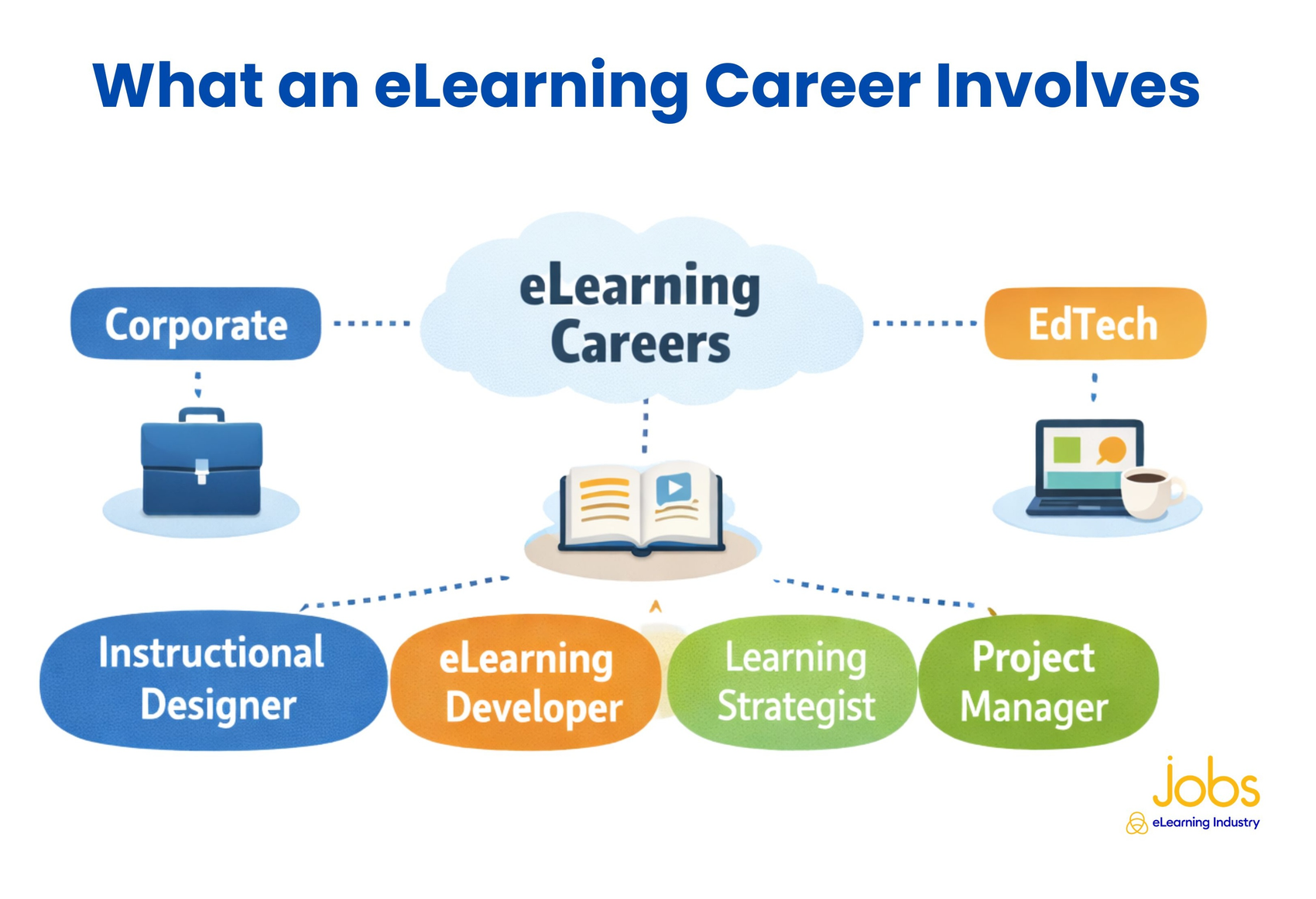
An eLearning career goes far beyond uploading slides into an online platform and delivering them to your audience. It involves designing intentional learning experiences that help people build knowledge and skills efficiently. Common roles in the field include Instructional Designers, eLearning developers, Learning Experience (LX) designers, learning strategists, multimedia specialists, and learning project managers. Each role combines education principles and methodologies with technology, creativity, and performance outcomes.
One of the great things about this profession is that you can pursue different paths depending on your interests and transferable skills for eLearning. For example, in corporate settings, eLearning teams focus on employee training, leadership development, compliance programs, and performance improvement. These roles often focus on measurable business results and collaboration with Subject Matter Experts. In the EdTech sector, you might work for companies that build learning platforms, create digital curriculum, or develop educational software. This path often involves product development cycles, user experience evaluation, and scaling learning solutions for larger audiences. Then there are eLearning freelancers, who often collaborate with businesses, universities, or startups to design courses and training programs. This gives you more flexibility but calls for entrepreneurial skills.
First and foremost, eLearning roles typically prioritize outcomes over seat time. Success is measured by performance improvement, learner engagement analytics, and business impact rather than assessment scores. Instead of lecturing in a classroom, eLearning pros design interactive modules, simulations, and digital resources that empower learners to apply knowledge immediately in the real world.
Can You Transition Into eLearning Without Experience?
You can transition into eLearning without direct experience, but it requires strategy. Many people mistakenly believe they have to start from scratch. In reality, "experience" often means demonstrating transferable skills, like curriculum planning, project management, writing, communication, visual design, or technical skills. Teachers, trainers, HR professionals, marketers, and even Subject Matter Experts often already have relevant competencies without even realizing it.
What truly matters is proving that you can apply skills in an eLearning context. Employers care less about job titles and more about achieving the objectives. Can you design a learning solution that solves a performance problem? Can you use authoring tools effectively? Can you structure content in a way that improves retention? A strong portfolio that showcases sample modules, scenario-based learning, or redesigned training materials sometimes carries more weight than years of hands-on experience in your current career.
Breaking into the field also typically involves building foundational knowledge in Instructional Design principles, learning theory, and digital tools. Creating practice projects, volunteering for internal training initiatives, or completing short certifications can help bridge these gaps to prepare you for the career change to eLearning. Networking within the industry and understanding the learning metrics that businesses value most also strengthens your job prospects.
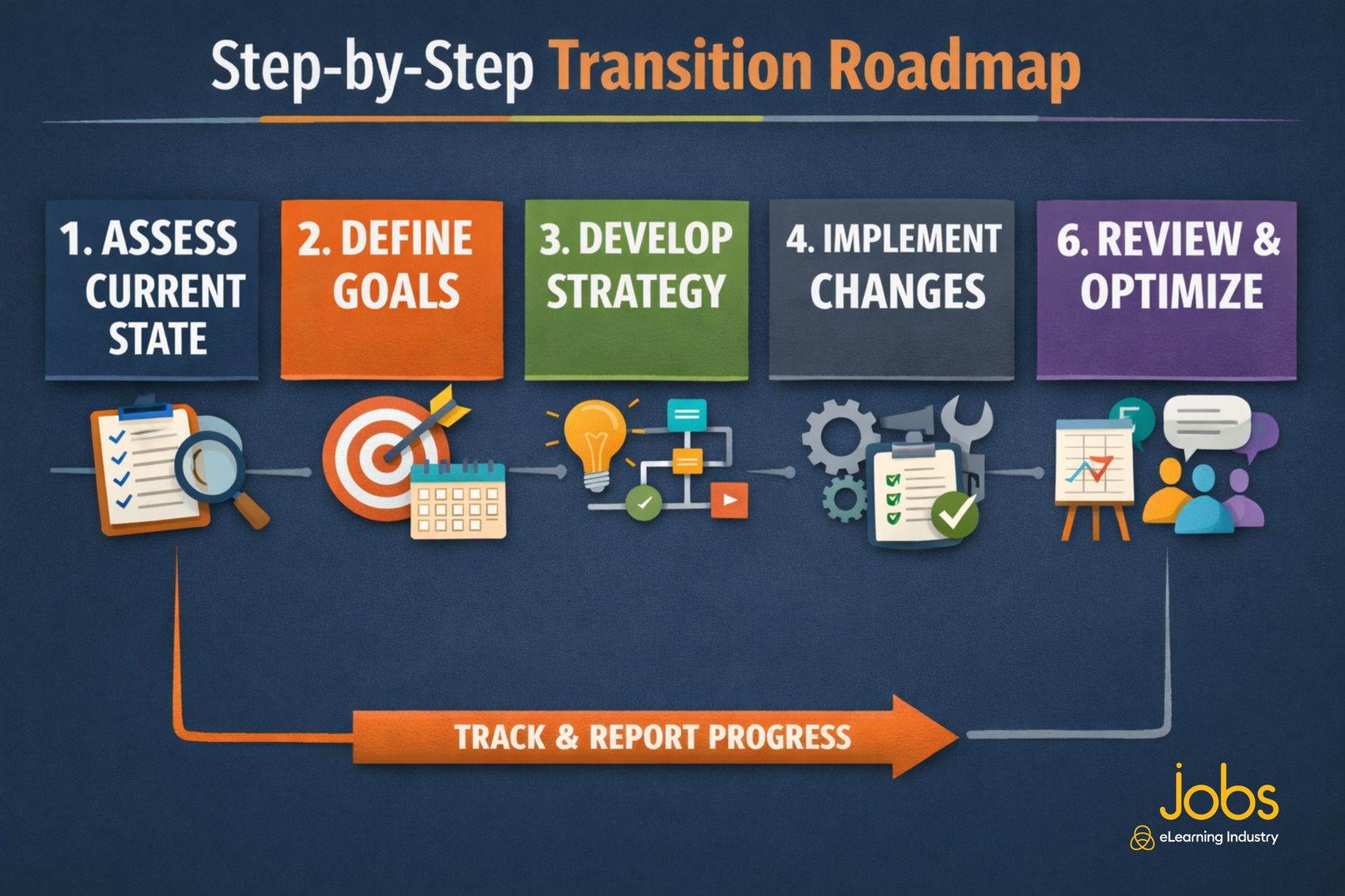
Step-By-Step Guide To Transitioning Into An eLearning Career
Step 1: Identify The Right eLearning Role For You
The first step to transition into eLearning is understanding how your strengths match up with different responsibilities. An Instructional Designer focuses on structuring learning experiences, applying learning theory, and mapping content to measurable outcomes. If you enjoy analyzing problems and organizing information into clear pathways, this may be a strong fit for you. Then there are L&D specialists who often work more broadly within an organization, identifying skill gaps, coordinating training initiatives, and aligning programs with business goals. This role is ideal for professionals who like strategizing and cross-functional collaboration.
If you're detail-oriented and enjoy systems and data, you might consider the LMS administrator role, which manages the technical side of learning platforms. For example, enrolling users, generating reports, troubleshooting issues, and maintaining systems. Another eLearning career path for beginners is an eLearning developer, which involves building interactive modules using authoring tools, multimedia, and visual design principles. If you gravitate toward hands-on creation and have strong technical skills, this role might be a good choice.
Step 2: Audit Your Transferable Skills Before Making The Transition Into eLearning
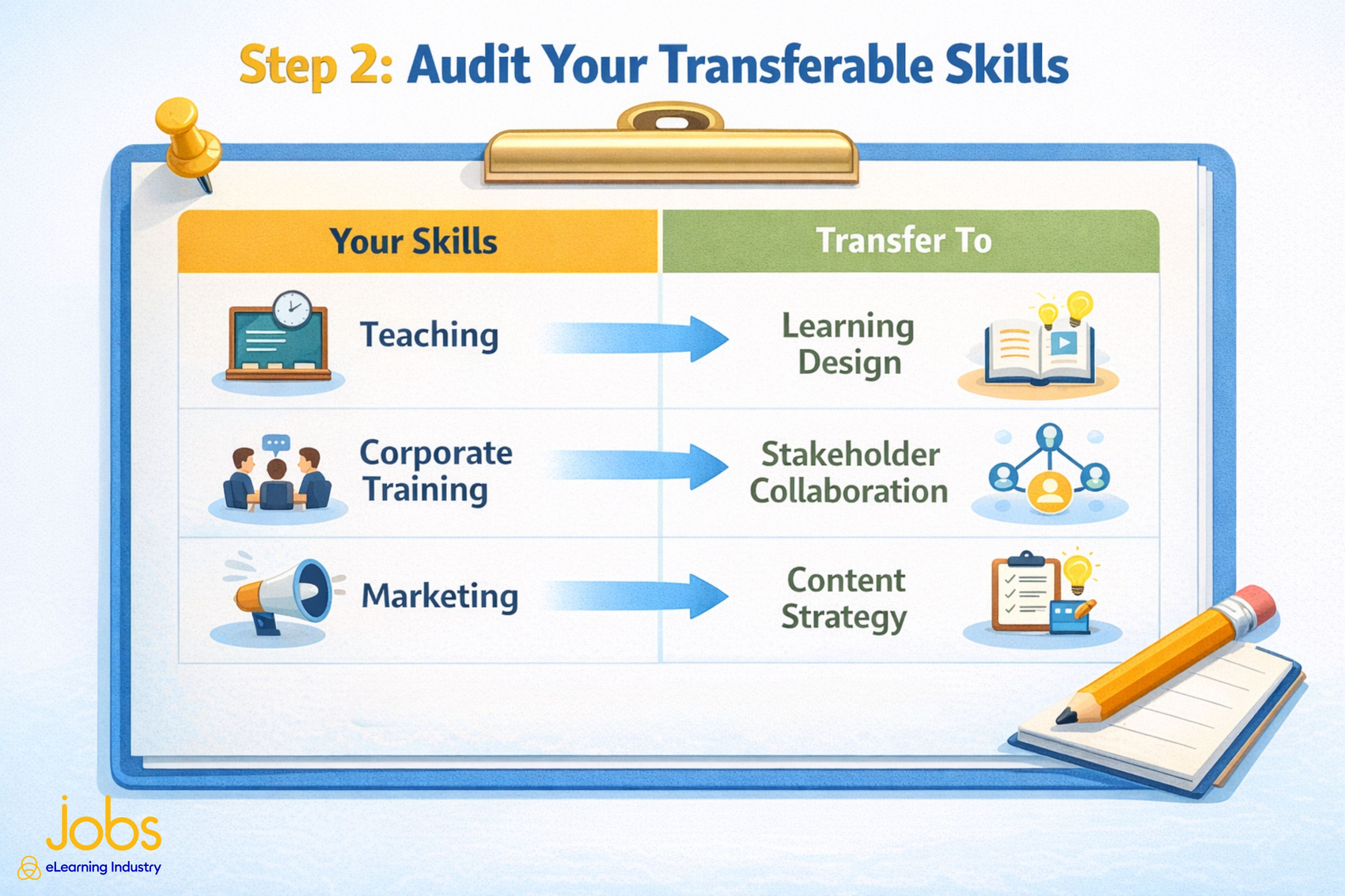
Making the switch to Instructional Design and any other eLearning career requires a self-audit. Namely, you need to value your existing experience. Instead of focusing on job titles, break down what you actually do and how those tasks translate into learning design. For example, teaching often involves structuring lessons, assessing levels of comprehension, and adjusting content based on learner needs. If you look at it from an eLearning POV, these responsibilities directly align with learning design and instructional strategy.
If you have experience in corporate training, you likely understand stakeholder collaboration. For instance, working with leadership, Subject Matter Experts, and cross-functional teams to deliver training solutions. That ability to gather requirements, manage expectations, and connect learning with business objectives is essential in eLearning careers.
Marketing experience can also transfer over when you transition into eLearning. Marketing pros develop content strategies, craft messaging for specific audiences, and analyze engagement metrics. These skills are relevant when it's time to design learner-centered experiences that drive measurable outcomes.
Explore entry-level eLearning jobs!
Step 3: Learn The Core eLearning Tools
Getting familiar with the top L&D tools is a critical step in moving into eLearning. It's best to start with LMS basics. A Learning Management System is the platform that delivers, tracks, and reports on training. Understanding how courses are uploaded, learners are enrolled, and reports are generated gives you foundational insight into how organizations actually manage L&D programs.
Next, explore Instructional Design tools. Authoring platforms allow you to create interactive modules, quizzes, simulations, and multimedia content. Even basic proficiency shows employers that you can transform static information into engaging online learning experiences. Focus on structuring content logically, applying visual hierarchy, and designing meaningful interactions instead of simply mastering software features.
Collaboration platforms are just as important when you start an eLearning career. Projects often involve experts, designers, managers, and technical teams working together remotely. You need to be familiar with shared document systems, project management tools, and communication platforms to demonstrate that you'll keep productivity levels up when working with global teams.
Step 4: Build A Small But Strong Portfolio
When you transition into an eLearning career, your portfolio matters more than your job title. You don't need to include dozens of samples. Instead, focus on a few well-crafted projects that demonstrate your thought process and execution. Start with practice projects. For example, create a short compliance module, onboarding lesson, or skills-based microlearning experience. Concentrate on solving a realistic performance problem rather than simply presenting all the info. Employers want to see how you structure content, apply learning principles, and design for engagement.
Another insider strategy is to redesign existing content. Take a hefty slide deck, outdated training manual, or lengthy document and transform it into an interactive online learning experience. Explain your design choices, such as why you reorganized sections, added scenarios, or incorporated knowledge checks. This shows analytical thinking, not just technical know-how.
Most importantly, outline the outcomes, even in mock projects. You need to clarify the desired results. What should learners be able to do after completing the module? How would success be measured? By showing that your focus is on performance improvement and measurable impact, you position yourself as a solution-oriented job candidate rather than a beginner who's just experimenting with tools.
Step 5: Update Your CV For The Career Shift
A new career path means a new CV. Well, at least an updated one that reflects capability rather than chronology. A skills-first format can help emphasize relevant competencies before listing all of your past roles. Kick things off with a professional summary that clearly states your pivot and highlights strengths such as Instructional Design, content development, stakeholder collaboration, or proficiency with digital tools.
Next, organize a core skills section that meshes with common eLearning responsibilities. Include learning analysis, curriculum development, project management, facilitation, multimedia development, or LMS familiarity, which all depend on your experience. This ensures hiring managers immediately spot your relevance when scanning eLearning CVs.
Role alignment is equally important. For each previous position, update your bullet points to reflect outcomes that tie into learning and performance. Instead of listing generic duties, describe how you improved knowledge retention, streamlined onboarding, or increased engagement. Also, rewrite your past achievements from an eLearning angle.
Finally, highlight relevant impact with measurable results if possible. Numbers add credibility. So, don't shy away from metrics. Whether you trained 200 employees, reduced onboarding time by 15%, or increased course completion rates by 22%, quantifiable outcomes demonstrate value.
Step 6: Apply Strategically For Entry-Level Roles
Applying strategically instead of sending dozens of generic applications. Targeted applications allow you to tailor your CV, portfolio, and cover letter to each company and role. Research the organization, understand its industry, and align everything with its learning goals. This shows genuine interest and increases your chances of standing out from the CV pile.
Reading job descriptions carefully is another must. Identify recurring themes, such as required tools, collaboration expectations, performance metrics, or stakeholder engagement. Then, highlight matching skills and examples in your application. Even if you don't meet every qualification, focus on demonstrating competence in the areas they prioritize in the listing.
Finally, avoid scattershot applications. Submitting high volumes of untailored applications rarely ever yields interviews. Instead, concentrate on entry-level eLearning jobs that genuinely match your developing skillset, such as junior Instructional Designer, learning coordinator, or LMS support specialist.
Best Backgrounds For Transitioning Into eLearning
Because this field blends education, technology, communication, and business strategy, people from diverse industries can transition into an eLearning career without having to completely reskill. Below are some of the strongest backgrounds for pivoting into eLearning, and why they work so well.
Teachers And Educators
Teachers and educators often make some of the smoothest transitions into eLearning, since their daily work already revolves around structuring content, assessing understanding, and adapting instruction based on learner needs. Lesson planning has much in common with Instructional Design, as both require defining objectives, sequencing information logically, and measuring outcomes.
Educators also understand learning theory, cognitive load, and learner engagement, all of which are critical for designing effective virtual learning experiences. Classroom management skills translate into anticipating learner challenges and creating clear guidance so that learners don't get overwhelmed.
The main adjustment for educators when figuring out how to move into eLearning from teaching is shifting from classroom delivery to performance-based design. This is particularly true in corporate settings, where the focus is often on solving business problems rather than covering curriculum standards.
Corporate Trainers
Corporate trainers already work in adult learning environments, making their transition into eLearning even more seamless. They understand stakeholder expectations, business metrics, and the importance of aligning learning initiatives with organizational goals.
Facilitating workshops, onboarding programs, or compliance sessions means that you already have experience in communication and learner engagement. Corporate trainers are also accustomed to working with Subject Matter Experts and converting complex material into accessible training content.
When changing careers to learning and development, trainers usually need to hone their digital design skills. While they may already have a great deal of experience with in-person facilitation, eLearning involves designing interactive modules, asynchronous activities, and multimedia content. Fortunately, trainers' business awareness and real-world training experience give them a competitive edge when applying for eLearning jobs.
HR And L&D Professionals
Human Resources and L&D pros bring a strategic perspective to eLearning careers. They regularly assess skill gaps, coordinate professional development programs, and evaluate employee performance. This systems-level experience is valuable in eLearning programs. Also, because HR and L&D teams often manage LMS platforms, vendor relationships, and compliance training, they are already familiar with the operational side of things. For instance, they understand reporting, analytics, and regulatory requirements.
However, many people with HR and L&D backgrounds may need to strengthen their authoring skills to make the career transition to Instructional Design. The upside is that, combined with a deeper understanding of organizational priorities, building these skills can lead to learning strategy or digital program management roles.
Content Creators And Marketers
Content creators and marketers have strengths that are critical in eLearning. This ranges from audience analysis and storytelling to engagement strategy. Marketing professionals are skilled at crafting messages tailored to specific demographics, measuring engagement metrics, and refining content based on performance data. These abilities tie into learner-centered design.
The secret to eLearning success is understanding what motivates learners, how they consume information, and what drives action. Storytelling, visual communication, and concise writing are all part of the package. They also happen to be common marketing skills. The key skill-building area for marketers who want to transition into eLearning careers is learning science. While they may know the ins and outs of engagement, they must also understand instructional alignment, knowledge checks, and fundamental behavioral science principles.
Technical Or IT Professionals
Technical and IT professionals bring system thinking and digital fluency to eLearning roles. Their familiarity with software platforms, tech troubleshooting, integrations, and data management makes them a good fit for LMS administration or eLearning development jobs. Because modern eLearning relies so heavily on technology, technical pros often adapt quickly to the tools of the L&D trade. Their analytical mindset also comes in handy when measuring effectiveness and optimizing learning systems.
To start an eLearning career, IT professionals may need to build up their knowledge of Instructional Design principles and adult learning theory. Understanding how people learn allows them to build technical solutions that are not only functional but backed by pedagogy.
Common Mistakes Career Switchers Make
One of the most common mistakes career switchers make is overloading on certifications without applying what they learn. While professional development is a must, simply earning multiple credentials without building practical skills or sample projects won't impress recruiters. Another frequent faux pas is ignoring your portfolio. A strong portfolio often carries more weight than formal qualifications because it demonstrates how you design solutions and think through learning challenges.
Some candidates also begin applying before connecting their skills with job requirements. Submitting applications without tailoring a CV based on the role and responsibilities may signal that you either lack the necessary experience or don't care enough about the job to customize the resume. Finally, don't overlook the importance of business impact. eLearning roles are not just about creating content; they're about improving performance. You need to be able to connect learning solutions to real organizational results.
How Long Does It Take To Transition Into eLearning?
A realistic estimate for most people making the career change to eLearning is three to nine months. This depends on your starting point, available time, and how quickly you build practical skills. If you have a background in teaching, training, or content development, the process may move faster because you already have a strong skill foundation.
Expect a learning curve, especially when it comes to Instructional Design frameworks, authoring tools, and understanding how learning ties into business performance. The first phase typically involves foundational learning, such as delving into core principles and exploring tools. The second phase focuses on skill-building through practice projects and portfolio development. Then you should focus on refining your CV, strengthening your portfolio based on the path you choose, and applying strategically.
Where To Find Entry-Level eLearning Jobs
Finding entry-level eLearning jobs starts with filtering by role rather than using broad keywords. For example, instead of searching for "eLearning jobs," look for titles like "Junior Instructional Designer" or "LMS administrator." Narrowing your search helps you find positions that actually align with your current skill level.
It's also important to understand the difference between "junior" and "mid-level" roles. Junior positions typically require foundational knowledge and some demonstrated skills. On the other hand, mid-level roles usually involve independent project ownership and several years of applied experience. Reading job descriptions carefully will clarify expectations that go beyond the title.
Lastly, one of the benefits of transitioning into eLearning is remote opportunities because L&D teams often collaborate online. However, you need to know how to find these positions on job boards. Use location filters and include "remote" in your searches. For example, Jobs by eLearning Industry allows you to view "Remote OK" and "Remote only" opportunities.
Subscribe to get new job alerts and find out about new job opportunities right when they're posted!