

What Employers Look For In Training Manager Interviews
Training manager interview questions often go beyond course delivery, facilitation, or LMS administration. Employers want to see whether candidates can lead learning initiatives that support wider business goals. In a modern training manager interview, strong answers should demonstrate strategic thinking, leadership, and measurable impact.
Hiring teams increasingly evaluate how candidates make decisions, influence stakeholders, manage change, and align training programs with performance outcomes. This is especially true in L&D manager interview questions and Learning and Development manager interview discussions, where leadership responsibilities are central to the role.
Candidates should also be prepared to explain how they identify skill gaps, prioritize learning initiatives, measure training effectiveness, and support organizational growth. Employers look for evidence of collaboration with department leaders, budget awareness, and the ability to scale learning programs across teams, too.
Strong interview answers focus on outcomes, not just tasks. Instead of only describing what was delivered, candidates should explain why decisions were made, what business problem was addressed, and what results were achieved. This leadership-focused approach helps demonstrate readiness for senior L&D and training management roles.
Explore training manager and L&D leadership roles to understand current hiring expectations, required skills, and career pathways in Learning and Development. Reviewing active job listings can also help you prepare stronger interview examples aligned with real employer needs.
Key Takeaways
- Training manager interviews focus on leadership, strategy, and measurable impact.
- Employers expect candidates to demonstrate decision-making and team management skills.
- Behavioral and scenario-based questions are common.
- Strong answers connect learning initiatives to business outcomes.
How Training Manager Interviews Are Different From Other L&D Roles
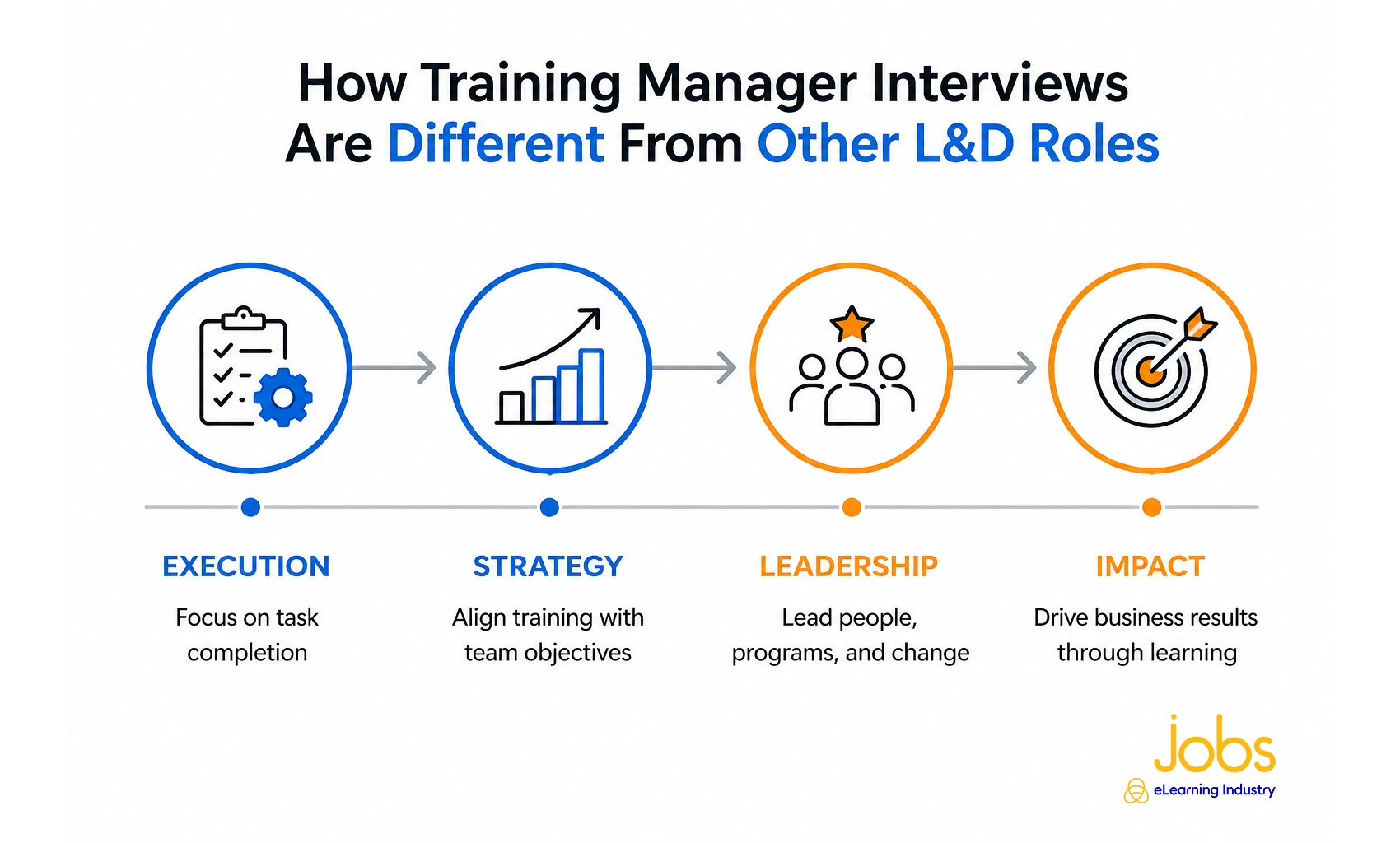
Training manager interview questions are typically more leadership-focused than interviews for Instructional Designers, trainers, or LMS administrators. While many L&D roles concentrate on content creation or delivery, training managers are expected to lead learning strategy, manage teams, and connect training initiatives to business performance.
In a training manager interview, employers often assess how candidates handle ownership and decision-making. This includes managing budgets, prioritizing training needs, working with stakeholders, and improving learning outcomes across departments. Candidates are also expected to demonstrate experience with reporting, workforce development, and long-term planning.
Many L&D manager interview questions focus on strategic alignment, too. Hiring teams want to understand how a candidate supports company goals through learning programs. Strong answers usually include examples of solving performance issues, supporting organizational change, or helping teams adapt to new systems and processes.
A Learning and Development manager interview may also include leadership scenarios that test communication, conflict resolution, and change management skills. Unlike specialist roles, training managers are expected to balance operational responsibilities with strategic leadership. This requires a broader understanding of business priorities, employee development, and organizational performance metrics.
Top Training Manager Interview Questions And Leadership Answers
Training manager interview questions increasingly focus on leadership, strategic thinking, and measurable business impact. In modern training manager interviews, employers seek evidence that candidates can lead teams, influence stakeholders, and align learning initiatives with organizational goals. Here are the top questions you may be asked when being interviewed for the role of training manager.
1. How Do You Align Training Programs With Business Goals?
This question evaluates strategic thinking and stakeholder alignment. You should answer explaining how learning initiatives support company priorities, performance metrics, or operational challenges.
A useful framework is:
- Identify business goals
- Assess performance gaps
- Build targeted learning solutions
- Measure outcomes
Candidates should include examples of working with department leaders to connect training with retention, productivity, compliance, or customer experience goals.
2. How Do You Measure The Impact Of Training Initiatives?
L&D manager interview questions often focus on data and ROI. Employers want to know how candidates evaluate learning effectiveness beyond completion rates.
Strong answers may include:
- Performance KPIs
- Learner engagement metrics
- Assessment scores
- Manager feedback
- Business outcomes
You should explain how you connect training to measurable improvements such as reduced onboarding time, higher sales performance, or improved employee retention.
3. How Do You Manage And Develop A Learning Team?
This question assesses your leadership style and people management skills. Employers look for candidates who can coach team members, delegate effectively, and build collaborative environments.
Strong answers should explain:
- How responsibilities are assigned
- The way feedback is delivered
- How team growth is supported
- How priorities are managed during busy periods
In a Learning and Development manager interview, hiring teams may also ask about mentoring Instructional Designers, facilitators, or LMS administrators.
4. Tell Me About A Training Program You Led
This question evaluates project ownership and execution. Candidates should describe the initiative's scope, the business problem, and the final results.
A strong answer typically includes:
- The challenge
- The learning strategy
- Stakeholder involvement
- Delivery methods
- Measurable outcomes
Employers value examples that demonstrate cross-functional collaboration and business impact rather than course production alone.
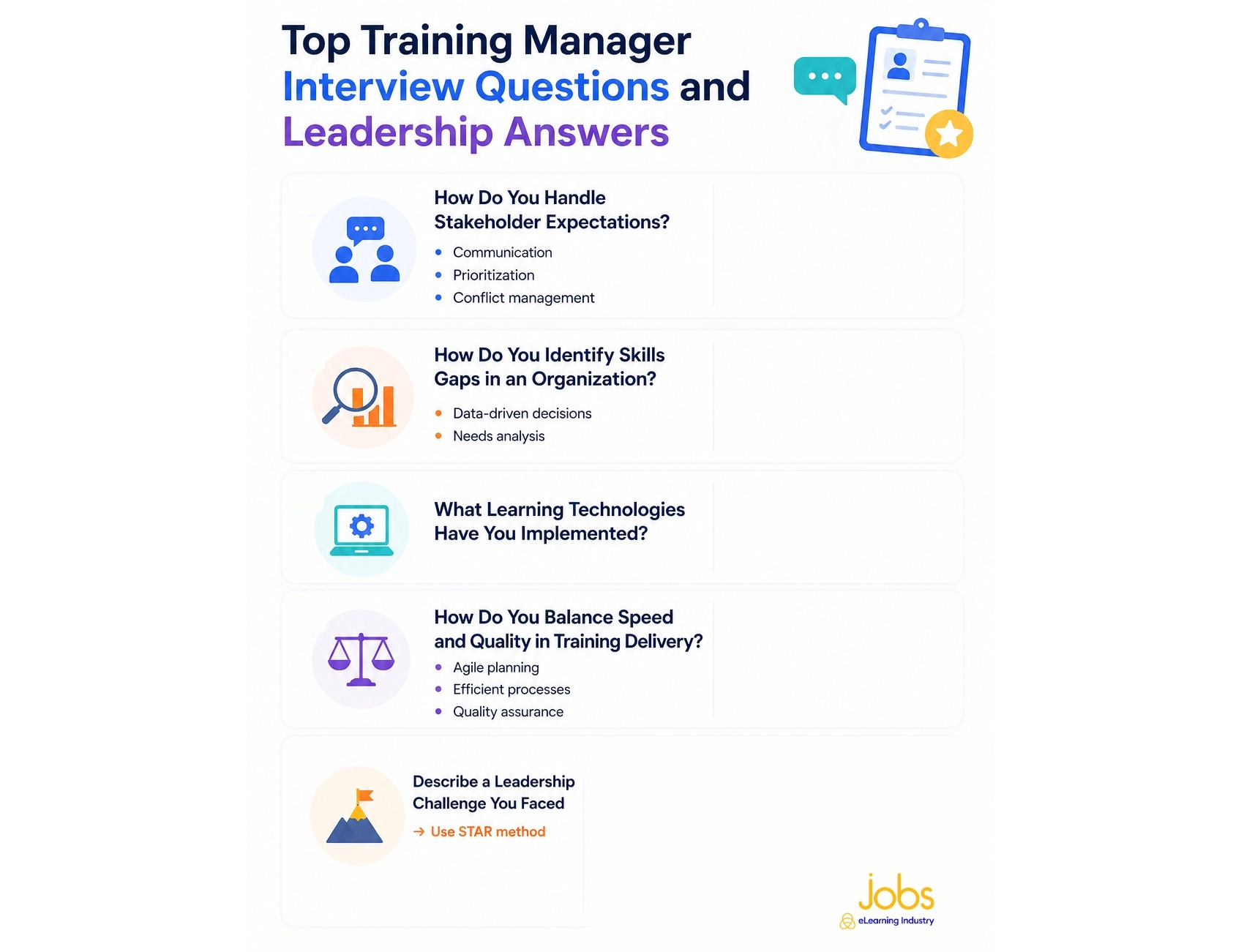
5. How Do You Handle Stakeholder Expectations?
Leadership interview questions that L&D teams often ask focus on communication and prioritization. Training managers regularly balance competing requests from leadership teams, HR departments, and operational managers.
Strong answers should explain:
- How priorities are evaluated
- How expectations are communicated
- The way disagreements are managed
- How timelines are negotiated
Candidates should demonstrate professionalism, transparency, and problem-solving skills.
6. How Do You Identify Skills Gaps In An Organization?
This question focuses on data-driven decision-making and needs analysis. Employers want to understand how candidates determine their training priorities, rather than relying on assumptions.
Strong answers may reference:
- Performance reviews
- Surveys and assessments
- Business KPIs
- Manager interviews
- Workforce planning data
Interview questions for training managers increasingly emphasize analytical thinking and strategic workforce development.
7. What Learning Technologies Have You Implemented?
Learning and Development leadership interview discussions often include learning technology experience. Employers may ask about LMS platforms, learning analytics tools, AI-powered learning systems, virtual training solutions, or other eLearning tools.
Candidates should explain:
- Why was a tool selected?
- How the implementation was managed.
- What challenges occurred?
- What business results followed?
8. How Do You Balance Speed And Quality In Training Delivery?
Organizations often need rapid training rollouts without sacrificing learning quality. Strong answers should demonstrate prioritization, agile planning, and stakeholder communication.
Candidates can explain how they:
- Identify urgent needs
- Simplify workflows
- Use templates or reusable assets
- Maintain review processes
- Adjust timelines when needed
This shows operational leadership and decision-making ability.
9. Describe A Leadership Challenge You Faced
Behavioral interview questions for manager roles often include leadership challenges. The STAR method helps structure strong responses:
- Situation
- Task
- Action
- Result
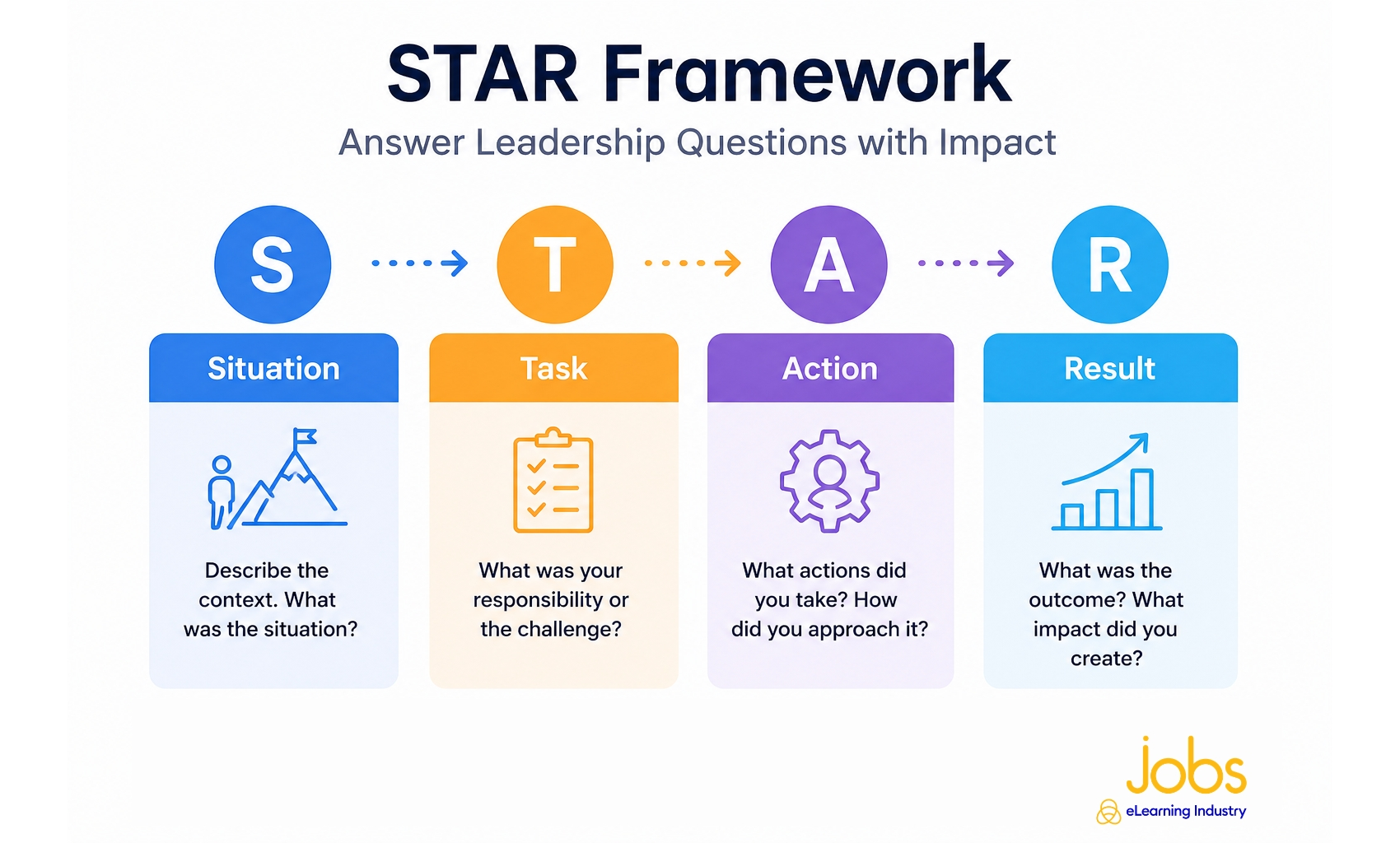 Candidates should focus on conflict resolution, change management, team performance, or stakeholder alignment. Employers look for accountability, communication skills, and measurable outcomes rather than perfect results alone.
What Strong Leadership Answers Look Like
Training manager interview questions are designed to evaluate how candidates think, lead, and drive business results through learning initiatives. Strong answers should focus on outcomes, not just responsibilities. Basically, employers want examples that show how training programs improved performance, solved organizational problems, or supported company goals.
First, in a training manager interview, candidates should explain the reasoning behind their decisions. This includes how they identified learning needs, prioritized projects, managed stakeholders, and measured success. Clear examples with metrics help demonstrate credibility and leadership readiness.
Many L&D manager interview questions also assess strategic thinking. Hiring teams often expect candidates to discuss budgeting, change management, team leadership, and cross-functional collaboration. Therefore, answers should show an understanding of how learning connects to retention, productivity, compliance, or employee development.
Strong leadership responses are also concise. Long explanations can weaken the impact of an answer. Effective candidates communicate the situation, action, and result clearly while keeping the focus on measurable impact.
Overall, in a Learning and Development manager interview, employers often look for leaders who combine communication skills with data-informed decision-making and practical business awareness.
Common Training Manager Interview Mistakes
Training manager interview questions often reveal whether a candidate can think beyond daily learning operations. To prepare accordingly, here are the most common mistakes people make when being interviewed for a training manager role.
Focusing Only On Execution
Many candidates explain how they delivered workshops, launched LMS courses, or coordinated onboarding programs without connecting those activities to business goals. However, employers expect training managers to understand how learning supports performance, retention, productivity, and organizational change. In L&D manager interview questions, hiring teams often look for evidence of strategic thinking. Answers that focus only on scheduling, content creation, or administration can make candidates appear too tactical for leadership roles.
Not Showing Measurable Results
Another common issue is failing to show a measurable business impact. Strong candidates explain what changed as a result of their training initiatives. This may include improved employee performance, reduced onboarding time, increased compliance rates, or higher learner engagement scores. Without metrics, interview answers can sound incomplete or difficult to evaluate.
Weak Leadership Examples
Weak leadership examples can also hurt performance during a Learning and Development manager interview. Senior-level roles require collaboration with executives, department managers, and cross-functional teams. So, candidates should demonstrate how they handled stakeholder alignment, managed resistance to change, supported team development, or influenced learning strategy decisions.
Not to mention that many interview questions for training managers are behavioral. Employers want clear examples of decision-making, communication, and leadership under pressure. General statements such as “I work well with teams” are less effective than structured examples that explain the situation, actions taken, and final results.
Insufficient Preparation
Preparation is also important. Candidates who understand how to prepare for a training manager interview are more likely to present strategic, outcome-focused answers that reflect leadership readiness rather than execution alone.
How To Prepare For A Training Manager Interview
Training manager interview questions often focus on leadership, business alignment, and decision-making rather than only instructional delivery. Employers want candidates who can connect learning initiatives to performance goals, support organizational change, and lead teams effectively. Preparing for a training manager interview requires clear examples, measurable outcomes, and an understanding of the company’s priorities.
Prepare Strategic Examples
One of the most important parts of preparation is selecting examples that demonstrate leadership and strategic thinking. In many L&D manager interview questions, employers evaluate how candidates solved business problems through learning initiatives.
Prepare examples that show how you:
- Improved employee performance
- Supported onboarding or reskilling efforts
- Increased training completion rates
- Managed stakeholders or cross-functional teams
- Introduced new learning technologies or processes
Strong examples should explain the situation, the action taken, and the measurable outcome. Instead of focusing only on course development or facilitation, explain why the initiative mattered to the business and how decisions were made. Candidates preparing for a Learning and Development manager interview should also be ready to discuss challenges, trade-offs, and lessons learned. Leadership-level interviews often assess how managers respond to change, limited resources, or competing priorities.
Practice Explaining Business Impact
Employers expect training managers to understand how learning supports an organization's broader goals. During interviews with training managers, hiring teams often ask about metrics, performance indicators, and training effectiveness. So, you must practice explaining the business impact of your work in simple and direct language. This may include:
- Reduced onboarding time
- Higher employee retention
- Improved compliance rates
- Increased productivity
- Better learner engagement scores
Avoid describing training programs without discussing results. Leadership interview questions in L&D are designed to evaluate strategic thinking, not only execution. Remember: candidates who connect learning outcomes to business performance are often viewed as stronger leadership candidates.
Align With Company Goals
Researching the company is another important part of preparing for a training manager interview. Review the organization’s products, services, culture, and growth priorities before the interview.
Look for information about:
- Expansion plans
- Digital transformation initiatives
- Workforce development goals
- Leadership values
- Learning culture
Use this research to tailor your answers. Employers want to see that candidates understand the company’s direction and can build learning strategies that support it. This approach also helps candidates answer behavioral interview questions for manager roles with greater relevance and confidence.
How To Structure Leadership-Level Interview Answers
Training manager interview questions often assess how candidates think through problems, make decisions, and communicate business impact. One effective way to structure leadership-level answers is the Context → Decision → Action → Impact framework. This approach helps candidates stay concise while demonstrating strategic thinking during a training manager interview.
Context → Decision → Action → Impact
- Start by explaining the context. Describe the business challenge, performance gap, or organizational need. Keep this section brief but specific enough to establish relevance.
- Next, explain the decision you made. Many L&D manager interview questions focus on leadership judgment, so employers want to understand why you selected a particular strategy, learning solution, or process.
- Then, describe the action you took. Outline how you implemented the initiative, collaborated with stakeholders, managed resources, or guided the team through execution.
- Finally, explain the impact. Strong Learning and Development manager interview answers include measurable outcomes such as improved onboarding time, higher completion rates, stronger employee performance, or reduced support requests.
This structure helps candidates move beyond task-based answers and present themselves as leaders who successfully connect learning initiatives to business goals and organizational performance.
Find Training Manager Roles And Prepare To Apply
Carefully Review Positions
Training manager interview questions often reflect the specific leadership expectations of the role, making it important to evaluate positions carefully before applying. Candidates should review job descriptions closely to understand how organizations define the responsibilities of training leadership, performance management, stakeholder collaboration, and learning strategy.
Review Responsibilities
Different companies may expect different strengths from training managers. Some roles focus heavily on Instructional Design and delivery operations, while others prioritize organizational development, workforce transformation, or leadership coaching. Reviewing responsibilities, reporting structures, and required skills can help candidates identify positions that match their experience and career goals.
Research Company
Preparation should also include researching the company’s learning culture, business priorities, and growth stage. In a Learning and Development manager interview, employers often expect candidates to understand how training supports larger organizational objectives. This includes employee retention, productivity, onboarding efficiency, and leadership development.
Prepare Examples
Before applying, candidates should prepare measurable examples that demonstrate impact. Strong examples may include improving completion rates, reducing onboarding time, increasing engagement scores, or scaling learning programs across departments. This preparation helps candidates answer leadership-focused interview questions with greater clarity, relevance, and business context during the hiring process.
Create an account and set job alerts to stay updated on new training manager and learning leadership opportunities. You can also upload your CV to apply faster and track relevant roles more efficiently.