

Exit Interview Questions: How To Answer Them Professionally
You’ve made the decision to leave your job, submitted your resignation, and are getting ready for what’s next. Before you go, though, there’s still the exit interview. If you’re unsure about what HR will ask, how much to share, or if your answers might impact your relationships at work, you’re in good company.
An exit interview isn’t like a job interview where you have to prove yourself. Instead, it’s a chance to talk about your experience and why you’re moving on. You don’t have to mention every frustration, but you also don’t need to act like everything was perfect.
The aim is to give honest and helpful feedback while staying professional. In this guide, you’ll see common exit interview questions and answers, tips to help you prepare, real examples, and advice for tough conversations.
Preparing for your next career move?
Explore current opportunities in eLearning, Learning and Development, Instructional Design, and EdTech.
What Is An Exit Interview?
An exit interview is a conversation or questionnaire that happens when someone leaves a company. The goal is to find out why they are leaving and to get feedback about their job, manager, workload, pay, career growth, and overall experience at work.
Exit interviews usually happen near the end of your time at a company. They might be a meeting with someone from HR, a phone or video call, a written questionnaire, an online survey, or a mix of these options. In some cases, someone else from the company or an outside provider will lead the conversation.
Why Do Companies Conduct Exit Interviews?
Companies use exit interviews to learn about employees’ experiences and find ways to make the workplace better. For example, HR may ask if your job matched the description, if you got enough support, or if pay and career growth affected your decision to leave. Knowing these reasons can help you focus your feedback, so you don’t feel like you have to talk about every part of your job.
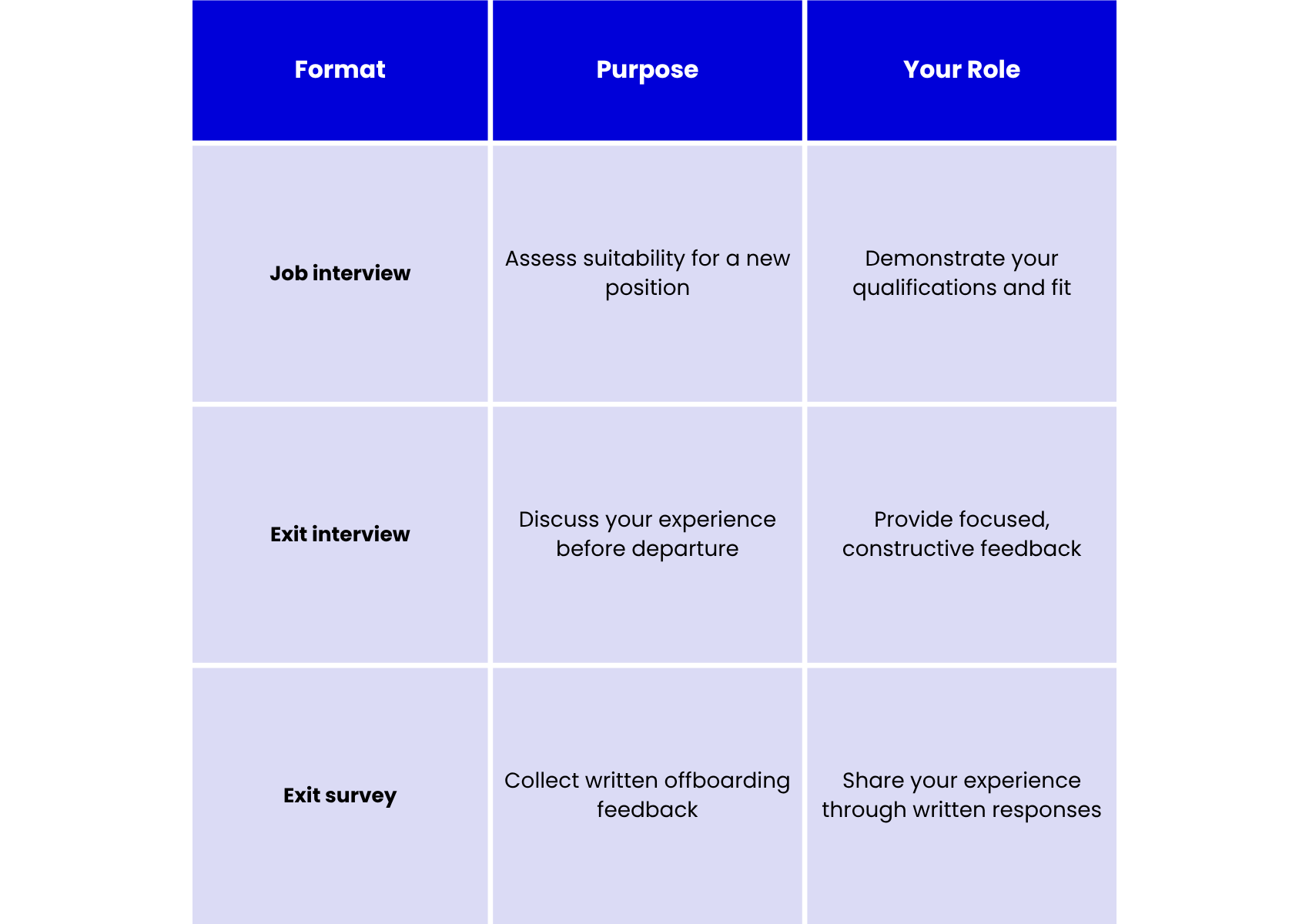
Exit Interview Vs. Job Interview Vs. Exit Survey
Even though these conversations might cover some of the same topics, each one has a different purpose.
How To Prepare For An Exit Interview
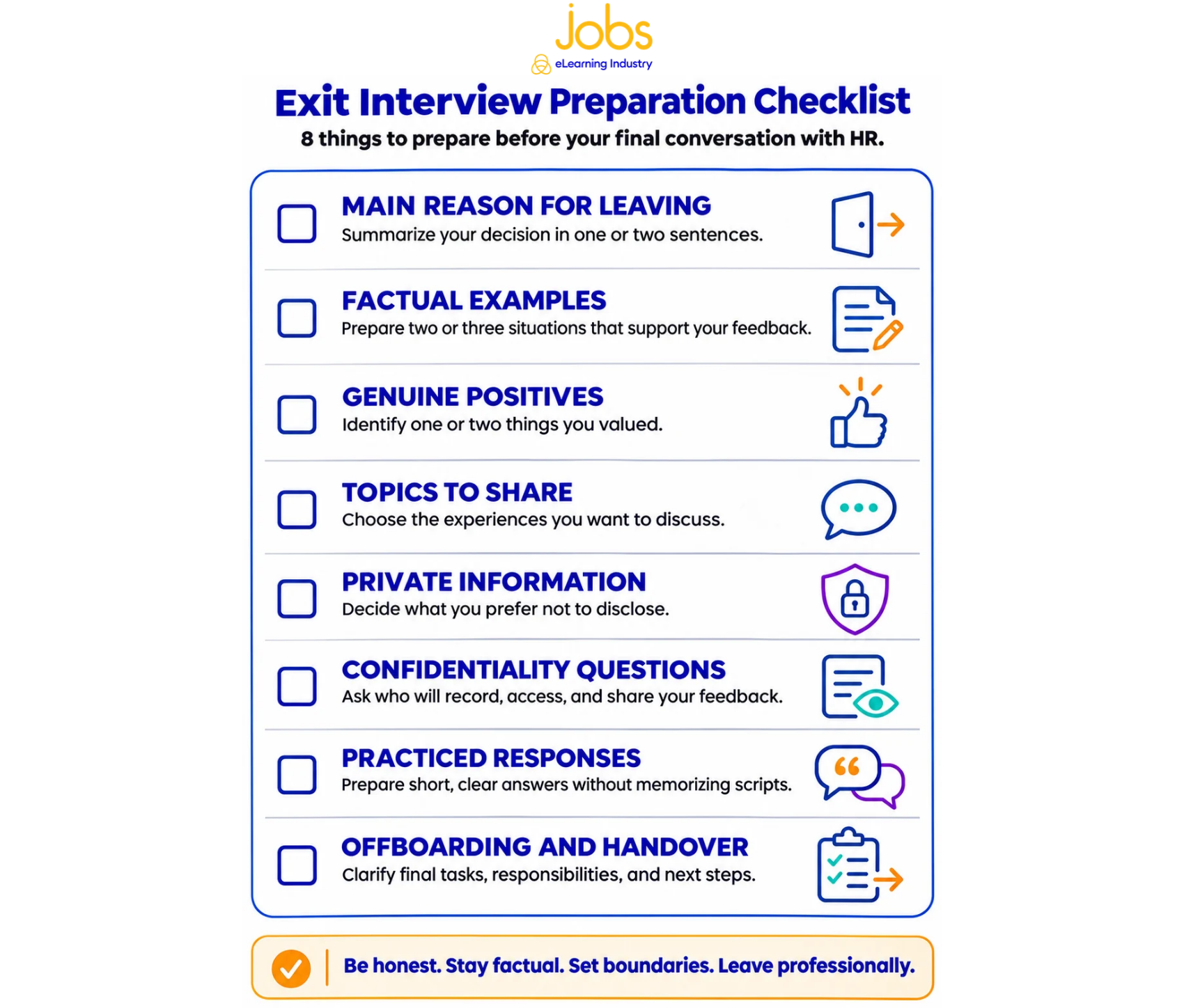
Getting ready for an exit interview can help you share your thoughts clearly, especially if you’re leaving because of tough experiences at work.
Here are seven steps you can take.
- Identify your main reason for leaving. Consider what made you decide to move on. Was it limited career growth, pay, management, workload, or changing priorities? Try to sum up your main reason in one or two sentences.
- Pick two or three clear examples. Rather than listing every frustration, focus on problems that happened more than once. For example, an Instructional Designer could mention repeated scope changes that slowed down course production.
- Separate facts from interpretations. "Project requirements changed three times after approval" describes something observable. "Management didn't care about our work" assumes intent.
- Think about what you feel okay sharing. Sort your information into three groups: what you’ll talk about openly, what you’ll mention only if someone asks, and what you’ll keep private or share in another way.
- Look for real positives. Think about helpful coworkers, good projects, new skills, or chances you valued. You don’t have to make up compliments.
- Get your confidentiality questions ready. Ask if the meeting will be recorded, who will see your feedback, and if your comments will have your name attached.
- Practice what you want to say. Try saying your answers out loud, but don’t try to memorize them word for word. Focus on sounding natural and clear.
How To Answer Exit Interview Questions Professionally
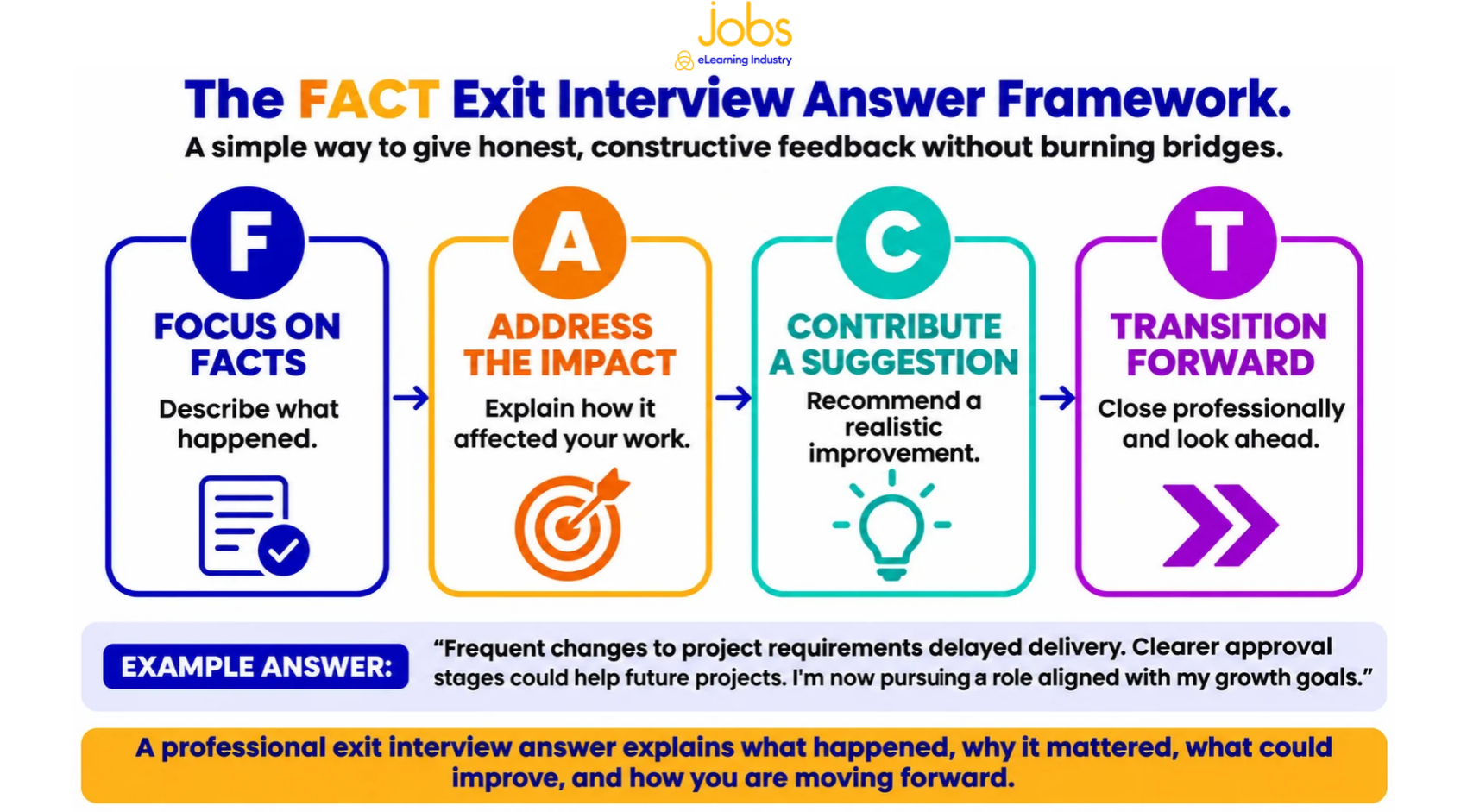
Answering exit interview questions is easier when you use a simple structure to organize your thoughts. A practical way to do this is to use the FACT framework. It helps you share helpful feedback at work without giving too much detail or criticizing anyone.
The FACT Exit Interview Answer Framework
F: Focus On Facts
Talk about a specific situation or a pattern you noticed. For example, you could mention unclear approval processes instead of saying management is incompetent.
A: Address The Impact
Share how the situation affected your work, teamwork, performance, growth, or your choice to leave.
C: Contribute A Constructive Suggestion
If it makes sense, suggest a realistic improvement. For example, you might recommend clearer responsibilities, involving stakeholders earlier, or setting better project priorities.
T: Transition Forward
End your answer in a professional way. You can mention something positive, talk about your next career step, or make it clear that your decision is final.
Reusable Exit Interview Answer Formula
"During [specific situation], [observable pattern] affected [work or employee impact]. A useful improvement would be [realistic suggestion]. I appreciated [positive aspect], and I'm now moving toward [professional next step]."
You don’t have to use every part each time. Adjust the framework to fit the question and your situation.
13 Common Exit Interview Questions And How To Answer Them
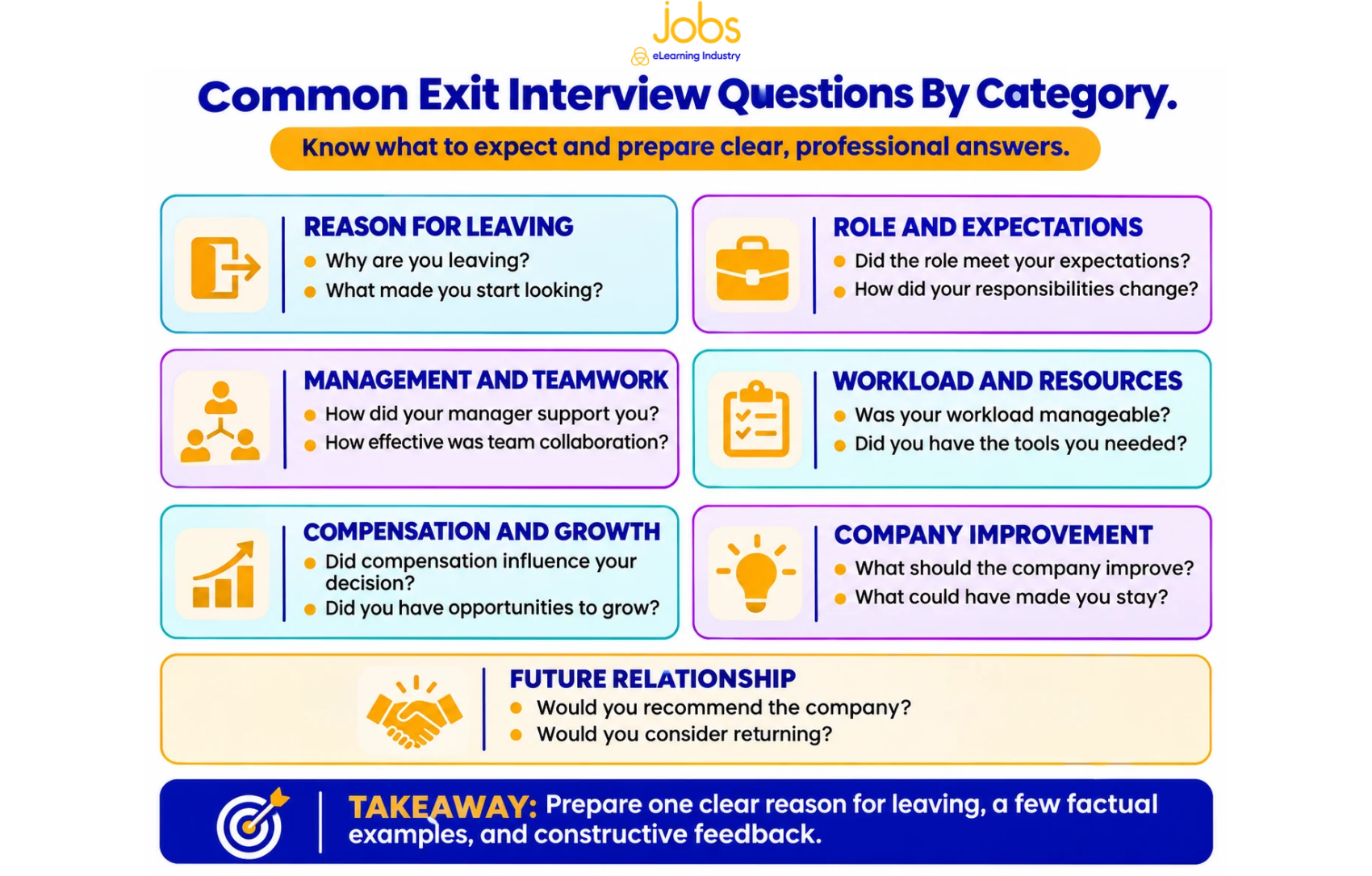
Exit interview questions usually focus on why you’re leaving, what your experience was like, and what might have made things better. The sample answers below are meant to guide you. Feel free to adapt them to your own experience rather than memorizing them word for word.
1. Why Are You Leaving?
What HR wants to know: Your main reason for leaving the company.
How to answer: Start with the main reason, such as career growth, workload, pay, or how well the role suited you.
Avoid: Making personal attacks or listing too many complaints.
Sample answer:
"I've enjoyed working on our learning projects, but my career goals have shifted toward learning strategy and performance consulting. There haven't been many opportunities to move in that direction within my current role, so I've decided to pursue a position that offers more strategic responsibilities and professional growth."
2. What Made You Start Looking For Another Job?
What HR wants to know: What initially triggered your job search.
How to answer: Explain the situation or pattern that led you to look for a new job.
Avoid: Going over every disagreement you had.
Sample answer:
"I started exploring opportunities when I realized my responsibilities were becoming increasingly administrative. Although I enjoyed supporting the team, I wanted to spend more time designing learning experiences and evaluating their impact. After several conversations about potential development opportunities, I decided to explore other roles."
3. Did The Role Match Your Expectations?
What HR wants to know: Whether the actual responsibilities matched what was discussed during hiring.
How to answer: Talk about how your actual responsibilities compared to what was described when you were hired.
Avoid: Overstating changes or criticizing tasks that weren’t part of your main role.
Sample answer:
"When I joined, I expected to focus primarily on Instructional Design and learning development. Over time, much of my work shifted toward LMS administration and troubleshooting. I gained valuable technical experience, but the role became different from the design-focused position I originally accepted."
4. What Did You Value Most About Working Here?
What HR wants to know: What you truly enjoyed about your time at the company.
How to answer: Talk about particular projects, people you worked with, skills you learned, or chances you had.
Avoid: Giving praise that isn’t sincere or specific.
Sample answer:
"I particularly appreciated working with colleagues from different departments. Collaborating with HR, IT, and Subject Matter Experts helped me understand how learning projects support broader business goals. I also valued the opportunity to work with new authoring tools and improve my technical skills."
5. What Was The Most Challenging Part Of Your Role?
What HR wants to know: What challenges made your job harder.
How to answer: Point out ongoing issues with processes and how they impacted your work.
Avoid: Blaming people without explaining what the real problem was.
Sample answer:
"The biggest challenge was managing frequent changes to project requirements after development had already started. These changes sometimes affected deadlines and required considerable rework. Earlier agreement on learning objectives, content ownership, and approval stages would have made projects easier to manage."
6. Did You Have The Training, Tools, And Resources You Needed?
What HR wants to know: Did a lack of resources make your job harder?
How to answer: Point out any important resources you didn’t have, like LMS access, authoring tools, analytics, SME support, or training.
Avoid: Saying every tool you liked was absolutely necessary.
Sample answer:
"I had access to the main authoring tools, but limited LMS reporting permissions made it difficult to evaluate learner performance independently. I often had to request data from other teams, which delayed project reviews. More direct access to relevant learning analytics would have improved the process."
7. How Would You Describe The Support You Received From Your Manager?
What HR wants to know: How your manager’s actions shaped your experience.
How to answer: Talk about things like communication, feedback, setting priorities, recognition, and support for your growth.
Avoid: Judging your manager's personality.
Sample answer:
"My manager was available when urgent issues arose, which I appreciated. However, I would have benefited from more consistent feedback and clearer priorities during busy periods. Sometimes I received conflicting directions on projects, which made planning difficult. Regular check-ins could have helped address those issues earlier."
8. How Effective Was Team And Stakeholder Collaboration?
What HR wants to know: Did teamwork and communication across departments help you do your job?
How to answer: Mention how decisions were made, who was responsible, how everyone worked together, and how reviews went.
Avoid: Blaming individual colleagues.
Sample answer:
"Collaboration within the L&D team was generally strong. However, projects involving several departments sometimes experienced delays because responsibilities weren't clearly assigned. For example, feedback from different stakeholders occasionally conflicted. Establishing one decision-maker for approvals would have made collaboration more efficient."
9. Was Your Workload Manageable?
What HR wants to know: Was your workload reasonable and manageable over time?
How to answer: Explain if busy times were just occasional or if there were ongoing workload issues.
Avoid: Saying things like "I was always overwhelmed" without giving details.
Sample answer:
"There were periods when the workload was manageable, but competing deadlines became a recurring issue as our project portfolio expanded. New requests were frequently added without adjusting existing commitments. Clearer prioritization and more realistic development timelines would have helped maintain quality without consistently extending working hours."
10. Did Compensation, Benefits, Flexibility, Or Career Growth Influence Your Decision?
What HR wants to know: Whether compensation and advancement opportunities contributed to your resignation.
How to answer: Be honest about what influenced your decision, but you don’t need to share private details about your new offer.
Avoid: Showing frustration, making unnecessary comparisons, or sharing your new salary if you’d rather keep it private.
Sample answer:
"Compensation and career growth were both factors in my decision. My responsibilities increased over time, but I didn't see a clear path toward progression that reflected those changes. I'm looking for an opportunity with responsibilities, development prospects, and compensation that better align with my experience."
If you’re looking at different job offers, the Yearly Salary Calculator can help you see how annual and hourly pay compare.
11. What Could The Company Have Done To Make You Stay?
What HR wants to know: Could anything at work have made you stay?
How to answer: Suggest practical changes, but make it clear you’ve made your decision.
Avoid: Giving the impression you might stay if you’ve already decided to leave.
Sample answer:
"A clearer career development path and more opportunities to contribute to strategic learning initiatives might have influenced my decision earlier. I had raised my interest in taking on broader responsibilities, but those opportunities didn't become available. At this point, I've made my decision, and I'm committed to a smooth transition."
12. What Should The Company Improve?
What HR wants to know: Which workplace changes you consider most important.
How to answer: Focus on one or two specific suggestions that could really help.
Avoid: Delivering a lengthy list of unrelated complaints.
Sample answer:
"I think the company could improve how learning projects are planned and approved. Involving key stakeholders earlier and agreeing on responsibilities before development begins would reduce unnecessary revisions. More transparent professional development pathways would also help employees understand how they can grow within the organization."
13. Would You Recommend The Company Or Consider Returning?
What HR wants to know: How you feel about the company overall and if you’d stay in touch professionally.
How to answer: Give a thoughtful, conditional response that reflects your experience.
Avoid: Forced praise or promises you don't mean.
Sample answer:
"I would recommend the company to someone whose career goals align with the opportunities available here. I've worked with talented colleagues and gained valuable experience. As for returning, I wouldn't rule it out completely, but it would depend on the role, management structure, and opportunities for professional growth."
Want a job that’s a better fit for your goals?
Set up your candidate profile and get job alerts tailored to your experience and career interests.
How Honest Should You Be In An Exit Interview?
In an exit interview, aim to be honest so your feedback is accurate and helpful, but also stay focused and professional by choosing what to share. This means you can talk about negative experiences without sharing all your emotions or personal details.
When To Give Direct Feedback
Be clear when discussing issues such as workload, pay, management support, career growth, communication, and project handling. For instance, it helps more to explain how constant changes to your work affected you than just saying the company was disorganized.
When The Issue Is Sensitive
Before you talk about sensitive topics, ask how your feedback will be used. You may want to find out if your comments will be written down, who can see them, if your name will be included, and if there are other ways to report issues.
Don’t assume your exit interview is always confidential or anonymous.
When The Issue Involves Serious Misconduct
If you’re leaving because of harassment, discrimination, retaliation, safety issues, or possible legal problems, don’t rely only on the exit interview to report them.
Think about using your company’s official reporting process, keeping written records, talking to a union rep if you have one, or getting legal advice. If you have urgent safety concerns, get help right away.
What If Your Manager Is The Reason You're Leaving?
If your manager played a part in your decision to leave, talk about their actions or habits instead of making it personal. For example, you could say that priorities often changed without notice or that you didn’t get regular feedback. If you brought up concerns before, mention when and how you did it.
If you want more tips on spotting ongoing workplace problems, check out Toxic Workplace: 12 Signs, Examples, And How To Protect Your Career.
What Should You Not Say In An Exit Interview?
It's just as important to know what not to say in an exit interview as it is to prepare your answers. Try to avoid the following:
- Personal insults, name-calling, and sarcastic comments.
- Rumors presented as facts or accusations you cannot explain.
- Threats or statements intended to retaliate against someone.
- Broad statements that use words like "always" or "never."
- Confidential customer, learner, colleague, or company information.
- Private details about your next employer or compensation.
- Statements you wouldn't be comfortable seeing documented.
- Listing lots of unrelated complaints or giving praise you don't mean.
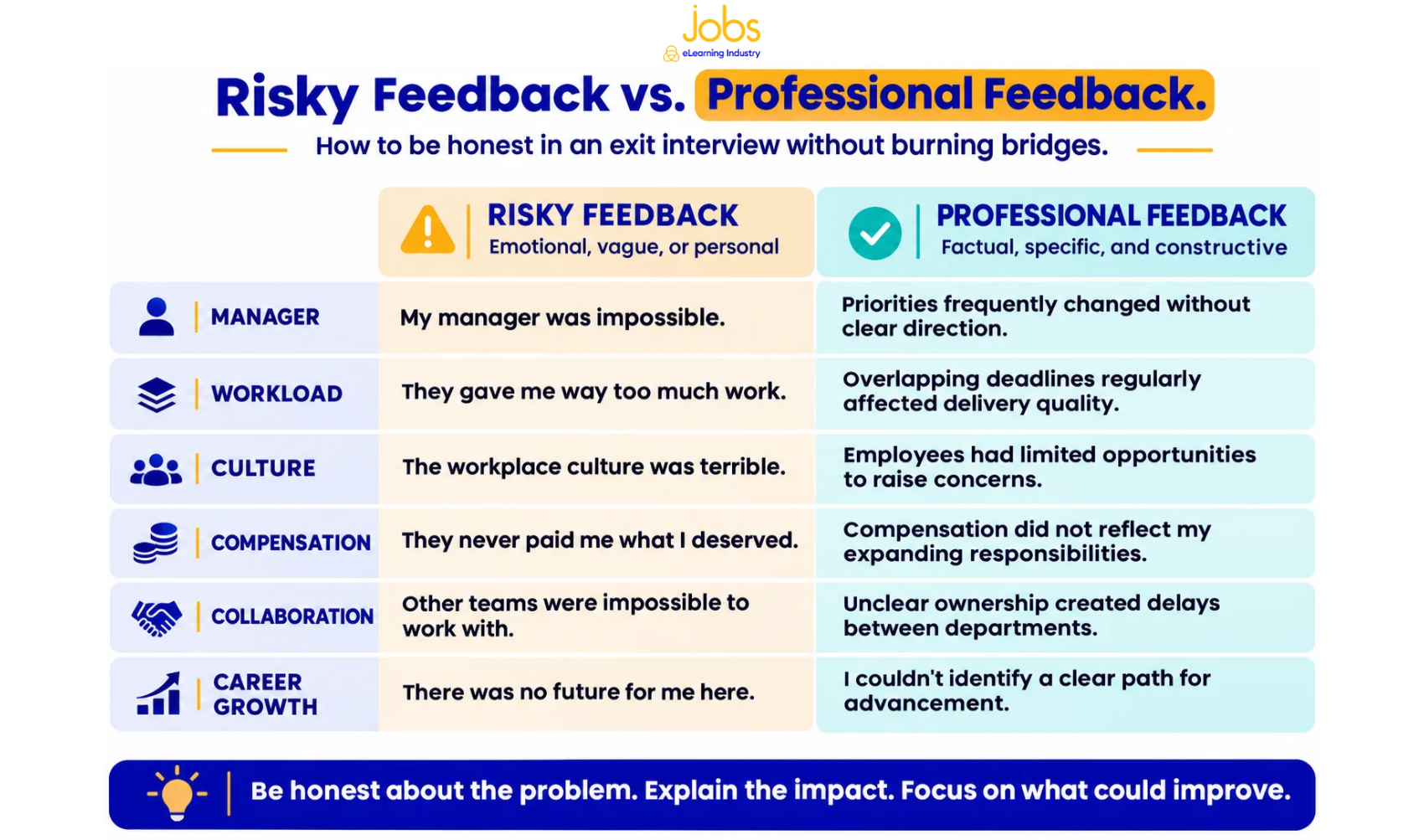
Here are some tips for handling sensitive topics professionally.
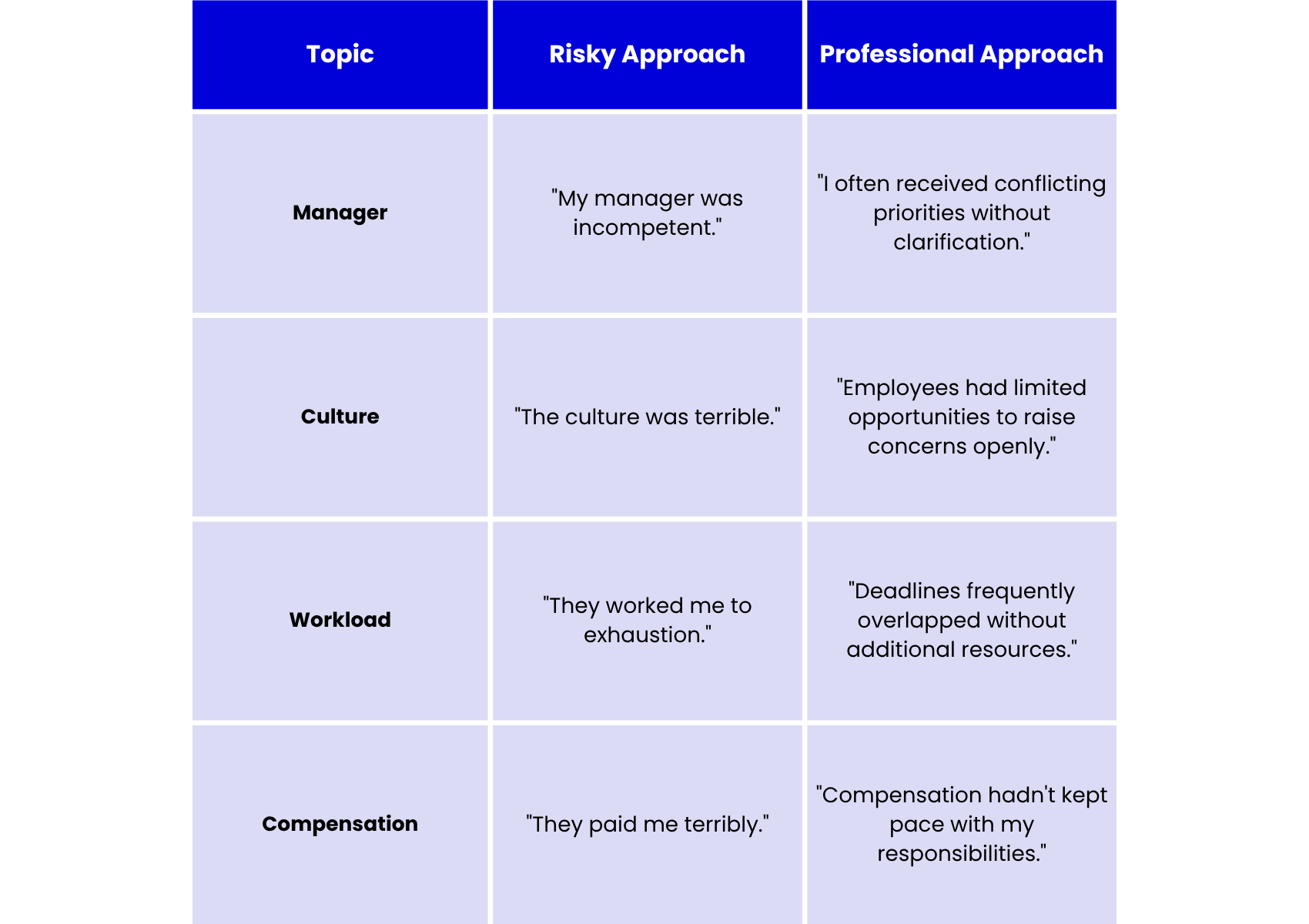
Avoiding inflammatory language does not mean covering up serious misconduct. The aim is to share information honestly without downplaying real concerns.
Can You Decline An Exit Interview Or Skip A Question?
You might be able to decline an exit interview, but whether you can depends on your company’s policy, your employment terms, any collective agreements, and local laws.
In many cases, exit interviews are voluntary. Still, it’s important to check your own situation instead of assuming the same rule applies everywhere.
Depending on your circumstances, you might choose to attend, ask for a written questionnaire, request a different HR representative, give limited feedback, skip questions you find sensitive, or decide not to participate at all.
Here are three ways to respond professionally.
If you want to decline the interview:
"Thank you for the invitation. After considering it, I'd prefer not to participate in an exit interview. I appreciate the opportunity and will complete my remaining transition responsibilities."
If you don't want to answer a question:
"I'd prefer to keep that information private, but I'm happy to discuss other aspects of my experience."
If you're concerned about confidentiality:
"Before answering, could you clarify how my responses will be recorded, who will have access to them, and whether they'll be attributed to me?"
What Happens After An Exit Interview?
After your exit interview, HR might write down your comments, sum up your feedback, share important points with company leaders, or follow up with more questions. Keep in mind that not everything you share will necessarily stay confidential, and your feedback may not influence your future references.
Next, focus on leaving your job in a professional way. Be sure to finish handing over your work, return any company items, take care of any remaining paperwork, and keep personal records of important details. It’s also a good idea to stay in touch with colleagues you trust.
Finally, think about how you’ll explain your departure to future employers. Our guide on Reasons For Leaving The Company: Best Answers For Interviews can help you talk about your career move in job interviews.
Leave Professionally And Prepare For Your Next Career Move
You don’t have to say only positive things in an exit interview. What matters most is being clear, honest, and keeping things professional. After you leave, take some time to think about what you learned from your experience and what you’d like to do differently in your next job.
Update your CV, think about which responsibilities and work conditions are important to you, and take a close look at potential employers. If you need help, check out our guide to good interview questions to help you evaluate new opportunities.
You might also want to look into Learning and Development roles or EdTech jobs that fit your career goals.
Are you ready for your next opportunity?
Finish this chapter on a professional note and get ready for what’s next. You can create a candidate profile, upload your CV, set up job alerts, and browse current openings in eLearning, L&D, Instructional Design, and EdTech.
FAQs About Exit Interviews
1. What Is An Exit Interview?
An exit interview is a structured meeting or questionnaire completed when an employee leaves an organization. It allows employees to explain their reasons for leaving and provide feedback about their role, manager, working conditions, professional development, and overall experience.
2. What Questions Are Usually Asked In An Exit Interview?
Common exit interview questions cover why you're leaving, whether your role met expectations, how your manager supported you, workload, compensation, company culture, and career development opportunities. You may also be asked what the organization could improve or whether you'd consider returning.
3. How Should I Answer "Why Are You Leaving?"
State your main reason for leaving clearly and professionally. Provide a brief explanation and, when appropriate, connect it to your future career goals. You don't need to discuss every factor that contributed to your decision, but your answer should remain accurate.
4. How Honest Should I Be In An Exit Interview?
Be truthful about your experiences while keeping your feedback factual, relevant, and constructive. You can discuss negative experiences directly without turning the meeting into a personal confrontation. If something is sensitive, ask how your comments will be documented and shared before responding.
5. What Should I Not Say In An Exit Interview?
Avoid personal attacks, threats, rumors presented as facts, unnecessary confidential information, and exaggerated statements. Instead, describe specific workplace practices and their impact. However, professionalism doesn't mean ignoring or concealing serious workplace misconduct.
6. Can I Decline An Exit Interview?
You may be able to decline an exit interview, request another format, or skip certain questions. However, participation requirements depend on your employer's policies, employment terms, and applicable laws or agreements. Review your circumstances before deciding how to respond.
7. Is An Exit Interview Confidential?
Not necessarily. Some organizations restrict access to employee feedback, while others share relevant details with managers or leadership. Confidentiality and anonymity aren't automatically guaranteed. Ask who can access your responses, whether your name will be attached, and how the information will be stored.
8. Should I Reveal My New Employer Or Salary?
You can explain what attracted you to your next opportunity without revealing the employer's name, your new salary, or confidential offer details. If you're uncomfortable answering, politely explain that you'd prefer to keep those details private.
9. Can An Exit Interview Affect A Reference?
It's possible, depending on company policies, reference practices, and who has access to your feedback. Some organizations provide only basic employment verification, while others may offer more detailed references. Staying factual and professional can help protect relationships, but it doesn't guarantee a particular outcome.