

Toxic Workplace: How To Spot It And What To Do
A toxic workplace is not just a place where you have tough days, challenging projects, disagreements, or a manager who isn't perfect. These things can happen even in healthy organizations. Workplace toxicity is a bigger problem when harmful behaviors, poor management, or a negative company culture erode trust, fairness, respect, and psychological safety, or make it hard for employees to do their jobs well.
Knowing the difference is important. It helps you figure out if you're facing a short-term problem or a lasting toxic environment. Then you can choose what to do, protect your reputation, and decide if it's time to look for a new job.
This isn't just a trendy phrase. According to the American Psychological Association's "2024 Work in America survey," 15% of workers said their workplace was somewhat or very toxic.
Thinking about changing jobs?
Check out the latest openings in eLearning, L&D, Instructional Design, and EdTech.
Key Takeaways
- A toxic workplace involves persistent patterns, not one difficult day, disagreement, or demanding project.
- Common toxic workplace signs include fear-based management, poor communication, favoritism, ignored boundaries, retaliation, and consistently high turnover.
- A toxic workplace is not automatically the same as a legally hostile work environment.
- Documenting facts, reviewing workplace policies, and maintaining professional boundaries can help protect your career.
- If conditions remain unchanged, a structured job search may be more productive than waiting indefinitely for the environment to improve.
What Is A Toxic Workplace?
A toxic workplace is an environment where ongoing behaviors, management styles, or company norms damage trust, fairness, respect, or psychological safety. These issues often make it hard for employees to do their jobs well. Usually, the problem is a pattern that keeps happening, not just a one-time issue.
Toxic workplaces can show up in different ways. Employees might feel scared to question decisions, admit mistakes, speak up about problems, or disagree with their managers. Communication can be unclear. Favoritism might affect who gets opportunities. Bad behavior may happen again and again without being addressed.
The issue is not always just one difficult coworker or boss. If leaders allow harmful behavior, treat people unfairly, or often ignore employee concerns, it can point to a bigger problem with the whole workplace culture.
Psychological safety is especially important. The U.S. Surgeon General's Framework for Workplace Mental Health and Well-Being says that protecting people from physical and psychological harm is a basic need at work. It also explains that psychological safety means people can speak up without worrying about being punished, getting back at, or feeling embarrassed.
However, just because a workplace is stressful or not perfect does not mean it is toxic. How often problems happen, how serious they are, how long they last, and how the company responds all make a difference.
Toxic Workplace Vs. Difficult Workplace: What's The Difference?
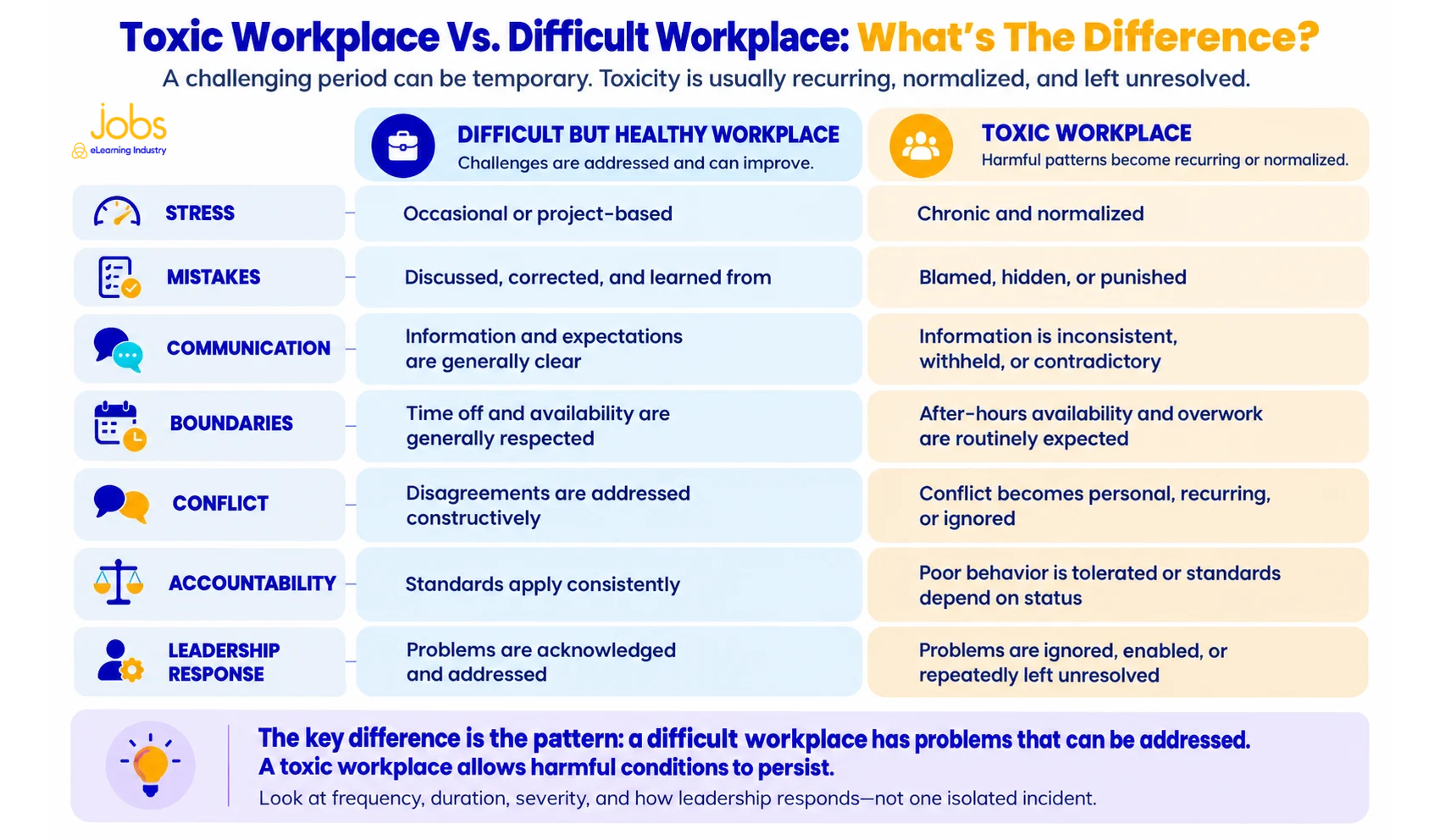
A toxic workplace is different from a difficult but mostly healthy one because harmful conditions often happen again and start to feel normal.
Stress can come from a busy quarter, a disagreement with your manager, or a project that did not go well. In a healthy workplace, people can usually talk about problems and fix them. In a toxic workplace, leaders might allow, ignore, reward, or fail to address bad behavior.
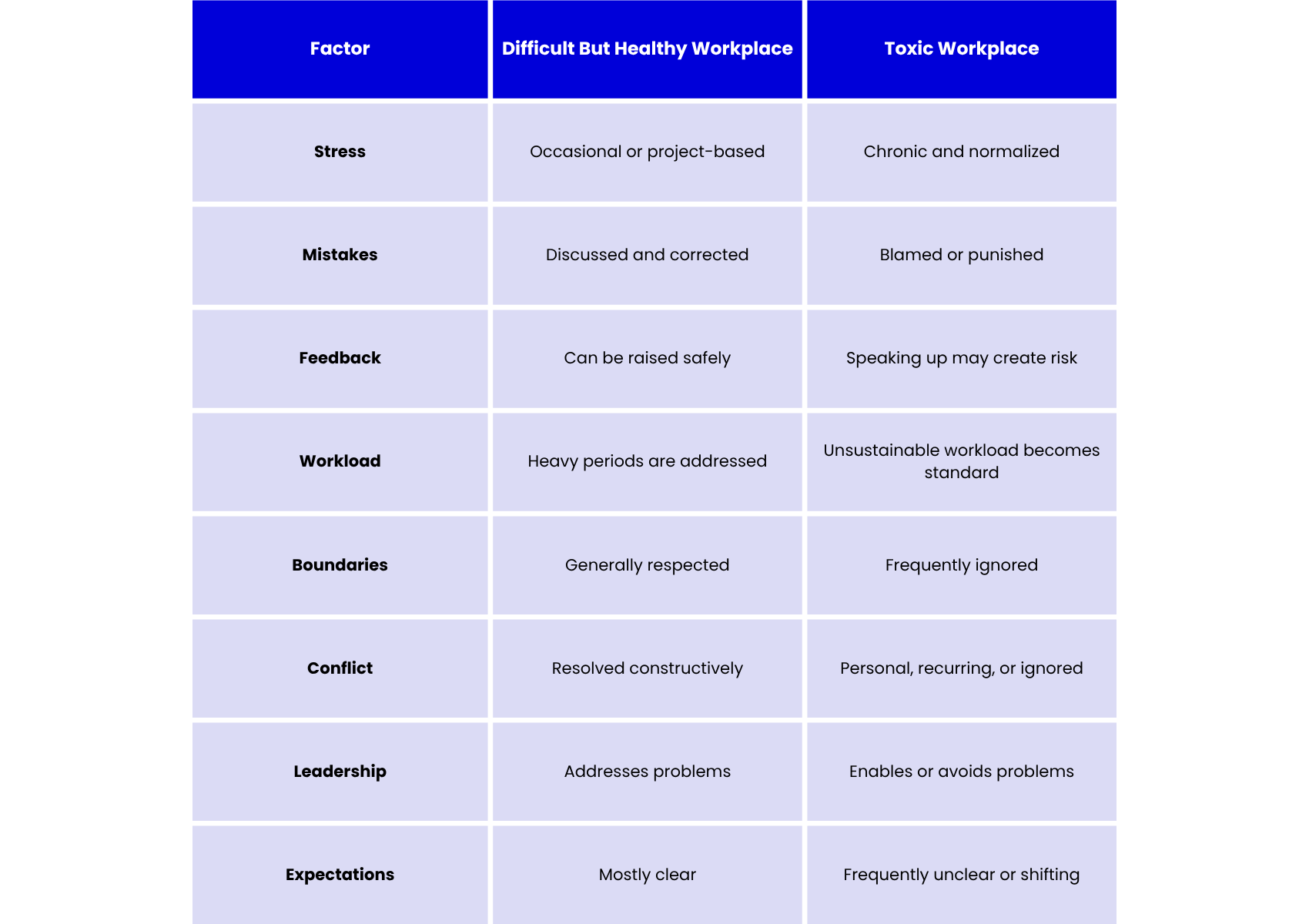
Having one difficult manager does not mean the whole company is toxic. What matters is how the company responds when that manager acts out. Does the company step in, set clear expectations, and fix the issue? Or does it keep letting the bad behavior go on? This distinction can help you distinguish between everyday workplace problems and ongoing toxic behavior.
Toxic Workplace Vs. Hostile Work Environment
A toxic workplace is a general term for negative work environments and cultures. In contrast, a hostile work environment has a specific legal definition, especially in U.S. employment law.
The U.S. Equal Employment Opportunity Commission explains that unlawful workplace harassment under federal anti-discrimination laws must involve conduct connected to a legally protected characteristic, such as race, religion, sex, national origin, disability, age, or genetic information. Depending on the circumstances, unlawful harassment may involve an adverse employment action or conduct that is severe or pervasive enough to create an environment that a reasonable person would consider hostile or abusive.
Personality clashes, unfair treatment, rude behavior, or disagreements can make a workplace very unpleasant, but they do not always constitute a hostile work environment under the law.
Editor's Note: Employment laws vary by country and region. If you are facing harassment, discrimination, retaliation, threats, or another potentially unlawful situation at work, it is a good idea to seek advice tailored to your location and circumstances. This article is meant to offer general career information, not specific legal advice.
12 Signs Of A Toxic Workplace
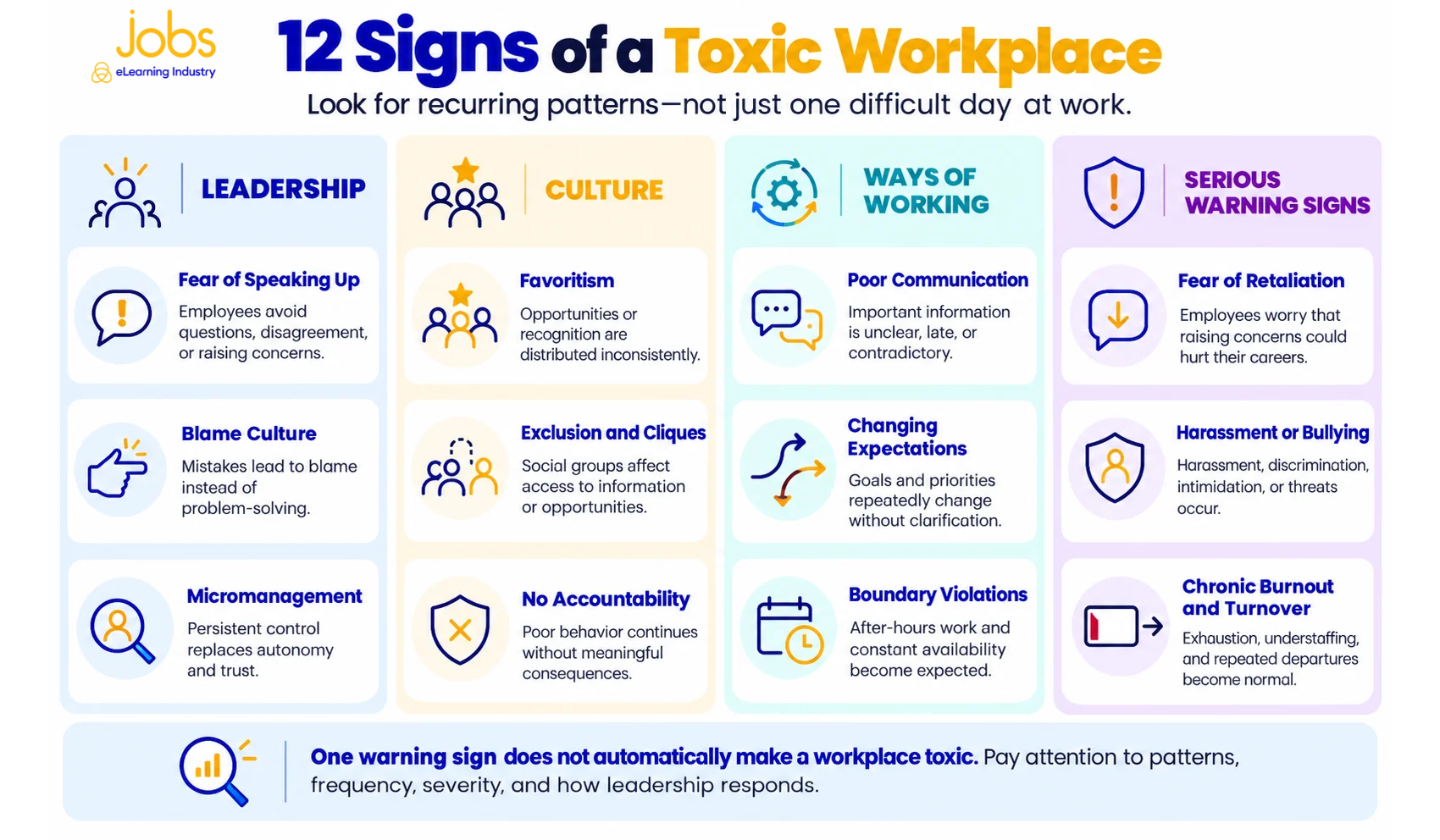
The most obvious signs of a toxic workplace tend to show up as repeating patterns. While a single incident might be worth noticing, seeing several warning signs over and over often means there is a bigger problem with the work environment.
1. People Are Afraid to Speak Up
A major sign of a toxic workplace is when people are afraid to speak up, ask questions, admit mistakes, or disagree with their managers.
Employees might stay quiet because they worry about being criticized, left out, or punished. As a result, mistakes are hidden instead of talked about, which lowers trust and makes people feel less safe at work.
2. Blame Is More Common Than Problem-Solving
In a blame culture, people care more about finding someone to blame than about understanding what caused the problem.
For example, managers might call out employees in front of others after a project fails, but ignore issues like unrealistic deadlines, confusing instructions, or choices made by leaders.
Holding people accountable is important, but constantly humiliating or blaming others is not.
3. Communication Is Inconsistent or Deliberately Unclear
Poor workplace communication becomes problematic when employees routinely lack the information they need to succeed.
Sometimes, important decisions are kept from employees, priorities change without warning, or managers give conflicting instructions. Then, employees might get blamed for results they could not have predicted.
4. Favoritism Influences Opportunities
Favoritism at work can show up in who gets promoted, which assignments people get, who has more flexibility, who gets recognized, who can talk to leaders, or who gets chances to grow.
Not every difference in outcome means there is favoritism. Things like performance, experience, and job duties can fairly affect opportunities. The real warning sign is when some people keep getting special treatment for reasons that are not clear or consistent.
5. Expectations Constantly Change
It is normal for priorities to change in many jobs. The problem starts when employees are judged by expectations that were never explained to them.
Goals may change after work is finished, responsibilities may expand without discussion, or managers may criticize employees for failing to predict unstated requirements.
6. Micromanagement Replaces Trust
Not every situation with close supervision counts as micromanagement. New hires, complicated projects, or risky tasks might need more oversight.
The real warning sign is when managers maintain tight control, show little trust or helpful feedback, and do not let employees make routine decisions on their own, yet still hold them fully responsible for the results.
7. Work-Life Boundaries Are Routinely Ignored
In a toxic work culture, employees may be expected to always be available.
You might find that after-hours messages are treated as mandatory, vacations are often interrupted, unpaid extra work is expected, and every deadline feels like an emergency.
Having an urgent situation once in a while is normal, but constant urgency should not be the standard way of working.
8. Burnout and Turnover Are Normalized
If burnout and high turnover become a regular part of how a team operates, it's a sign that something needs attention.
You might see the same roles posted again and again, teams that are always understaffed, or tired employees being told that overwork is just part of the job.
High turnover by itself doesn't always mean a company has a toxic culture. Things like industry trends, restructuring, or pay can also play a role. Try to notice the bigger pattern.
9. Gossip, Cliques, or Exclusion Affect Work
Most workplaces have social groups, but they become a problem when cliques or exclusion start to affect who gets information, opportunities, or a say in decisions.
For example, remote employees might miss out on important discussions if decisions are made informally by a small group in the office.
10. Poor Behavior Has No Consequences
A clear sign of a toxic workplace is when accountability is not applied consistently.
Sometimes, a top performer is allowed to mistreat others just because they get results. Complaints about managers might go nowhere, and senior employees may not have to follow the same rules as everyone else.
If an organization keeps protecting harmful behavior, it means the issue is bigger than just one person.
11. Employees Fear Retaliation
Employees might worry that speaking up about problems will lead to fewer opportunities, worse assignments, being left out, or even being treated badly.
This fear can stop real concerns from reaching the people who could help.
Retaliation can also have legal consequences, especially when employees use their protected rights. In these cases, it may be important to get professional or legal advice.
12. Bullying, Harassment, Discrimination, or Threats Occur
Workplace bullying, harassment, discrimination, intimidation, violence, and threats are some of the most serious signs of a toxic workplace.
If you have immediate safety concerns at work, your safety comes first. You can seek help through company reporting channels, HR, security, outside authorities, a professional representative, or legal advice, depending on your situation.
Toxic Workplace Examples In eLearning, L&D, And EdTech
A toxic workplace can show up in many ways, depending on the profession. In eLearning, L&D, Instructional Design, and learning technology, problems often appear in project expectations, how people work together, and unclear responsibilities.
- Instructional Designer: When a project's scope and deadlines keep changing, the Instructional Designer may still get blamed for missing the original delivery date.
- L&D Specialist: Leadership wants measurable training results, but does not give enough time, access to learners, support from stakeholders, or resources to make it possible.
- LMS Administrator: The LMS Administrator is often blamed for infrastructure problems, even when the technical issues have already been reported and raised with others.
- Remote Learning Team: Remote employees are often left out of important meetings, decisions, professional development, or high-profile projects.
- Training Manager: The Training Manager is asked to fix ongoing performance problems with more training, even when the real issues are about staffing, workflows, incentives, processes, or management.
In each of these situations, the main question is whether the problem happens only once and is handled well, or if it keeps happening without real solutions.
How Can A Toxic Workplace Affect Your Career?
A toxic workplace affects more than just how happy you feel at work. Over time, it can lower your confidence, hurt your performance, slow your professional growth, and limit your future career choices.
For instance, if expectations keep changing, it can be tough to show you're doing a good job. When there aren't many chances to learn new things, your skills might stop improving. If relationships at work are strained, you might miss out on projects that could build your portfolio or help you get promoted.
Chronic stress and burnout can make it harder to do your best work, connect with others, earn certifications, or get ready for your next step. Sometimes people switch jobs more often just to get away from a bad environment, which can lead to a career path they have to explain later.
This has a big impact on career movement. According to the APA's "2023 Work in America survey, "58% of people who said their workplace was toxic planned to look for a new job in the next year. Only 27% of those who didn't describe their workplace as toxic said the same.
If you notice these career effects early, you can make a more thoughtful choice about what to do next, instead of staying in a bad situation just because you're unsure.
What Should You Do If You Work In A Toxic Workplace?
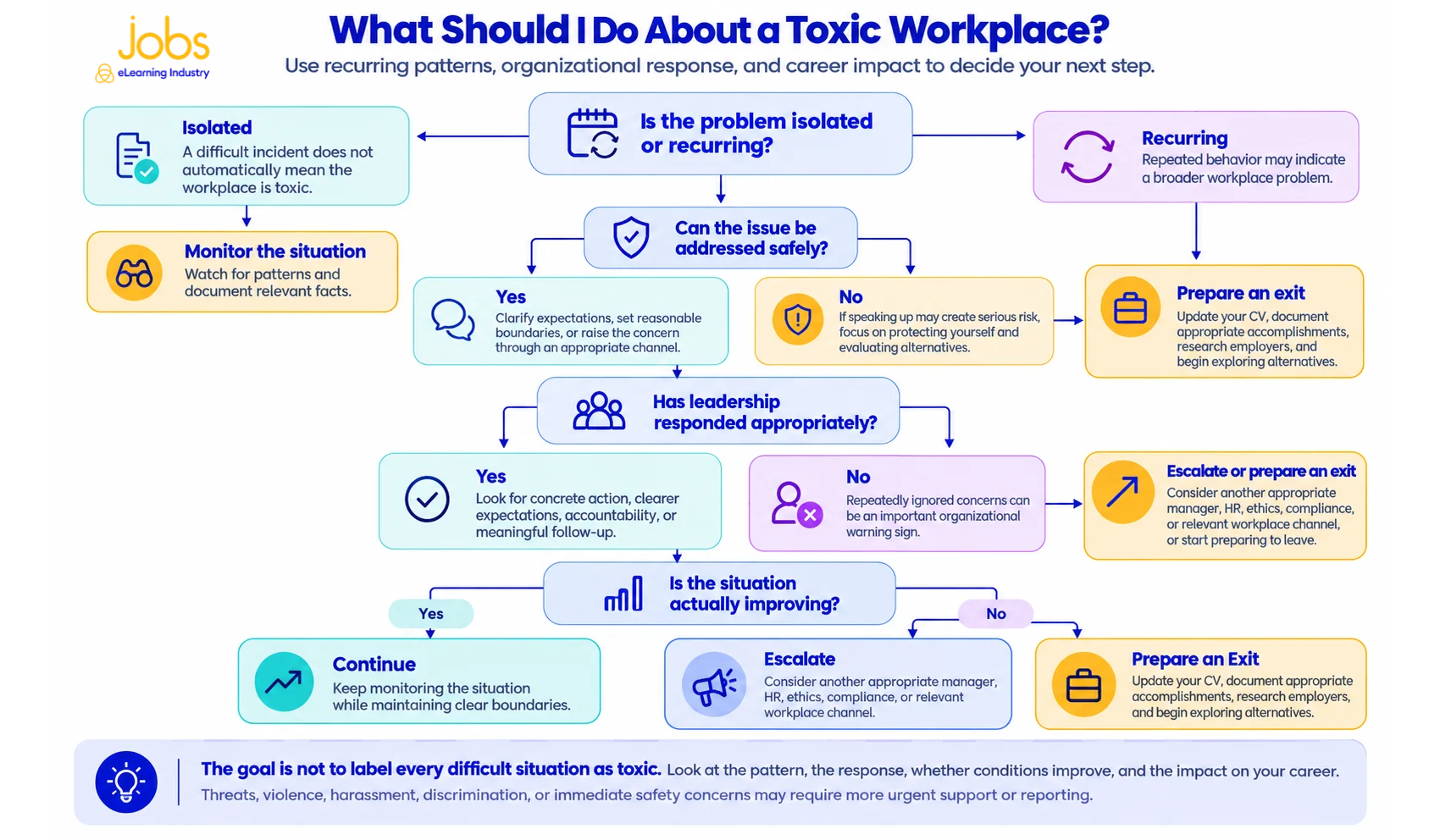
If you think your workplace is toxic, start by understanding what is going on and making sure you keep your options open, instead of reacting right away.
1. Identify Patterns, Not Just Incidents
Try to tell the difference between one-time events and recurring patterns. Think about what happened, how often it happens, who is involved, if others have the same issues, and how leaders react. Patterns usually reveal more than just a single bad experience.
2. Document What Happens
Keep records of what happens when it makes sense. Write down dates, what happened, who was there, any instructions, changes in expectations, messages, and what you have already done.
Stick to the facts instead of guessing why someone did something. Do not take or copy any confidential or protected company information when making your records.
3. Review Workplace Policies and Reporting Channels
Look at your employee handbook and any other workplace policies. Depending on where you work, you might have options like HR, management, ethics, or compliance systems, harassment policies, or other official ways to report problems. Knowing the process can help you decide if and how you want to raise your concern.
4. Establish Reasonable Boundaries Where Possible
Communicating clearly can often help prevent problems that might otherwise have been avoidable. When you have several tasks competing for your attention, check which ones are most important. Write down key instructions and make sure everyone knows when you are available. If your manager gives you several urgent tasks, ask which one should come first.
Setting boundaries may not solve every problem in a difficult workplace, but it can help make things clearer and protect your work.
5. Raise Concerns Through Appropriate Channels
If it feels safe and makes sense, you might choose to talk with your manager, another manager, HR, an ethics or compliance team, or someone else who represents your workplace. Stick to the facts when you talk. Describe what happened, how it affected your work, and what outcome you hope for.
Don't expect HR or another internal group to always fix the problem. Instead, see how they respond as one more thing to consider about your workplace.
6. Start Evaluating Your Alternatives
Sometimes things get better at work, but sometimes they don't. Looking for a new job is a valid choice, but you don't have to quit right away. You can start by researching roles, checking out job search tips, exploring job sites, and thinking about what you want in your next workplace before you decide.
When Should You Consider Leaving A Toxic Workplace?
Deciding to leave a toxic workplace is a personal choice. The right answer depends on how serious the situation is, what options you have, and how your organization responds.
Rather than just asking, "Is my workplace toxic?" consider these five factors:
1. Severity: How serious is the behavior or working condition?
2. Frequency: Is this an isolated problem or something that happens repeatedly?
3. Duration: Has it continued despite reasonable attempts to address it?
4. Response: Does leadership acknowledge concerns and take meaningful action?
5. Career impact: Is staying supportive or limiting your performance, development, reputation, and future opportunities?
These questions can help you tell the difference between a tough time at work and a workplace where staying is becoming too costly for your career.
If you face violence, threats, illegal harassment, discrimination, or urgent safety issues, act quickly. In these cases, seek help from professionals, your organization, legal experts, or emergency services as needed.
How To Leave A Toxic Workplace Without Damaging Your Career
You do not have to make the toxic environment the main part of your professional story when you leave. Planning your exit carefully can help protect your reputation and set you up for a better opportunity.
Build Your Exit Plan Before You Resign
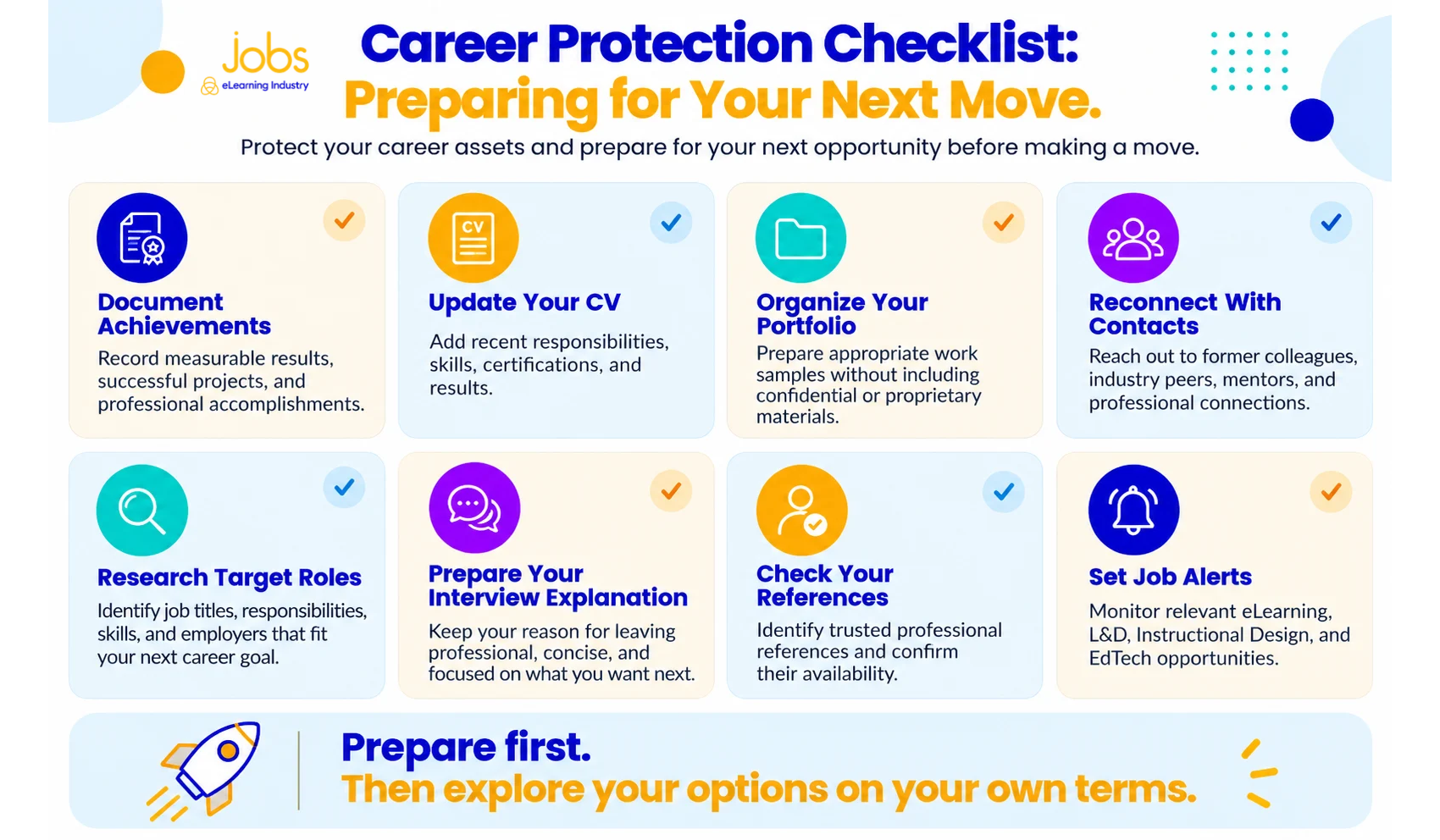
If possible, get ready before you give your notice. Figure out what jobs you want next. Check your finances. Update your resume, CV, and portfolio. Reach out to your professional contacts. Look into possible employers.
You can also set up or refresh your candidate profile and start looking at job openings before you resign.
These resources can help you organize your job search:
- 10 Job-Hunting Tips And Strategies From Jobs by eLearning Industry
- Cover Letter Sample: Templates & Examples For Every Job
- Best Job Search Engines in 2026: Where to Find the Right Job Faster
Preserve Evidence of Your Accomplishments
Before you leave, be sure you can clearly explain what you accomplished. Keep records of your results, finished projects, qualifications, feedback, and any other achievements you are allowed to keep.
Do not copy any company-owned courses, learner data, confidential reports, client materials, internal documents, or other protected information for your portfolio.
Keep Your Job Search Professional
Do not publicly criticize your employer or share emotional complaints about coworkers. The same principle applies during interviews. Recruiters rarely need a detailed account of every conflict at your current workplace. They need to understand what you want next and why the opportunity makes sense.
Prepare to Explain Why You Are Leaving
Try using a simple, future-focused approach:
What you learned → What you are looking for next → Why this opportunity fits
For example, you could say your current job helped you build stakeholder-management skills, but now you want a role with clearer responsibilities, better teamwork, and more chances to focus on your skills.
This guide can help you get ready without making the interview about criticizing your old employer:
Thinking about your next move?
Look for jobs that fit your skills and set up job alerts so you can keep an eye on new openings without feeling rushed.
How To Spot A Toxic Workplace Before You Accept The Job
To avoid ending up in another toxic workplace, look beyond just the job title, salary, and benefits. No interview process can promise a healthy company culture. Still, you can watch for red flags, ask specific questions, and see if the information you get stays consistent.
Pay Attention to the Hiring Process
Watch out for red flags during interviews, like repeated scheduling issues, interviewers giving different descriptions of the job, unclear reporting lines, vague ways to measure success, or pressure to accept the offer quickly without explanation. These issues alone do not prove a workplace is toxic. They just give you a reason to ask more questions.
Ask Why the Position Is Open
There are plenty of good reasons a job might be open, like company growth, someone getting promoted, restructuring, or a new business need. But asking why the job is open can also show if there's been a lot of turnover, unclear responsibilities, or expectations that haven't been met. Listen for a straightforward answer and ask more questions if you need to.
Ask How the Team Handles Mistakes and Conflicting Priorities
Asking about daily work routines often gives you more insight than simply asking, "What is the culture like?"
You might want to ask questions like these:
- "How does the team handle competing deadlines?"
- "How is feedback usually delivered?"
- "What happens when someone raises a concern?"
- "How would you describe the manager's working style?"
- "What would success in the first 90 days look like?"
If you want more ideas, check out Good Questions To Ask In An Interview before you talk to your next employer.
Look for Consistency
Pay attention to what you hear from the recruiter, hiring manager, potential teammates, the job description, and the company's career materials. See if the information matches up. If someone tells you the job has clear boundaries, but someone else says people often work evenings, don't hesitate to ask for more details.
Contradictions don't always mean the company culture is bad, but if you notice big differences, it's worth looking into them before you accept a job offer.
What Does A Healthy Workplace Look Like Instead?
A healthy workplace does not mean there are no deadlines, disagreements, stress, or mistakes. Instead, healthy workplaces help employees handle these challenges in a positive way.
- You should see clear expectations, respectful communication, healthy work-life boundaries, consistent accountability, helpful feedback, equal chances for growth, and fair recognition.
- Employees also need to feel safe enough to ask questions, respectfully challenge ideas, admit mistakes, and share concerns without always worrying about being punished.
- Transparency is important too. Even if employees do not agree with every decision, they should know how key decisions are made and what is expected of them.
- Most importantly, notice how managers respond when problems come up. A healthy workplace does not expect everyone to be perfect. Instead, it relies on noticing and dealing with issues instead of ignoring them.
Find A Workplace That Supports Your Next Career Move
Knowing what makes a workplace toxic can help you figure out what you want from your next employer.
When you understand the kind of environment where you do your best work, you can look at new job options with more focus.
Check out roles in:
- Learning & Development
- Instructional Design
- Corporate Training
- LMS Administrator
- Learning Technology
- and other eLearning or EdTech roles that fit your background.
You do not have to decide right away. Building a candidate profile, updating your CV, and setting up job alerts can help you explore your options as you consider your next step.
FAQs About Toxic Workplaces
1. What is a toxic workplace?
A toxic workplace is one where ongoing behaviors, management styles, or company habits erode trust, respect, fairness, or a sense of safety. Unlike short-term stress, toxic workplaces have lasting problems that leaders allow to persist or fail to fix.
2. What are the biggest signs of a toxic workplace?
Some common signs of a toxic workplace include fear of speaking up, blaming others, poor communication, favoritism, constantly changing expectations, ignoring work-life balance, frequent burnout or people quitting, and not holding people accountable for bad behavior. One sign alone does not mean a workplace is toxic. Pay attention to how often these things happen, how long they last, how serious they are, and how the company responds.
3. What are examples of toxic workplace behavior?
Examples of toxic workplace behavior include blaming employees in front of others, withholding important information, allowing top performers to treat coworkers badly, changing expectations without explanation, punishing people who speak up, excluding some employees from opportunities, ignoring healthy boundaries, and failing to address bullying or harassment.
4. Is a toxic workplace the same as a hostile work environment?
No. A toxic workplace is a general term for unhealthy work conditions. A hostile work environment has a specific legal meaning. In the U.S., illegal harassment usually involves behavior related to a protected characteristic and must meet certain legal standards. Regular disagreements or personality clashes do not count.
5. How do I deal with a toxic workplace?
If you are trying to handle a toxic workplace, begin by noticing repeated problems and writing down what happens. Check your company's policies, set clear expectations and boundaries when you can, and use the right ways to report issues. See if the company's response helps. If things do not get better, start looking at other job options and update your resume.