

Chief Learning Officer Interview Questions: Your 2026 Guide
Chief Learning Officer interview questions cover much more than just designing training programs or managing an L&D team. At this level, hiring teams want to see if you can link learning to business goals, build workforce skills, influence leaders, manage resources, measure outcomes, and make good technology choices.
This is what sets a Chief Learning Officer interview apart from a typical Learning and Development interview. You are not just being judged on your L&D expertise. You are also being considered as an executive who could help the organization build the skills it needs to achieve its goals.
This guide highlights the key CLO interview questions about strategy, ROI, leadership, workforce development, technology, and organizational impact. It also explains what hiring teams are really looking for and what examples you should get ready.
Are you getting ready for your next L&D leadership role?
Check out the latest senior Learning and Development jobs on Jobs by eLearning Industry.
Key Takeaways
- CLO interviews focus heavily on how the learning strategy supports the business strategy.
- Candidates should prepare measurable examples of learning initiatives that influenced workforce, performance, or business outcomes.
- Executive influence, prioritization, and stakeholder management matter as much as technical L&D expertise.
- Strong answers distinguish learning activity metrics from performance and business impact measures.
- Candidates should also prepare questions that reveal the organization's mandate for L&D, executive expectations, resources, and definition of success.
What Do Interviewers Look For In A Chief Learning Officer?
In a Chief Learning Officer interview, you'll be asked to show how you can turn business goals into workforce skills, learning plans, measurable results, and positive outcomes for the organization.
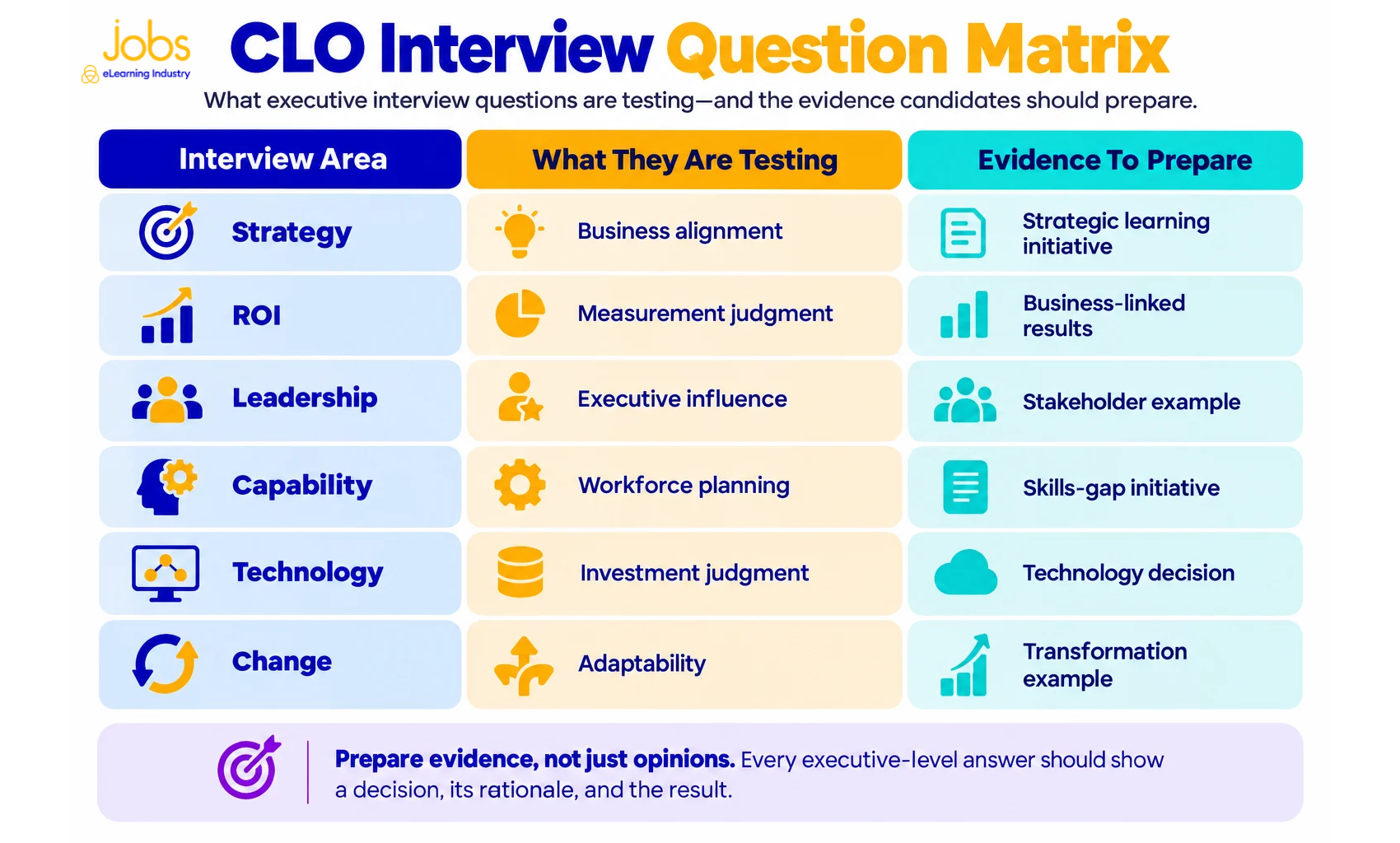
Interviewers usually focus on eight main areas:
- Strategic thinking: Are you able to understand business priorities and turn them into the skills your team needs?
- Business alignment: Can you link learning and development investments to the organization's true needs?
- Measurement and ROI: Can you show that your learning programs are making a real difference?
- Executive influence: Are you able to get buy-in from senior leaders and speak up when you need to challenge their assumptions?
- Leadership: Can you create and lead a strong learning and development team?
- Workforce capability: Can you spot important skills gaps and find ways to close them?
- Technology judgment: Can you make smart choices about AI, learning platforms, and other tools for learning?
- Change leadership: Are you able to adjust your learning strategy as the organization evolves?
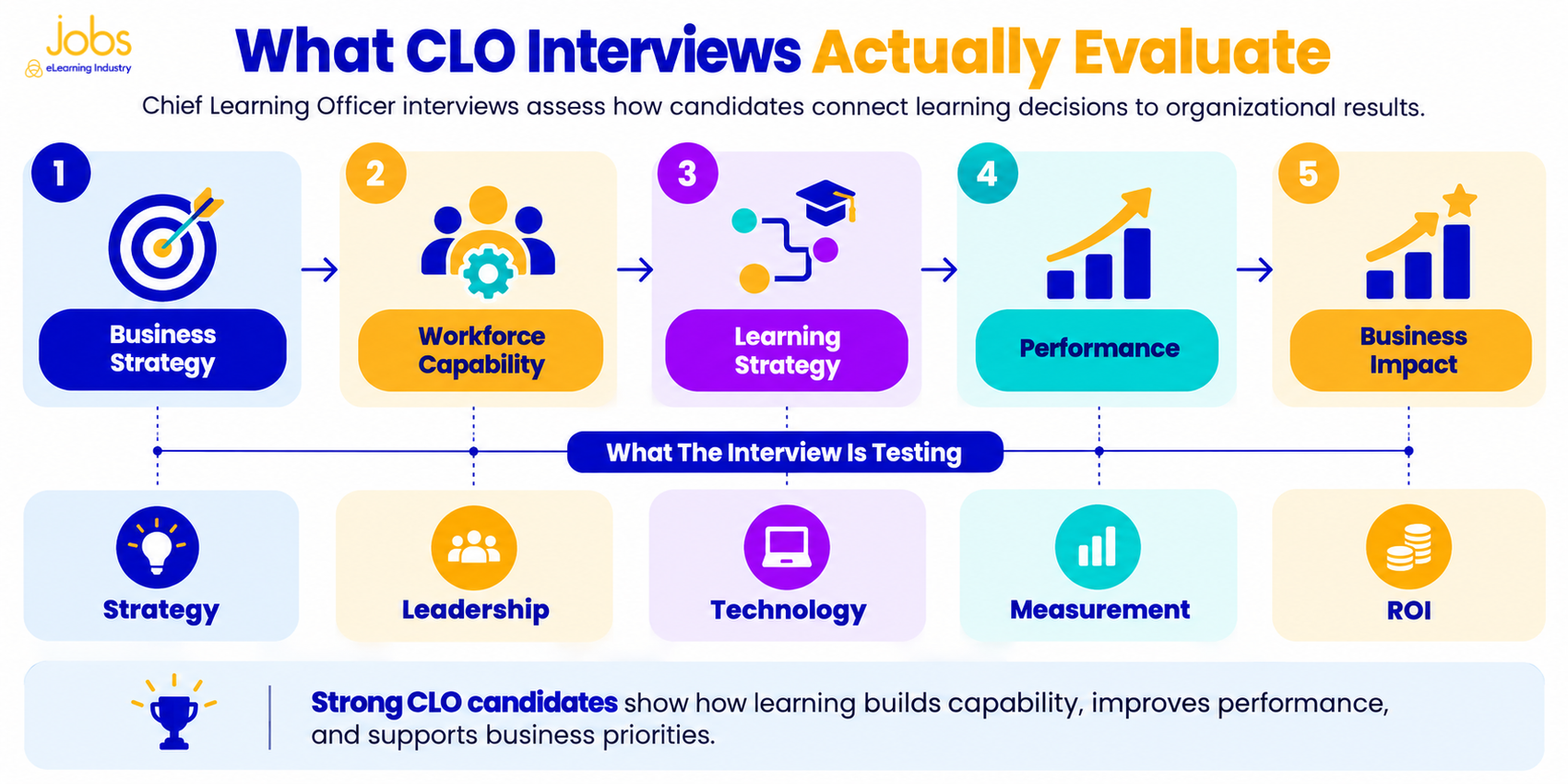
Moving from an operational L&D role to a Chief Learning Officer is mostly about changing how you think. Instead of starting with courses, a CLO needs to draw a clear connection:
Business strategy → workforce capability → learning strategy → performance → business impact
You should show this connection in all your interview answers.
Chief Learning Officer Interview Questions About Business Strategy
Chief Learning Officer interview questions about business strategy are often among the most important because they reveal whether you think beyond programs and content.
At the executive level, learning should begin with the organization’s goals and what people need to do differently to help achieve them.
How Do You Align Learning Strategy With Business Strategy?
A good answer will show how you connect organizational priorities to specific capability needs.
Explain how you:
- Understand strategic business priorities.
- Identify the workforce capabilities required to deliver them.
- Diagnose current skills or performance gaps.
- Prioritize the gaps that matter most.
- Select appropriate interventions.
- Establish measures connected to the original business need.
Don’t just say, “I meet with stakeholders to understand their needs.” That’s only part of the process. As an executive, you should also explain what you do with that information.
For example, if the business wants to enter a new market, describe how you would figure out which sales, product, leadership, compliance, or customer skills are needed, and then decide how learning can help.
How Would You Build A Learning Strategy For Our Organization?
This question checks if you can build a learning strategy for the organization without just using the same approach every time.
A strong answer might cover:
1. Business discovery: Understand strategic priorities, operating challenges, and upcoming changes.
2. Workforce analysis: Review roles, talent data, performance issues, and future workforce requirements.
3. Capability mapping: Identify the skills and behaviors required for success.
4. Prioritization: Determine which capability gaps deserve investment first.
5. Learning architecture: Decide how formal learning, performance support, coaching, technology, and other interventions should work together.
6. Implementation: Establish ownership, governance, resources, and timing.
7. Measurement: Define how progress and business contribution will be evaluated.
The best answers adapt this process to the organization’s situation rather than treating it as a one-size-fits-all formula.
How Do You Decide Which Learning Initiatives Should Receive Investment?
This question focuses on how you prioritize and manage the learning and development budget.
Discuss factors such as:
- Business importance
- Size of the capability gap
- Number of employees affected
- Urgency
- Expected performance impact
- Resource requirement
- Cost
- Operational feasibility
- Opportunity cost
A CLO has to prioritize requests. Senior leaders should show they can approve the right projects, postpone less important work, and sometimes decide that training is not the best answer.
Tell Us About A Learning Strategy That Produced A Business Result
Prepare at least one example using this order:
Business problem → capability response → implementation → measurement → result
Begin by describing the business problem, not the course.
Next, explain why you chose the intervention, how you put it in place, what evidence you gathered, and what changed as a result.
Use real numbers when possible, but do not make up details or claim credit for results that learning alone did not achieve. Executives build credibility by recognizing other factors that contributed to the outcome.
Chief Learning Officer Interview Questions About ROI And Business Impact
In the Chief Learning Officer interview, questions about ROI assess whether you can go beyond merely describing learning activities and clearly explain what the organization gains from investing in capability development. Top candidates know how to measure results and also recognize the limits of what measurement can show.
How Do You Measure The ROI Of Learning?
Begin by explaining that you can measure learning effectiveness in several ways:
1. Participation: Did people take part?
2. Satisfaction: Did they find the experience useful or relevant?
3. Learning: Did knowledge or skill improve?
4. Behavior or application: Are people applying what they learned?
5. Performance: Has job performance changed?
6. Business results: Has the relevant organizational KPI improved?
7. Financial ROI: Can the financial benefit reasonably be compared with the cost of the initiative?
You don’t always need to calculate a formal financial ROI for every intervention.
For example, a required compliance module might need different success measures than a big sales capability program. Your measurement approach should fit the goal, investment, business importance, and the data you have available.
Which L&D Metrics Do You Report To Executives?
Your answer should make it clear which metrics track learning activity and which ones show impact at the organizational level.
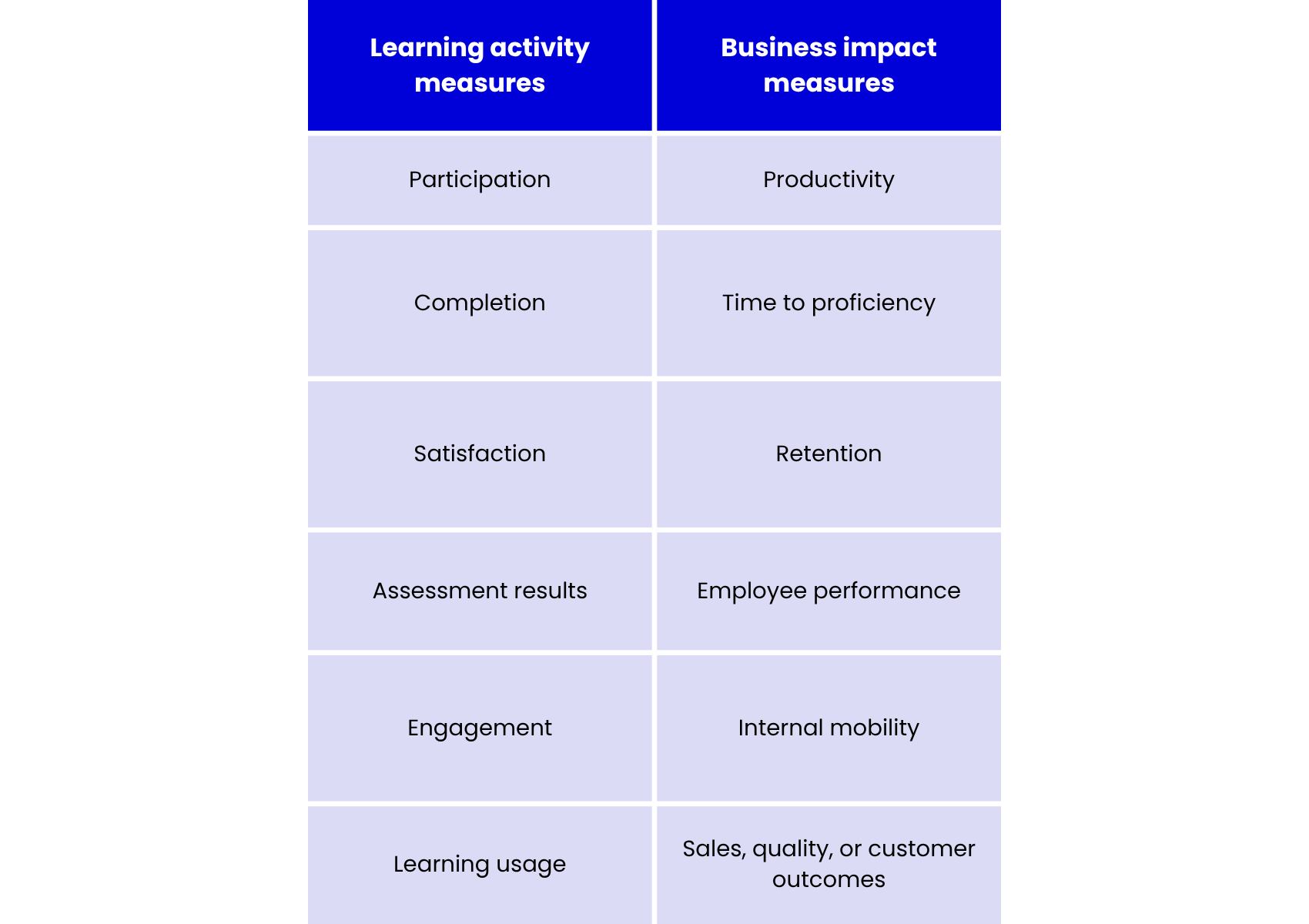
No category is always better than the other. What matters most is whether the metric helps you assess the problem your initiative aims to address.
If the goal of onboarding is to help people become proficient faster, just looking at completion rates will not show if it worked. For a leadership program meant to improve internal succession, it is more useful to look at promotion readiness or internal mobility.
How Do You Demonstrate Learning's Contribution To Business Performance?
Be thoughtful about what caused the results.
A good answer might include:
- Baseline performance
- Relevant business KPIs
- Pre- and post-intervention comparisons
- Comparison groups (where practical)
- Behavioral indicators
- Manager or stakeholder evidence
- Changes in workforce metrics
- Other factors that may have influenced the result.
For instance, if sales go up after a training program, do not assume the training was the only reason. Other things like pricing, market conditions, incentives, staffing, or product changes could have played a part, too.
Showing good judgment about what caused the results is usually more believable than making big claims about ROI.
Tell Us About A Program You Stopped Or Changed Because The Data Did Not Support It
This question is important for L&D executive interviews because it shows if you can make tough decisions about resources.
Think of a time when data led you to:
- Stop an initiative.
- Redesign it.
- Change the delivery model.
- Reduce investment.
- Reallocate budget.
- Challenge an existing assumption.
Describe what the data showed, how you made your decision, how you worked with stakeholders, and what the outcome was.
Chief Learning Officer Interview Questions About Leadership And Executive Influence
When interviewing for a Chief Learning Officer role, questions about leadership usually focus on your ability to influence others, not just your formal authority.
As a CLO, you often need support from the CEO, CHRO, business leaders, finance, technology, and other executives, each with their own priorities.
How Do You Gain Executive Support For Learning Investment?
Focus your discussion on the business problem, not just the learning solution.
Describe how you:
- Understand what matters to each stakeholder.
- Connect the proposal to strategic priorities.
- Present relevant evidence.
- Explain costs and tradeoffs.
- Set realistic expectations.
- Define what success will look like.
- Communicate in language that makes sense outside L&D.
Rather than saying a leadership program is important just because leadership development matters, explain what specific organizational problem it will help solve.
How Do You Handle A Senior Leader Who Does Not Support An L&D Initiative?
Don’t treat resistance as something you must always overcome.
Start by understanding the objection. The leader might question the cost, timing, evidence, delivery method, or even if learning is the right solution.
Then consider whether you should:
- Strengthen the business case.
- Present additional evidence.
- Adjust the proposed approach.
- Test the idea through a pilot.
- Reduce the scope.
- Delay the initiative.
- Decide not to proceed.
Managing executive stakeholders means knowing when to stand your ground and when to adjust your position based on new information.
How Do You Lead And Develop An L&D Team?
Your answer should show more than just support or collaboration.
Discuss how you think about:
- Team structure
- Required capabilities
- Role clarity
- Delegation
- Performance expectations
- Coaching
- Succession planning
- Operating models
- Cross-functional collaboration
Hiring teams for CLO roles also want to know how you decide which skills should stay within L&D and which should be handled by partners, vendors, technology, or business teams.
How Do You Balance Stakeholder Requests With Enterprise Priorities?
This question checks if you can keep L&D from becoming just an order-taker. Describe how you weigh individual requests against company priorities, business impact, needed skills, available resources, and urgency.
Good answers also explain how you communicate when a stakeholder’s request isn’t prioritized.
Chief Learning Officer Interview Questions About Skills And Workforce Capability
Chief Learning Officer interview questions about workforce capability aim to check if you view learning as part of a broader talent strategy, not just a set of courses.
How Do You Identify The Skills The Organization Will Need Next?
Explain how you would use different sources of evidence, such as:
- Business strategy
- Workforce data
- Changes in job roles
- Internal skills inventories
- Performance data
- Manager input
- External industry developments
- Technology changes
The aim is not to predict every future skill exactly. Instead, you want to spot capability risks early so you can make smart decisions about workforce development.
How Would You Address A Major Organizational Skills Gap?
One helpful way to approach this is:
Identify → prioritize → build, buy, or borrow capability → enable application → measure
Start by identifying the gap and why it matters to the business.
Next, decide if the organization should train current employees, hire new people, bring in outside experts, change how work is done, add new technology, or use a mix of these options.
This shows that upskilling and reskilling are just one part of the workforce strategy, not a one-size-fits-all solution for every capability issue.
How Do Learning, Talent Development, And Succession Planning Connect?
Use this question to show that you can think about the bigger picture for the organization as a whole.
Learning helps employees build new skills. Talent development maps out ways for people to grow, and succession planning prepares the organization for key future roles.
A CLO needs to understand how these systems support one another and when to share responsibility with HR, talent management, business leaders, and managers.
Chief Learning Officer Interview Questions About AI And Learning Technology
When interviewing for a Chief Learning Officer role, questions about AI and learning technology should show your ability to make thoughtful decisions, not just excitement about new tools.
In 2026, senior L&D leaders may be expected to make decisions across LMSs, LXPs, analytics, content technology, AI-enabled tools, performance support, and other parts of the learning ecosystem.
How Do You Decide Whether A Learning Technology Is Worth Investing In?
A good answer should cover these points:
- Business needs
- Learner or employee needs
- Integration requirements
- Usability
- Data and analytics
- Scalability
- Security and governance
- Total cost of ownership
- Vendor support
- Measurable value
Begin by identifying the problem the technology is meant to address.
A platform with many features is not truly valuable if people do not use it, if it is hard to integrate, or if the business need is not clear.
How Should AI Change An Organization's Learning Strategy?
A well-rounded answer might touch on these areas:
- AI literacy
- Workflow-integrated learning
- Personalized learning experiences
- Content development
- Skills development
- Role redesign
- Governance
- Responsible use
- Changing capability requirements
However, do not make adopting AI the main goal. Leaders should ask if AI helps the organization build skills, improve results, reach more people, make better choices, or adapt to changes at work.
How Do You Build A Learning Technology Ecosystem That Can Scale?
Describe your overall approach to the learning technology ecosystem.
Think about how systems connect, the user experience, how data moves, governance, analytics, content, administration, and how all of this fits with the organization's other technology.
A scalable learning technology strategy is not always about adding more platforms. Sometimes, simplifying or improving integration brings more value than buying another tool.
Planning your next L&D leadership move?
Compare current eLearning and L&D salary trends and explore the roles hiring right now to put your next opportunity into context before you apply or accept an offer, here:
- Top eLearning & L&D Jobs Hiring Right Now
- eLearning Salaries In 2026: What Different Roles Really Pay
Behavioral And Scenario-Based Chief Learning Officer Interview Questions
Behavioral Chief Learning Officer interview questions focus on how you have handled real executive decisions, not just how you think you would act in theory.
Get ready to share specific examples for questions like these:
1. Tell us about a learning transformation you led.
2. Describe a learning initiative that failed or underperformed.
3. Tell us about a time you changed your strategy because business priorities changed.
4. Describe a difficult decision involving your L&D budget.
5. Tell us about a time you disagreed with an executive stakeholder.
6. Describe a capability gap your team successfully addressed.
7. Tell us about a major technology decision you made.
8. Describe a situation in which you had to stop or deprioritize a learning initiative.
Avoid relying only on general leadership philosophies. For each example, be clear about the size of the situation, your role, the decision you made, who was involved, what evidence you used, and what happened as a result.
Also, prepare examples where things did not go as planned. Executive interviews often show your judgment best through tradeoffs, setbacks, and course corrections, not just through success stories.
How To Answer Chief Learning Officer Interview Questions
Your answers to Chief Learning Officer interview questions are important. Executive interviews expect more than just a detailed explanation of your training solution.
To prepare for interviews in general, review common questions and answer strategies. For CLO interviews, focus your answers on the business context and the impact of your work.
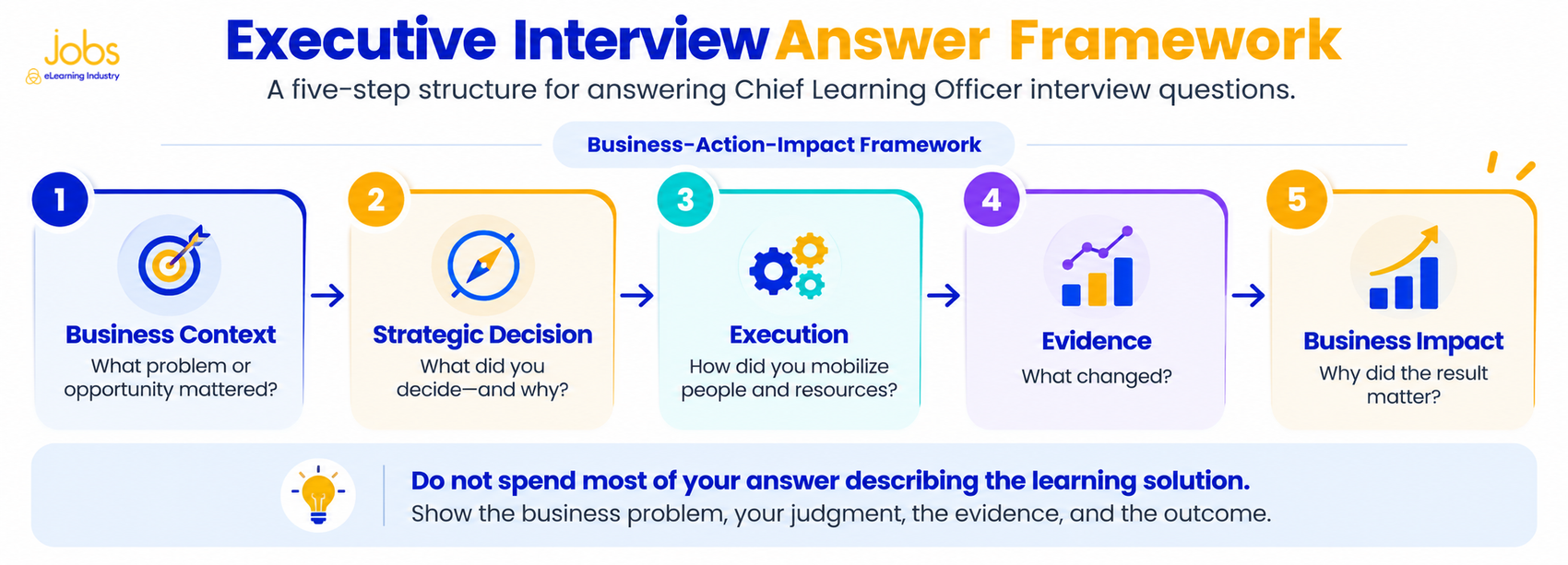
Use The Business–Action–Impact Framework
Structure your answer using five key elements.
1. Business Context
What organizational problem, strategic priority, or opportunity existed?
Establish why the situation mattered.
2. Strategic Decision
What did you decide to do, and why?
Explain the reasoning behind your decision instead of just listing what you did.
3. Execution
How did you mobilize stakeholders, resources, technology, teams, or external partners?
Focus on decisions that highlight your leadership in this part.
4. Evidence
What changed?
Share relevant performance data, workforce indicators, behavioral examples, financial results, or feedback from stakeholders.
5. Business Impact
Why did the result matter to the organization?
Link the outcome to the original business goal. You can use the STAR principles within this framework, but focus more on your strategic thinking and its impact on the organization.
A common mistake is spending too much time describing the learning solution and only briefly mentioning the result. When needed, spend more time on the outcome. The interviewer wants to know why your work was important.
Ready to put your interview prep into action?
Look at Training and Skill Development roles to see what employers want today.
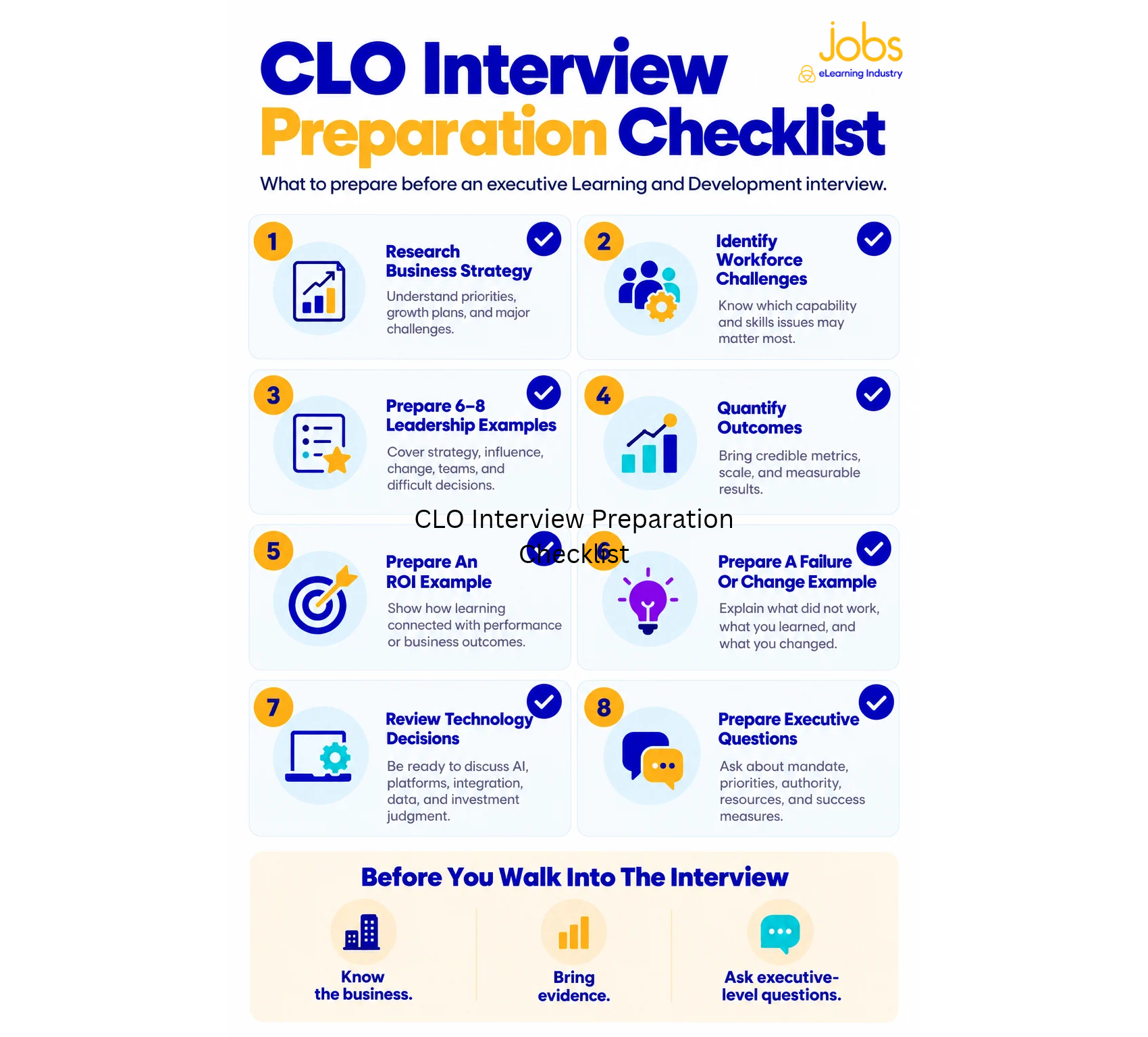
What Evidence Should You Prepare Before A CLO Interview?
Chief Learning Officer interview preparation should include a portfolio of examples that prove how you operate across different executive responsibilities.
Be ready to share evidence about:
- Enterprise learning strategy
- Measurable business impact
- Capability building
- Executive stakeholder influence
- Budget or resource decisions
- Learning technology strategy
- Organizational change
- Team leadership
- An initiative that did not succeed
- A difficult strategic tradeoff
For each example, make sure to include:
1. The business challenge.
2. The scale.
3. Your role.
4. The decision you made.
5. The stakeholders involved.
6. The relevant metrics.
7. The outcome.
8. What you learned.
Try to prepare several examples you can adapt to different CLO interview questions.
Whenever you can, use numbers to show scale. This might include the number of employees impacted, regions covered, budget managed, time to proficiency, productivity gains, internal moves, costs saved, or other relevant measures. Only include numbers you can clearly explain and support.
Questions To Ask During A Chief Learning Officer Interview
A Chief Learning Officer interview is also your chance to see if the organization's expectations, resources, and authority fit what you are looking for in the role.
You might want to ask questions like these:
1. What business priorities should the learning strategy support over the next 12–24 months?
2. What capabilities does the organization believe it needs to strengthen most?
3. How does the executive team currently evaluate L&D's contribution?
4. What would success look like for the CLO after the first year?
5. How much decision-making authority does the CLO have?
6. How mature is the organization's learning data and technology infrastructure?
7. What expectations do the CEO and CHRO have for this role?
8. What are the biggest barriers the previous or current L&D function has faced?
9. How are learning, talent management, workforce planning, and succession currently connected?
10. Which strategic decisions would the incoming CLO be expected to influence?
These questions can help you understand the role’s responsibilities, available resources, level of authority, what executives expect, and the organization's maturity.
If you want more ideas beyond executive L&D interviews, check out our guide to good interview questions.
Common Chief Learning Officer Interview Mistakes
Even experienced candidates can run into common pitfalls during Chief Learning Officer interviews.
Watch out for these mistakes:
- Talking mainly about courses instead of business problems.
- Using completion rates as proof of business impact.
- Claiming financial ROI without credible evidence.
- Discussing technology without explaining the need it solves.
- Giving vague leadership examples.
- Failing to quantify the scale of your work.
- Taking sole credit for outcomes created by multiple teams.
- Using excessive L&D terminology with non-L&D executives.
- Presenting AI adoption as a goal in itself.
- Ignoring the organization's strategic priorities.
- Failing to prepare questions for the executive panel.
The best answers are clear, evidence-based, and show how your work supports the organization's main goals.
Prepare for the broader leadership conversation.
CLO interviews may focus on executive strategy, but you still need strong answers about leadership, career decisions, stakeholder management, and business impact. Explore our guides to strengthen the rest of your interview preparation:
- Training Manager Interview Questions And Leadership Answers
- Reasons For Leaving The Company: Best Answers For Interviews
Prepare To Interview As A Business Leader, Not Only An L&D Expert
Chief Learning Officer interview questions ultimately test whether you can connect learning → capability → performance → business results.
Prepare examples that show not only what you built, but why the organization needed it, how you made the decision, what changed, and what evidence supports the result. At the CLO level, that business connection is what separates a description of L&D activity from evidence of executive leadership.
Ready for your next leadership opportunity?
Explore Chief Learning Officer and senior L&D jobs, create your candidate profile, and set job alerts for roles that match your experience.
FAQs About Chief Learning Officer Interview Questions
1. What Questions Are Asked In A Chief Learning Officer Interview?
Chief Learning Officer interview questions commonly cover business strategy, learning ROI, executive influence, workforce capability, leadership, technology, change management, and measurement. Candidates may also receive behavioral questions about failed initiatives, strategic tradeoffs, stakeholder disagreements, budget decisions, and organizational transformation.
2. How Do I Prepare For A Chief Learning Officer Interview?
Prepare examples that demonstrate strategic learning leadership, measurable business impact, executive stakeholder management, workforce capability development, budget decisions, technology strategy, team leadership, and organizational change. Research the employer's business priorities and be ready to explain how your experience could help address its capability needs.
3. How Should A Chief Learning Officer Explain Learning ROI In An Interview?
Explain that ROI depends on the objective and scale of the initiative. Distinguish participation and learning measures from behavioral, performance, business, and financial outcomes. When discussing financial ROI, explain the assumptions and avoid attributing an entire business result to learning when other factors contributed.
4. What Metrics Should A Chief Learning Officer Track?
Relevant L&D KPIs depend on the business problem being addressed. Metrics may include participation, completion, skill attainment, application, time to proficiency, productivity, internal mobility, retention, performance, quality, sales results, customer outcomes, and operational efficiency. Executive reporting should focus on the measures most closely connected to organizational priorities.
5. How Does A CLO Align Learning Strategy With Business Strategy?
A CLO begins by understanding business priorities, identifies the workforce capabilities required to execute them, diagnoses capability gaps, prioritizes the most important needs, selects appropriate interventions, and defines business-linked measures of success. The goal is to connect learning investment directly with organizational capability and performance.