

How Do You Answer Behavioral Interview Questions?
Behavioral interview questions focus on what you have done in the past, not what you would do. They usually start with phrases like “Tell me about a time,” “Describe a situation,” or “Give me an example.”
You’ll find these questions in interviews for eLearning, Learning and Development, EdTech, corporate training, and talent development roles. Employers ask them to see how you communicate, solve problems, work with others, and get things done.
To prepare well, don’t just memorize perfect answers. Instead, pick real experiences and organize them using the STAR method: Situation, Task, Action, and Result. This guide shares practical behavioral interview questions and answers for today’s learning roles.
Getting ready for an interview?
Look at current eLearning, L&D, and EdTech job openings. Use each job description to spot the skills and examples you’ll want to talk about.
Key Takeaways
- Behavioral questions ask for evidence of how you handled a past situation.
- STAR organizes answers into Situation, Task, Action, and Result.
- Strong answers emphasize your actions, decisions, and outcomes.
- 5 to 8 flexible stories are more useful than memorized scripts.
- Projects, education, volunteering, and transferable experience can provide valid examples.
What Are Behavioral Interview Questions?
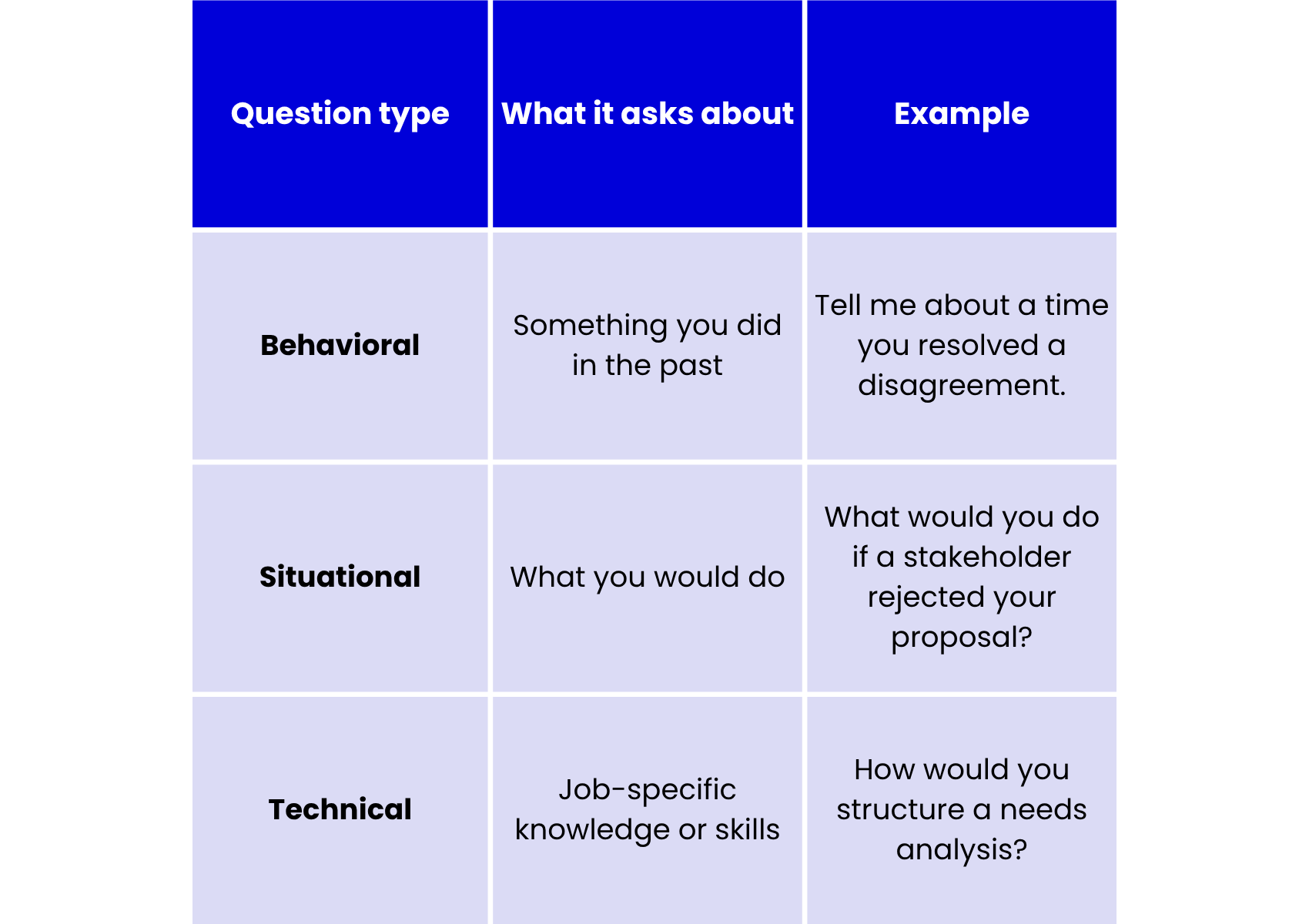
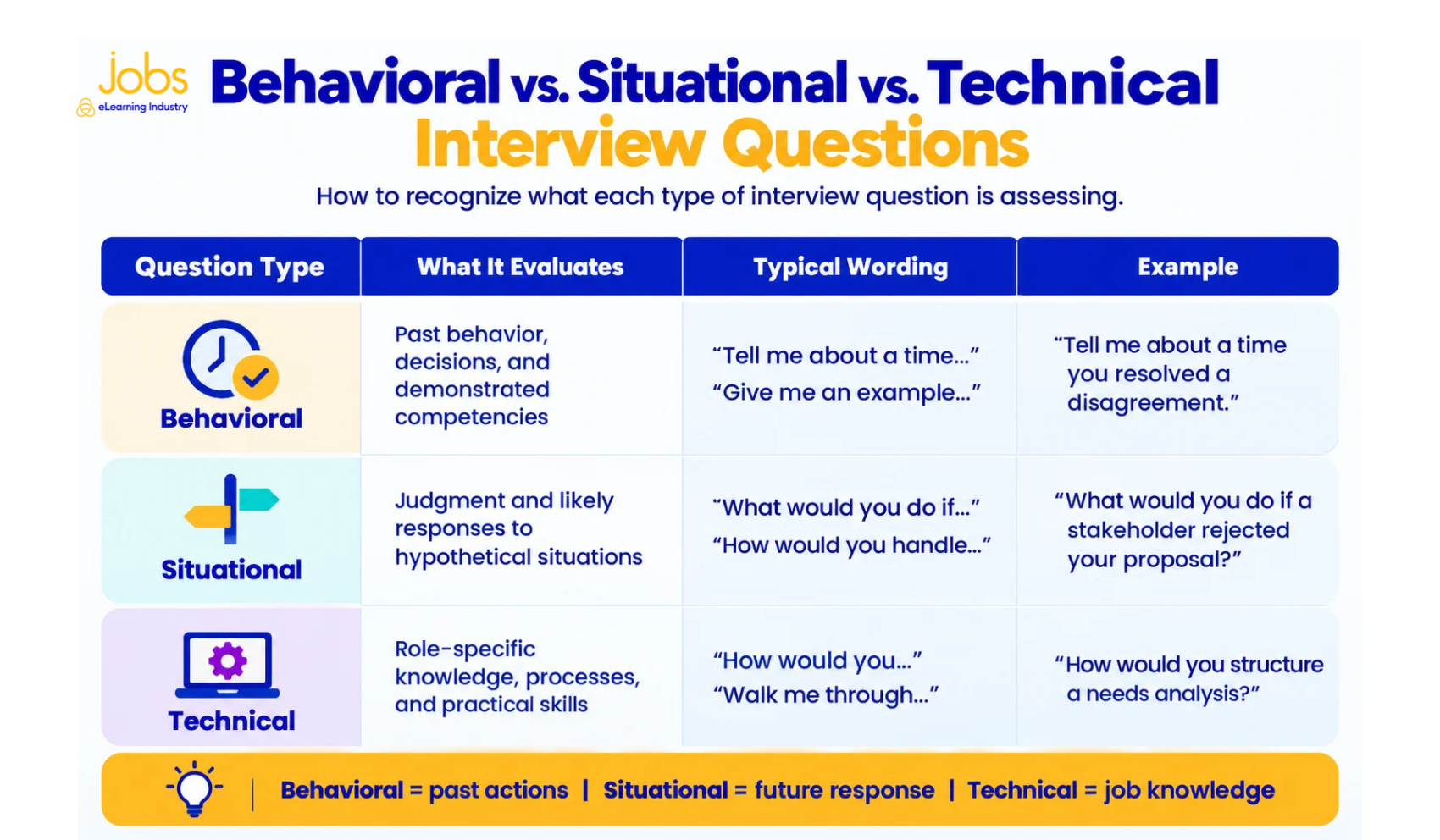
Behavioral interview questions ask you to describe how you handled a specific situation in the past. Employers use these questions to assess skills such as teamwork, communication, leadership, adaptability, problem-solving, and decision-making.
These questions often start with:
- “Tell me about a time…”
- “Give me an example of…”
- “Describe a situation where…”
Situational questions are different because they ask what you would do in a certain scenario, while technical questions focus on your job-specific knowledge. You can also look at a general guide to top job interview questions to get ready for other types.
Why Do Employers Ask Behavioral Interview Questions?
Employers ask behavioral questions because real examples tell them more than just hearing you say things like “I work well under pressure.” Your answers help them see how you handle teamwork, conflict, leadership, accountability, deadlines, and shifting priorities.
Interviewers usually focus on how you handled the situation, not just whether things turned out well. They want to hear how you gathered information, made decisions, communicated, and what you learned.
In L&D and EdTech interviews, you might be asked about working with Subject Matter Experts, dealing with conflicting feedback, changing course requirements, solving problems for learners or platforms, or balancing learning needs with business goals.
How To Answer Behavioral Interview Questions Using The STAR Method
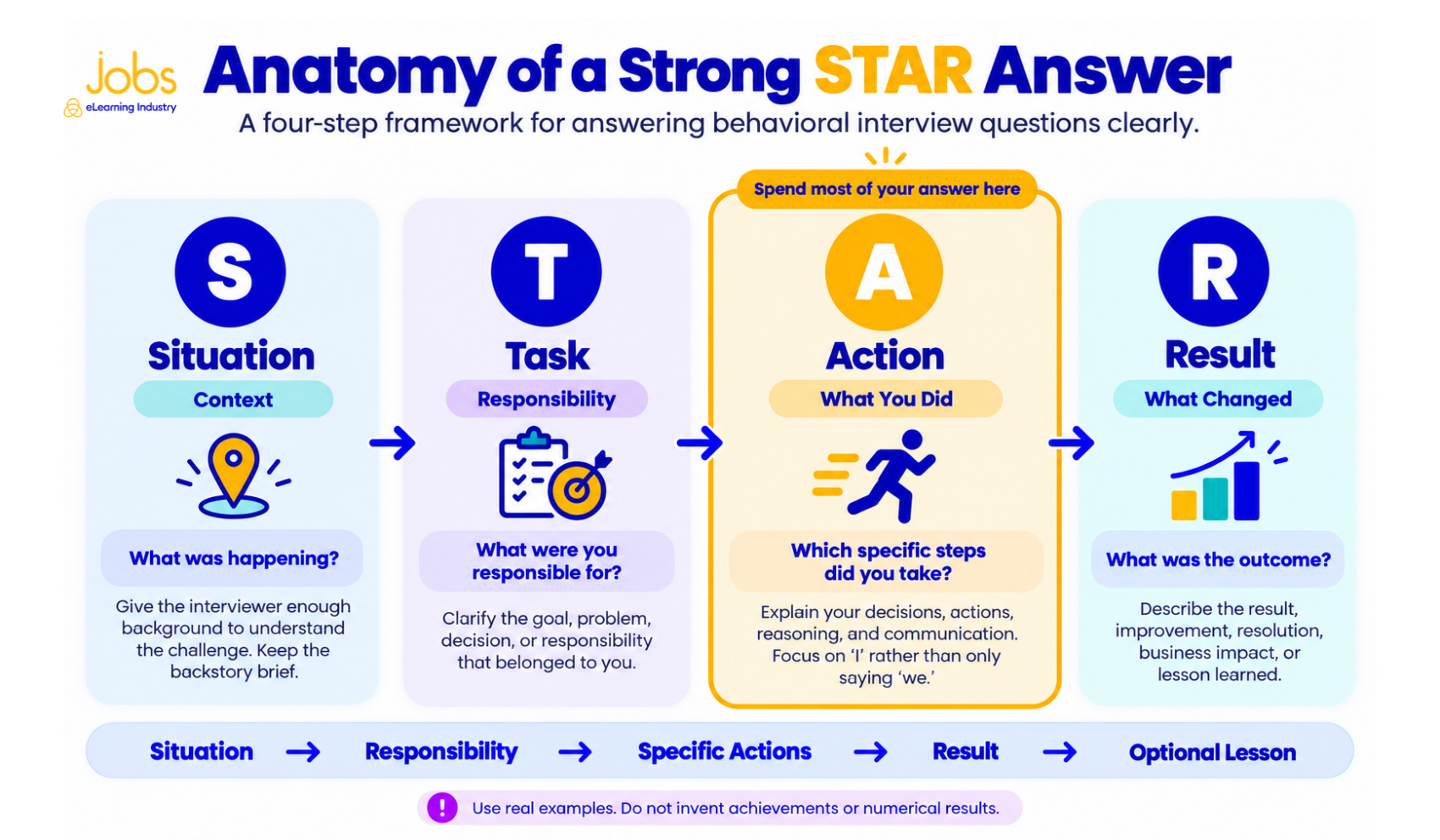
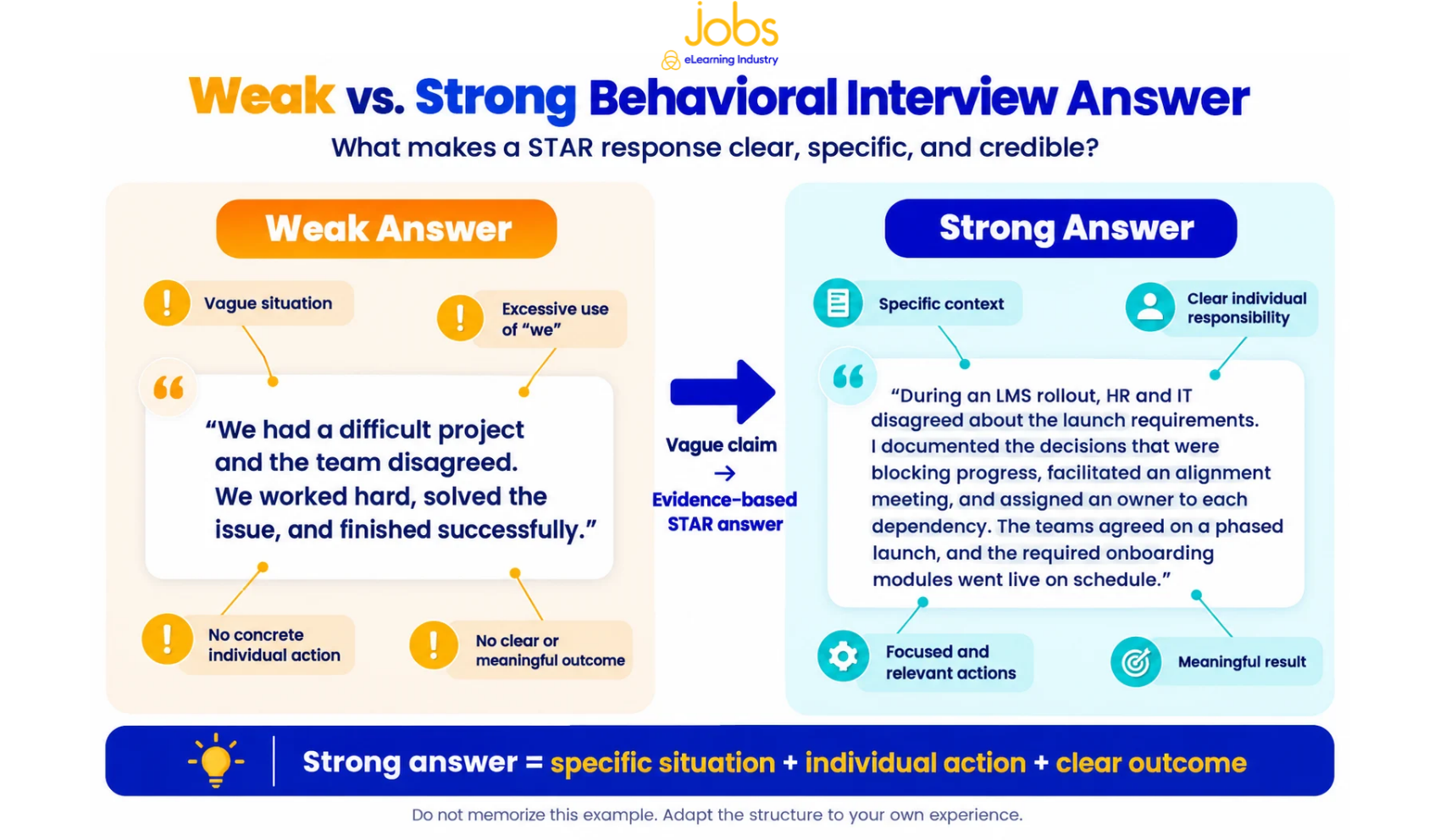
Pick one experience that fits the question and use the STAR method to organize your answer. Start with a short background, explain what you were responsible for, focus on what you did, and end with the outcome.
Situation
Share just enough background to make the challenge clear. Skip any long explanations.
Task
Explain what you needed to accomplish, decide, or solve for yourself.
Action
Describe what you decided to do, the steps you took, why you chose them, and how you worked with others. Use “I” to show your own role instead of saying “we.”
Result
Share what happened in the end. Results could include meeting a deadline, solving a problem, reducing mistakes, improving performance, getting everyone on board, or learning from the experience. Only use numbers if you can back them up.
Reusable answer formula: Situation → Responsibility → Specific Actions → Result → Optional Lesson
How To Prepare Your Behavioral Interview Story Bank
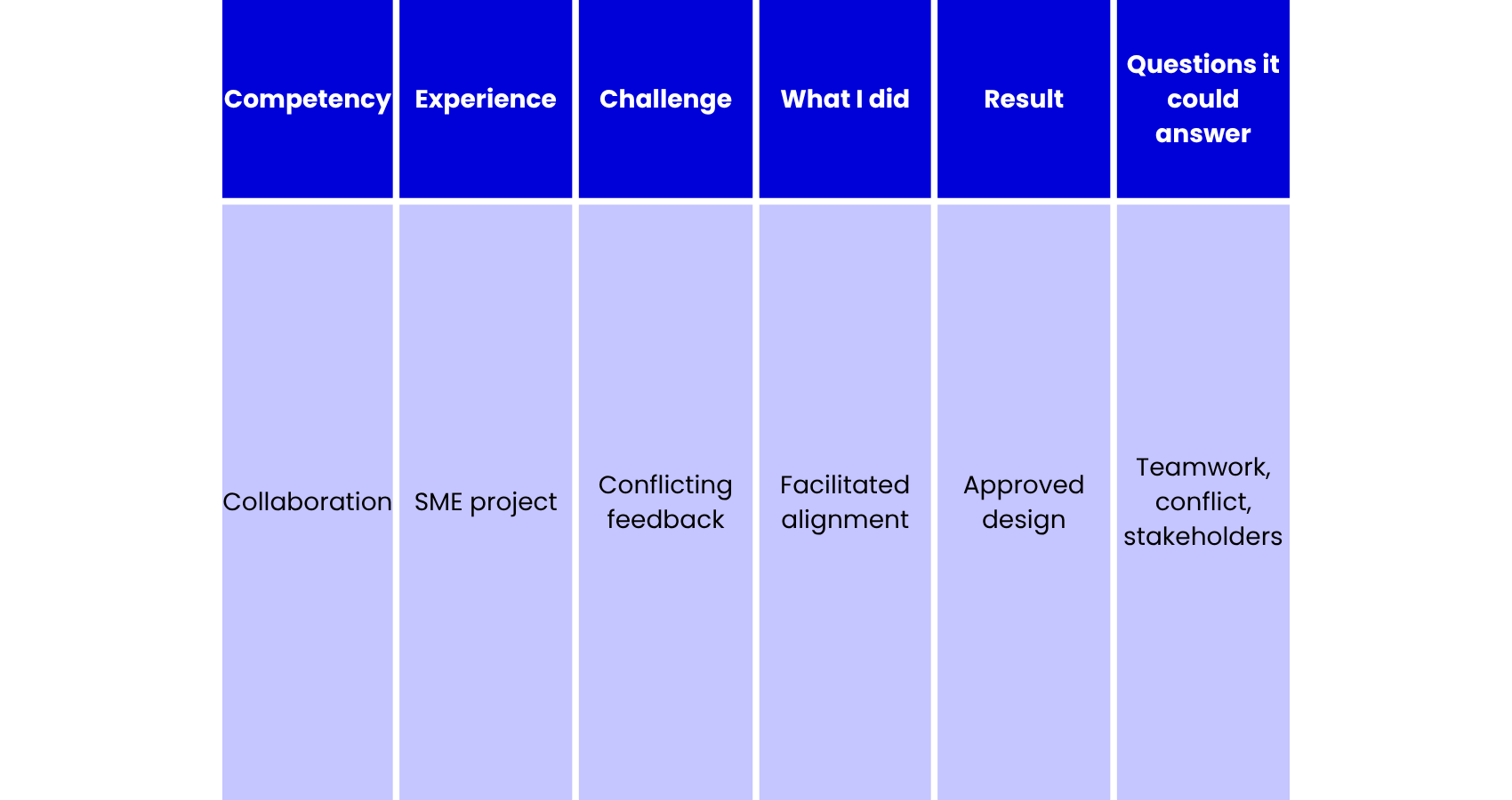
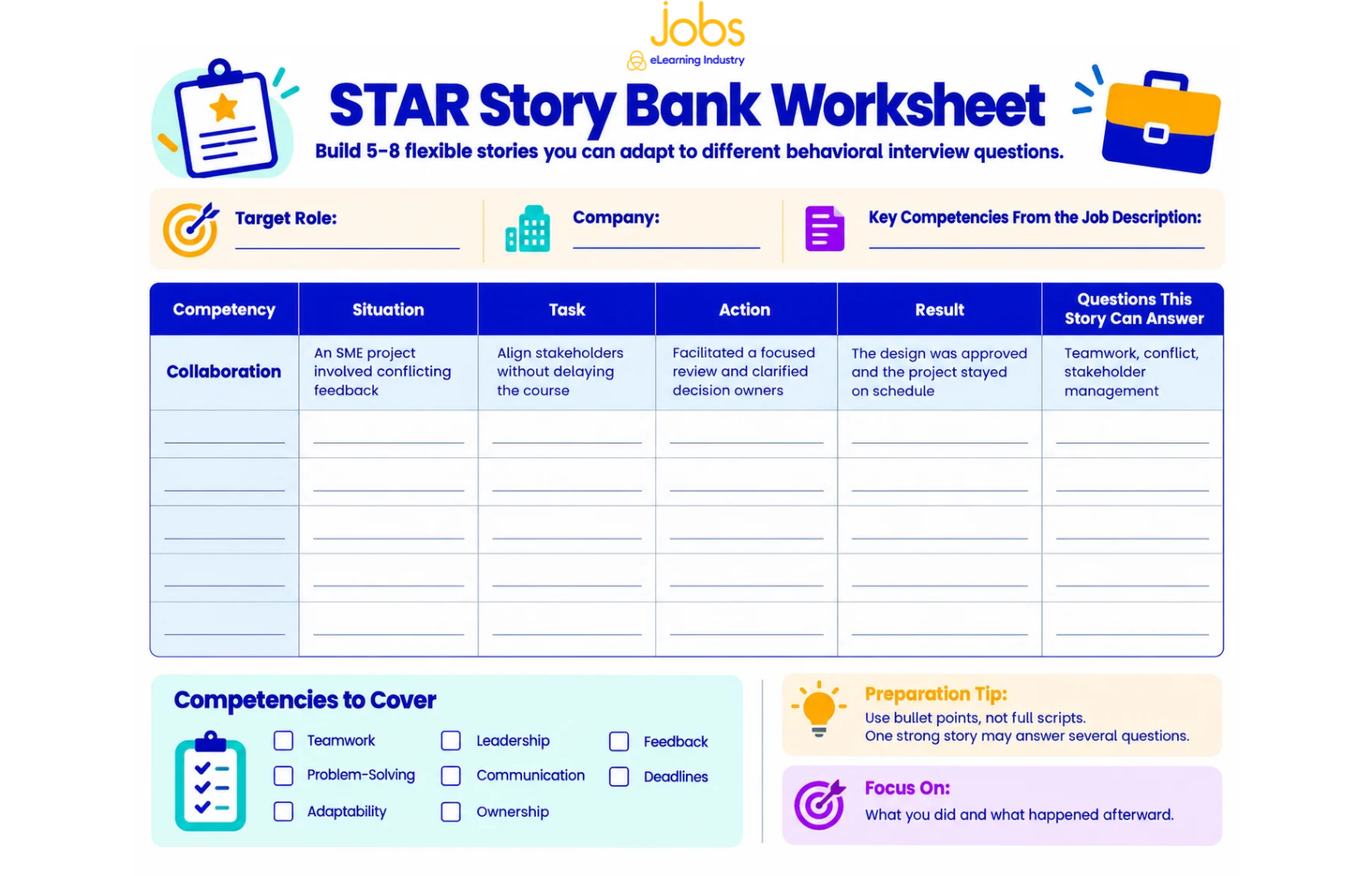
You don’t need a different story for every interview question. Instead, come up with five to eight examples that show a range of your skills.
1. Start by reading through the job description carefully.
2. Look for skills and responsibilities that come up more than once.
3. Pick examples from your experience that show you have these skills.
4. Write down what your role was, what you did, and what happened as a result.
5. Think about how each story could answer different types of interview questions.
6. Practice changing what you focus on in each story, rather than memorizing exact words.
Some helpful themes include teamwork, problem-solving, communication, flexibility, taking ownership, leadership, time management, and giving or receiving feedback. For more ideas, check out the skills employers want in eLearning professionals.
Already know your target role?
Turn the most relevant experience in the job description into 5 to 8 flexible STAR stories.
15 Common Behavioral Interview Questions And Answers
These behavioral questions focus on skills that are important in learning-focused jobs. Use your own experiences to answer them instead of memorizing responses.
Teamwork And Conflict Behavioral Interview Questions
1. Tell me about a time you disagreed with a team member.
What the interviewer is assessing: Conflict resolution and professionalism.
How to approach your answer: Show how you protected the relationship and project goal.
Sample STAR answer: A developer advised me that my branching activity might not perform well in our LMS. We discussed the learning goal and the technical limits together. I cut down five decision points to two and added targeted feedback. The activity still achieved its objective and launched on time.
2. Tell me about a time you worked with people from different teams.
What the interviewer is assessing: Cross-functional collaboration and coordination.
How to approach your answer: Explain how you created clarity across competing priorities.
Sample STAR answer: During an onboarding rollout, I worked with HR, IT, L&D, and department leaders. I created one plan with owners, dependencies, and review dates, then used weekly check-ins to resolve decisions. Every team completed its launch responsibilities on time.
3. Tell me about a time you worked with a difficult stakeholder.
What the interviewer is assessing: Stakeholder management and diplomacy.
How to approach your answer: Discuss the behavior and solution, not the person.
Sample STAR answer: An SME kept asking for content after we approved the scope. I helped identify crucial performance information and separated it from helpful background material. We added the essential information to the course and moved the rest to optional resources. The stakeholder felt listened to, and the launch stayed on schedule.
Problem-Solving And Decision-Making Behavioral Interview Questions
4. Tell me about a difficult problem you had to solve.
What the interviewer is assessing: Analysis, judgment, and problem-solving.
How to approach your answer: Show how you identified the root cause.
Sample STAR answer: Employees completed their training, but quality errors persisted. I checked the assessments, spoke with managers, and watched the workflow. The issue was an outdated process document, not a lack of knowledge. I suggested updating the job aid and reinforcing it with managers. After that, errors decreased.
5. Tell me about a time you made a decision without all the information you wanted.
What the interviewer is assessing: Judgment under uncertainty and risk management.
How to approach your answer: State your assumptions and how you limited risk.
Sample STAR answer: A program had to launch before complete performance data was available. I used support requests, manager interviews, and policy requirements to define a minimum viable version. I documented assumptions and scheduled a post-launch review. With the first feedback, I then guided the next update.
6. Give me an example of a process you improved.
What the interviewer is assessing: Initiative and continuous improvement.
How to approach your answer: Identify the bottleneck, change, and effect.
Sample STAR answer: We received feedback from SMEs via email, chat, and separate documents, resulting in some duplicate edits. To address this, I created a review file called "decision owners" and limited feedback to two structured rounds. This helped the team spend less time sorting through comments, making approvals more predictable.
Adaptability And Learning Behavioral Interview Questions
7. Tell me about a time priorities changed suddenly.
What the interviewer is assessing: Adaptability and prioritization.
How to approach your answer: Emphasize trade-offs and communication.
Sample STAR answer: Right before the launch, leadership asked for a new policy topic for a manager course. I identified the key content, added a brief launch section, and planned for more practice in the next release. Stakeholders understood the trade-off and needed the material to be launched on time.
8. Tell me about a time you had to learn something quickly.
What the interviewer is assessing: Learning agility and resourcefulness.
How to approach your answer: Describe a focused learning process and application.
Sample STAR answer: I needed to build an urgent module using a new authoring tool. I read the documentation, created a sample in a test environment, and asked a colleague to review my first interaction. Within two days, I was able to build independently without delaying the project.
9. Tell me about a time you received difficult feedback.
What the interviewer is assessing: Self-awareness and coachability.
How to approach your answer: Explain what changed because of the feedback.
Sample STAR answer: A stakeholder said my learning path was too complex for frontline employees. I reviewed the workflow with two intended users, simplified the steps, and replaced long explanations with decision-based practice. The revision was approved, and I added earlier user checks to future projects.
Leadership And Ownership Behavioral Interview Questions
10. Tell me about a time you took initiative.
What the interviewer is assessing: Ownership and proactive thinking.
How to approach your answer: Choose a meaningful need you addressed appropriately.
Sample STAR answer: New hires kept asking the same questions after onboarding. I grouped the questions by task, confirmed the gaps with managers, and built a searchable quick-reference pilot from existing content. Managers adopted it as an everyday support resource.
11. Tell me about a time you made a mistake.
What the interviewer is assessing: Accountability, judgment, and learning.
How to approach your answer: Show ownership, correction, and prevention.
Sample STAR answer: I published a job aid that referred to an outdated process. I informed the project lead, fixed the file, and notified the affected users. Then, I added source verification and owner approval to our publishing checklist. This error did not happen again.
12. Tell me about a time you led without formal authority.
What the interviewer is assessing: Influence and stakeholder alignment.
How to approach your answer: Show how you created direction without a management title.
Sample STAR answer: I led a team of experts, a developer, and a designer to launch product training. I made sure everyone knew their roles, kept track of decisions, and connected deadlines to the launch. When priorities clashed, I helped the team agree on what to prioritize. All necessary materials were prepared before the release.
Communication, Prioritization, And Delivery Questions
13. Tell me about a time you explained something complex to someone unfamiliar with the topic.
What the interviewer is assessing: Communication and audience awareness.
How to approach your answer: Show how you adapted the message.
Sample STAR answer: I explained learning analytics to managers who were not familiar with dashboard terms. I focused on who was having trouble, where they were struggling, and what actions the managers could take next. By the end, they could understand the report and plan specific support.
Candidates pursuing design roles should also prepare for Instructional Designer interview questions.
14. Tell me about a time you had to meet a difficult deadline.
What the interviewer is assessing: Prioritization and planning under pressure.
How to approach your answer: Focus on scope and trade-offs, not excessive overtime.
Sample STAR answer: A compliance program’s launch moved forward by two weeks. I separated mandatory content from enhancements, reused an approved template, and checked blockers daily. Stakeholders agreed to move optional elements to a later update, and the essential program was launched by the revised deadline.
15. Tell me about a time you had several competing priorities.
What the interviewer is assessing: Organization, time management, and judgment.
How to approach your answer: Explain how you decided what came first.
Sample STAR answer: I managed three projects that had overlapping review and launch dates. I prioritized the work based on business risk, fixed deadlines, and dependencies, and then shared this order with each project owner. Two projects stayed on schedule, while a lower-risk deliverable was adjusted with stakeholder agreement.
Ready to put your preparation into practice?
Explore current opportunities, create your candidate profile, upload your CV, and set personalized job alerts for roles that match your skills and career goals.
How To Answer Behavioral Interview Questions With No Work Experience
Experience isn’t limited to full-time jobs. You can share examples from university projects, internships, volunteering, teaching, freelance work, student groups, portfolio projects, community activities, or even a past career.
If you’re asked about managing conflict, don’t just say, “I have never managed workplace conflict.” Instead, talk about a group project where team members disagreed about responsibilities. Share how you clarified the goal, divided up the work, and kept things on track. The situation may be different, but the skill still applies.
Pick specific, recent examples and clearly explain where they happened. Don’t make up an experience just to sound impressive. If you’re new to the field or changing careers, focus on transferable skills and look for entry-level eLearning opportunities.
Still building your application strategy? You can also read these resources:
Strong CV achievements can often become useful STAR stories.
Common Behavioral Interview Answer Mistakes
Try to avoid these common mistakes:
- Giving a made-up answer instead of sharing a real experience.
- Taking too much time to explain the situation.
- Saying “we” but not making your own role clear.
- Picking an example that does not match the skill being asked about.
- Talking about what you did but not sharing what happened as a result.
- Mentioning achievements or numbers you cannot back up.
- Blaming others, like coworkers or managers.
- Reciting your answer exactly as you memorized it.
- Using the same story for every question, even when it does not fit.
- Covering up a real mistake by pretending it is a weakness.
- Thinking that every example has to have a perfect ending.
- Leaving out what you learned from an experience that had mixed results.
How To Practice Behavioral Interview Answers Without Sounding Rehearsed
When you prepare, focus on remembering key details and organizing your thoughts, rather than memorizing a script.
1. Jot down bullet points instead of writing out your answers word for word.
2. Say your answers out loud as you practice.
3. Keep the Situation and Task parts short and to the point.
4. Focus most of your answer on what you did to address the situation.
5. Wrap up by sharing the Result or what you learned from the experience.
6. Try practicing a few different ways to answer the same type of question.
7. Be ready to answer any follow-up questions the interviewer might ask.
Focus on remembering the main facts and order of your story, not the exact words. Most STAR answers should take about one to two minutes to share at a comfortable pace.
Find Roles And Tailor Your Behavioral Interview Examples
It’s easier to prepare when you understand what each role values most. For example, Instructional Design often looks for skills in stakeholder management and project delivery. L&D leadership roles usually focus on influence, strategy, and leading change. EdTech jobs tend to emphasize solving customer problems, adaptability, working with technology, and cross-team collaboration.
Review current Instructional Designer jobs, Learning and Development jobs, EdTech jobs, corporate training jobs, talent development jobs, and remote learning jobs. Use recurring requirements to select your strongest examples.
FAQs About Behavioral Interview Questions
1. What are behavioral interview questions?
They ask you to describe how you handled a real situation in the past. Employers use them to assess competencies such as teamwork, communication, leadership, adaptability, judgment, and problem-solving.
2. What is the best way to answer behavioral interview questions?
Use a specific example and the STAR method. Briefly explain the Situation and Task, focus on the Action you took, and finish with the Result.
3. What is the STAR method for behavioral interviews?
STAR stands for Situation, Task, Action, and Result. It provides a clear structure for explaining the context, your responsibility, the steps you took, and the outcome.
4. How many behavioral interview examples should I prepare?
Prepare five to eight flexible stories covering competencies such as teamwork, conflict, leadership, feedback, adaptability, problem-solving, and deadlines.
5. Can I use the same STAR example for more than one interview question?
Yes. One experience may demonstrate several competencies. Change the emphasis and details so the story directly answers the question being asked.
6. How do I answer behavioral interview questions if I have no experience?
Use examples from education, internships, volunteering, portfolio projects, freelance work, teaching, community activities, or another career. Be transparent about the context.